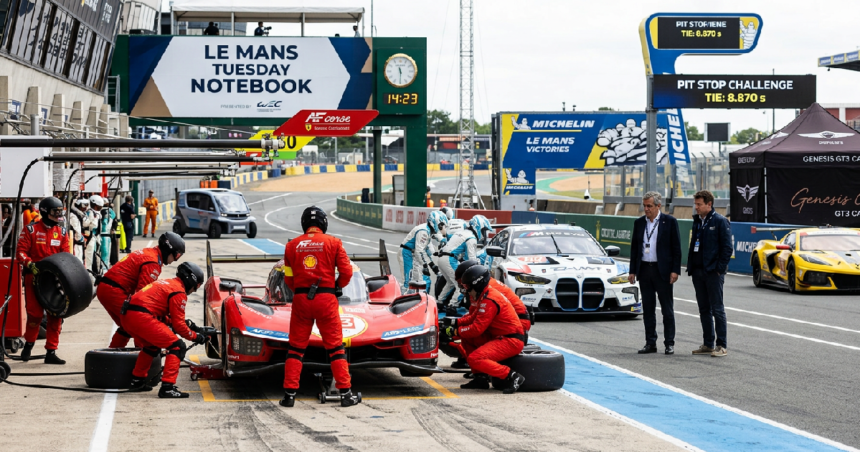
Le Mans race week officially commenced on Tuesday, June 9, 2026, as the No. 83 AF Corse Ferrari 499P and No. 69 Team WRT BMW M4 GT3 EVO stood out during the annual Pit Stop Challenge at the Circuit de la Sarthe.
ACO President Pierre Fillon and FIA World Endurance Championship CEO Frederic Lequien presided over the day’s traditional activities, which included the official drivers’ photo with the trophy, a pit walk, and autograph sessions for spectators in both the paddock and downtown Le Mans.
The Pit Stop Challenge, which required a four-tire change only, saw a remarkable statistical deadlock between the top and bottom classes. The Hypercar-winning No. 83 AF Corse Ferrari crew clocked a time of 8.870 seconds. In the LMGT3 division, the No. 69 Team WRT BMW crew triumphed with an identical time of 8.
870 seconds. Meanwhile, the No. 37 CLX Motorsport Oreca 07 Gibson secured the top honors in the LMP2 category.
Technical innovation took center stage in the paddock with the unveiling of the ‘Box Buggy’ by Luc Donckerwolke, the Chief Creative Officer of Genesis. This experimental electric vehicle (EV) features 360-degree mobility through four-wheel steering and four-wheel drive, powered by quad 30kW electric motors. The vehicle utilizes a battery from the Hyundai Tucson Hybrid SUV and was just completed on Sunday, June 7, 2026.
Genesis hints at GT3 future ahead of Friday press conference
The presence of Luc Donckerwolke and senior Genesis personnel has intensified rumors regarding the manufacturer’s entry into top-tier GT racing. Genesis Magma Racing team principal Cyril Abiteboul confirmed that the brand is preparing for a press conference on Friday, June 12, where they are expected to share “visual news” regarding their GT3 plans. Abiteboul previously described an expansion into production-based ranks as a long-term project.
The “Box Buggy” serves as a mobile laboratory for Genesis, allowing the brand to test technologies like steer-by-wire and brake-by-wire in a paddock environment. This isn’t the only technology Hyundai Motor Group is testing at Le Mans; Genesis Magma Racing mechanics have also been equipped with wearable exoskeleton vests. Similar to how com/luke-littler-england-darts-leadership-training-2026/”>technical drills improve precision in other high-stakes environments, these vests assist staff in carrying heavy tires by reducing muscular effort.
These innovations reflect a broader shift at Le Mans toward using the race week as a platform for sustainable and industrial technology. Beyond the paddock EVs, the newly opened M24 Museum is scheduled to host two hydrogen-themed roundtables on Thursday, June 11. These sessions are part of the FIA Sustainable Innovation Series, highlighting the endurance classic’s role in shaping future automotive standards.
Revised qualifying rules and expanded Hyperpole grids for 2026
The ACO has introduced several modifications to the qualifying format for the 2026 edition of the 24 Hours of Le Mans. A significant change dictates that the driver who qualifies the car in the Q1 session is no longer permitted to drive during Hyperpole 1.
Furthermore, if a car advances to Hyperpole 2, all three drivers from the crew must be utilized, a rule that now applies across every class in the field.
Class-specific requirements for the Pro-Am categories remain stringent. In the LMP2 and LMGT3 classes, the lowest-graded driver (LMP2) or the FIA Bronze-rated driver (LMGT3) must participate in the Q1 session. This ensures that the amateur-rated drivers remain a focal point of the competition’s tactical structure, much like how shifting squad dynamics affect outcomes in major tournaments globally.
The grids for the final shootouts have also been expanded to allow more teams to compete for the top starting positions. Instead of 12, the top 15 cars from Q1 in the LMP2 and LMGT3 classes will now advance to Hyperpole 1.
The final Hyperpole 2 session will now feature the top 10 cars from those classes, an increase from the eight-car limit enforced in previous years.
Michelin approaches historic milestone in Hypercar class
Michelin enters the 2026 race on the verge of becoming the most successful tire manufacturer in the history of the event. The French brand is currently tied with Dunlop at 34 overall victories.
With Michelin serving as the exclusive tire provider for the Hypercar class, an overall win by any of the top-class entries on Sunday would secure the record for the firm based in Clermont-Ferrand.
The scale of Michelin’s operation at the Circuit de la Sarthe is immense, involving a 10,000 square-foot on-site workshop and over 100 personnel. This team includes 44 tire fitters working 24 hours a day in three shifts.
To maintain peak performance, Michelin has also deployed 12 technical advisors to work directly with the Hypercar teams, alongside 16 engineers specializing in performance analysis, chemistry, and tire diagnostics.
Regulation-wise, each Hypercar entry is allocated six sets of Michelin Pilot Sport Endurance tires for the practice and qualifying sessions. For the race itself, teams are limited to 14 sets across all compounds. Entries that reach the Hyperpole sessions receive an additional three sets, which can be re-used for future private testing.
This level of technical oversight is as detailed as an eighty million pound investment in sport infrastructure, where every fraction of performance is measured.
Keating and Hanafin navigate late changes to the grid
In the LMGT3 class, Ben Keating and the TF Sport squad are employing unique methods to find extra speed. Keating, driving the No. 33 Chevrolet Corvette Z06 GT3.R, revealed he has opted for a new vinyl wrap that has all stickers printed directly onto it to improve aerodynamics.
After suffering an elbow injury in a mountain biking accident earlier this year, Keating is aiming to find a 2 km/h gain in top speed, which he believes is worth seven-tenths of a second per lap.
The TF Sport garage has also seen more lighthearted moments, with co-driver Nicky Catsburg presenting Keating with a hobby horse. This followed a joke Catsburg started earlier in the season claiming Keating’s injury happened during a hobby horse competition. On the track, the No. 33 Corvette has proven competitive, recording a top speed of 295.
4 km/h during test day, just 0.8 km/h shy of the class leaders.
The team also welcomed Lorcan Hanafin as a late addition to replace Afiq Ikhwan Yazid. The 23-year-old Briton received the call-up only eight days ago while preparing for a flight to Canada. Because the deal was finalized so late, Hanafin was required to participate in scrutineering and the initial test day wearing borrowed overalls.
Despite the short notice, Hanafin brings previous Corvette experience to the JMR/TF Sport lineup for his second Le Mans appearance.