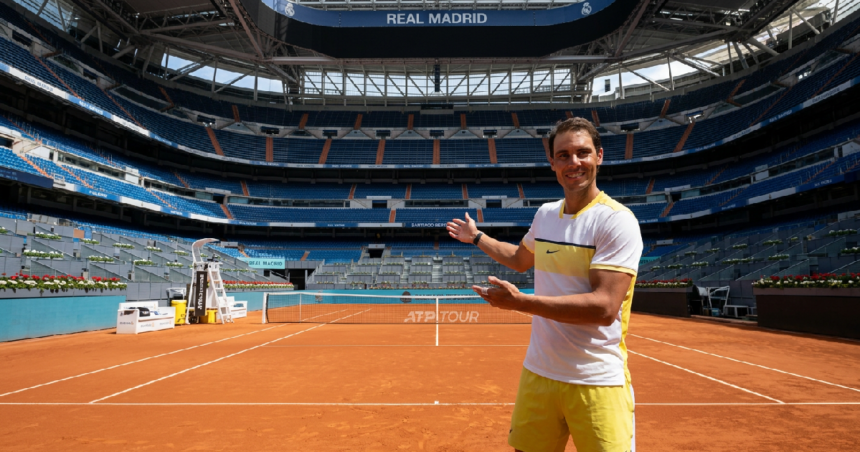
Rafael Nadal joined tennis stars and Real Madrid figures at the Santiago Bernabéu this week to unveil a unique tennis installation inside the iconic football stadium. The temporary clay court, constructed as a promotional and training centerpiece for the Madrid Open, utilizes the venue’s sophisticated retractable pitch technology to integrate the tournament into the heart of the city’s sporting landmark. Nadal, a long-time supporter of Real Madrid, reportedly praised the ambitious crossover as a historic moment for both the sport and the city.
The transformation of the Bernabéu pitch into a functional tennis arena represents a significant expansion in how the Madrid Open utilizes the city’s infrastructure. While the tournament traditionally centers its competitive action at the Caja Mágica, this new initiative provides players with a high-profile training space that doubles as a major marketing showcase. For Nadal, the experience of hitting balls in the stadium he has frequented as a fan for years was a highlight of the tournament’s opening days.
The veteran Spaniard described the setting as spectacular, noting that the venue was redesigned to host multi-sport events of this magnitude. He emphasized that the ability to play tennis in such a storied location is a unique occurrence that will likely be remembered as a landmark in the history of the Madrid Open. The project reflects a broader trend of major venues diversifying their utility, much like how NBA expansion into new markets often hinges on the versatility of modern arena designs.
Engineering Behind the Madrid Open Installation
The presence of a clay court inside the Santiago Bernabéu is made possible by the stadium’s extensive modern renovations. The facility features a sophisticated tray system that allows the grass pitch to be stored safely while the floor is replaced with other surfaces. This has turned the home of Real Madrid into a year-round hub for concerts, exhibitions, and now, elite-level tennis training and exhibitions.
Tournament organizers view the move as a way to reaffirm the Spanish capital’s status as a leader in sporting innovation. By placing a court in the Bernabéu, they have bridged the gap between Madrid’s most famous football club and its premier tennis event. This logistical feat provides players with a dedicated training environment that remains fully integrated into the tournament’s operational flow, potentially reducing the strain on the existing facilities at the Caja Mágica.
Nadal’s participation in the event comes during a busy period for the multiple Grand Slam champion. He has reportedly been involved in various mentorship and training roles, further cementing his influence on the tour even as his own playing schedule becomes more selective. His presence at the Bernabéu underscores the intergenerational mix currently defining the ATP circuit, where established legends share the stage with rising talents like Arthur Fils and other top prospects who have made deep runs in recent tournaments.
Collaborations Between Football and Tennis Stars
The sight of top footballers and tennis champions exchanging shots provided a powerful image for the tournament’s global audience. It represents a growing trend of “cross-pollination” between major sports, where athletes from different disciplines support each other’s events to drive engagement. For the football stars involved, the event offered a brief respite from the pressures of the domestic season in a stadium they usually occupy under very different circumstances.
This type of high-profile collaboration is becoming more frequent as sport stars seek to expand their reach beyond their primary fan bases. We have seen similar technical crossovers in other sports, such as when Luke Littler participated in training drills to share expertise across different competitive environments. In Madrid, the goal was clearly to showcase the city as a unified sporting power, blending the prestige of the tennis tours with the heritage of one of the most successful football clubs in history.
What This Means for the Future of the Madrid Open
While the Santiago Bernabéu is not expected to replace the Caja Mágica as the primary home of the Madrid Open, the success of this week’s installation suggests that the stadium could become a frequent fixture of the tournament’s landscape. Future editions could see competitive matches or exhibition sessions held under the retractable roof of the Bernabéu to accommodate larger crowds than the current venues allow.
The move also serves as a strategic response to the growing competition between international tournaments to provide the best player amenities and fan experiences. By leveraging a world-class stadium, the Madrid Open has set a new standard for urban tennis events. As the tournament progresses, the focus will shift back to the clay courts and the battle for the title, but the image of tennis being played on the hallowed ground of the Bernabéu is expected to remain the defining visual of this season’s event.