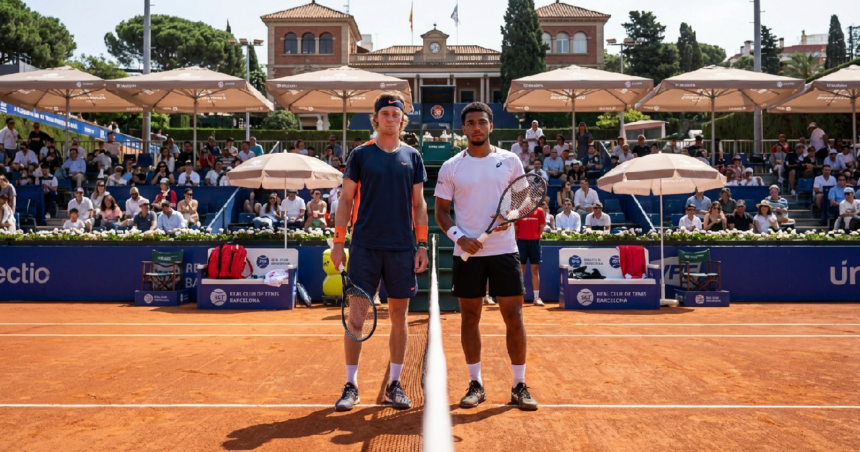
Barcelona’s clay has historically belonged to the titans of the game, but the focus of the current ATP 500 circuit has shifted toward a compelling clash between established power and the next generation. Andrey Rublev and Arthur Fils have reportedly navigated a grueling week to reach the final stages in Catalonia, setting up a heavyweight encounter that carries significant implications for the professional rankings and the hierarchy of European tennis.
For Rublev, this run represents a vital opportunity to find his footing on a surface where he has previously found success. Known for his explosive baseline aggression and relentless pace, the veteran has often been a fixture deep in high-stakes tournaments. However, throughout this week, he has exhibited a level of composure that suggests a maturing approach to the clay-court season. Facing an opponent of Arthur Fils’ caliber in a final of this magnitude requires more than just raw power; it requires tactical discipline and a steady temperament.
Young Gun Arthur Fils Faces Major Test
The rise of Arthur Fils has been one of the most discussed narratives on the tour over the last year. The Frenchman possesses a physical brand of tennis that seems well-suited for the red dirt, utilizing a high-velocity forehand and exceptional lateral movement. His path through the draw has not been a simple one, reportedly having to overcome seasoned clay-court specialists to secure his spot on the stadium court. This match marks a definitive moment for the youngster, as he looks to prove he can translate his potential into championship hardware.
Observers have noted that Fils has improved his point construction, moving away from being a purely reactive player to one who dictates terms. His development was recently noted in broader tennis news updates surrounding the Miami Open and other early-season events, where his trajectory suggested a breakthrough was imminent. Success in Barcelona, a tournament often used as a yardstick for French Open contenders, would bolster his standing among the world’s elite.
Stylistic Matchup on the Red Dirt
The contrast in styles between Rublev and Fils makes this encounter a fascinating tactical study. Rublev operates on a high-risk, high-reward principle, striking the ball exceptionally flat for a clay-court player. He aims to take time away from his opponents by hugging the baseline and taking the ball early. When he finds his rhythm, few players can live with his pace, though the consistency of his first serve often dictates whether he can maintain that pressure over a long match.
Fils brings a more traditional clay-court methodology, albeit one infused with modern power. He reportedly uses significantly more spin than Rublev, forcing the ball to jump out of the hitting zone of his opponents. His ability to slide into his shots and defend the corners will be tested to the limit by Rublev’s down-the-line hitting. The Frenchman’s backhand will likely be a primary target as the veteran seeks to exploit any perceived vulnerability.
Implications for the European Clay Swing
As the professional tour moves deeper into the spring, the performance of these two athletes will serve as a bellwether for the upcoming major in Paris. Rublev has long been a presence in the latter stages of top-tier tournaments, but he is still searching for the kind of sequence that moves him from a consistent contender to a champion on this surface. A victory here would act as a massive statement of intent for the remainder of the season.
Meanwhile, the French public has been searching for a new standard-bearer to lead their tennis resurgence. Fils represents one of their brightest hopes. His performance mirrors the rise of other young talents across different sports, such as how teenagers like Luke Littler have led technical drills in their respective fields, showing a level of maturity that belies their age. For Fils, securing a title on clay against an opponent with Rublev’s experience would be clear evidence that he belongs at the top of the game.
Tactical Adjustments and Environmental Factors
Conditions in Barcelona can vary significantly depending on the humidity and sunlight. A “heavy” court usually favors the high topspin game of someone like Fils, while a hot, fast day would play directly into the hands of Rublev’s flat-hitting aggression. Both players have shown adaptability this week, reportedly adjusting their court positioning to handle the Mediterranean climate.
Mental fortitude will play as much of a role as technique. Rublev’s greatest challenge has frequently been managing his own frustration during momentum shifts. If Fils can engage him in long, exhausting rallies and force him to play “one more ball,” the pressure on the veteran’s temperament will mount. But if Rublev starts finding the lines early, the sheer weight of his shot-making might overwhelm even a defender as resilient as the young Frenchman.
As the tour prepares for upcoming championship events, the winner of this clash will undoubtedly carry the momentum of a man who has conquered one of the most storied venues in the sport. Whether it is the experience of Rublev or the fearless energy of Arthur Fils, the tournament has once again proven why it remains a crucial stop on the road to the French capital. For more context on evolving careers and high-stakes transitions, one might look at how athletes like Mohamed Salah face career-defining choices as they navigate the peak of their professional lives.