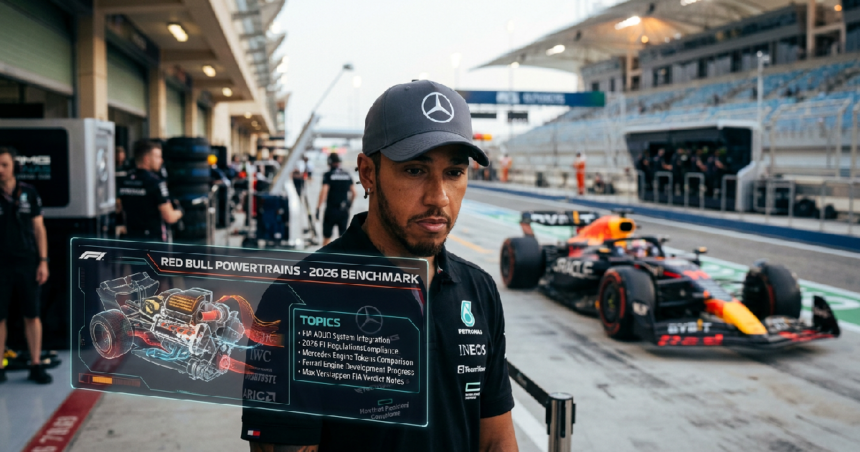
Lewis Hamilton has expressed “surprise” that Red Bull Powertrains has been provisionally designated as the benchmark Formula 1 engine manufacturer for the 2026 season.
Under the FIA’s new Additional Development and Upgrade Opportunities (ADUO) system, Red Bull’s internal combustion engine (ICE) was judged to be the most powerful, meaning the newcomer will receive zero homologation tokens for development.
Speaking after the Monaco Grand Prix on June 7, 2026, the seven-time world champion noted that the data suggests a hierarchy where rivals Mercedes and Ferrari are now eligible for varying degrees of technical support to close the performance gap.
The FIA’s assessment, which measured V6 combustion engine performance after the Canadian Grand Prix, revealed a spread across the grid. Mercedes is rated more than 2% behind the Red Bull benchmark, while Ferrari reportedly lags by over 4%.
This gap triggers specific recovery mechanisms designed to maintain competitive balance as the sport moves toward its 2026-2030 power unit regulations. The governing body is currently reviewing its findings after Red Bull questioned the verdict during ongoing discussions.
Hamilton suggested that while Red Bull has done an “amazing job” in a short timeframe, the gap to his former team, Mercedes, is minimal. “It is definitely a surprise, because the Red Bull and Mercedes engines are very, very close,” Hamilton told media including Crash.net.
He acknowledged the rapid rise of Red Bull Powertrains—which is co-branded with Ford—noting he had heard that technical personnel had moved from Mercedes to the Milton Keynes-based operation to assist their engine project.
Allocations for engine development and cost cap boosts
The ADUO system introduces a tiered approach to parity, providing trailing manufacturers with tokens and financial flexibility. Mercedes, with its deficit of over 2%, qualifies for one homologation token in 2026 and another in 2027. Additionally, the German manufacturer receives an extra $3 million in cost cap allowance and 70 additional hours of bench testing.
Similar to how teams reshape defense with major financial agreements in other sports, Mercedes will use these resources to hunt down the benchmark.
Ferrari faces a steeper climb, with a reported deficit in the region of 4% behind Red Bull. This entitles the Italian team to two homologation tokens for development in 2026 and two more for 2027.
Hamilton, who now drives for the Scuderia, estimated that closing this engine gap is an “eight-to-10-month project” and not something that can be resolved immediately. The objective is to prevent any single manufacturer from establishing an insurmountable lead in the new era.
Other entrants remain further adrift according to the preliminary data. Audi reportedly sits between 4% and 6% behind the benchmark and receives two upgrade tokens. Honda faces the most significant challenge with a deficit estimated between 6% and 8%, also qualifying for two tokens.
Technical shifts like these define the grid, much like how Piastri leads sessions during transitional weather, forcing teams to adapt their strategies for the long term.
Verstappen and Red Bull question benchmark status
The sentiment of surprise is not limited to the Ferrari garage. Max Verstappen, speaking on June 11, 2026, ahead of the Barcelona-Catalunya Grand Prix, admitted the Red Bull camp was also caught off guard by the ruling.
“We just were surprised because we don’t feel like we are the best,” Verstappen said, though he credited the engine division for being “super impressive” in such a short development window. The team is currently in talks with FIA single-seater director Nikolas Tombazis to understand how the governing body reached its conclusion.
Hamilton clarified that engine power is only one part of the competitive puzzle for Ferrari. He noted that during the Monaco Grand Prix weekend, he could see his team was lacking “pure downforce” when compared to Mercedes. He observed that rivals could get onto the power earlier and maintained more rear-end stability through corners.
This suggests that even with the newly allocated engine tokens, Ferrari must also address aerodynamic deficiencies to compete for wins alongside championship leader Andrea Kimi Antonelli.
With an official FIA announcement expected either within 14 days of the Canadian Grand Prix or in the coming weeks following the current review, the grid awaits final confirmation. These ADUO results will dictate the development trajectory for every manufacturer through 2027.
For now, the focus shifts to whether the FIA will adjust its percentages or if the current token allocations will stand, effectively locking Red Bull’s design while rivals begin their upgrade programs.