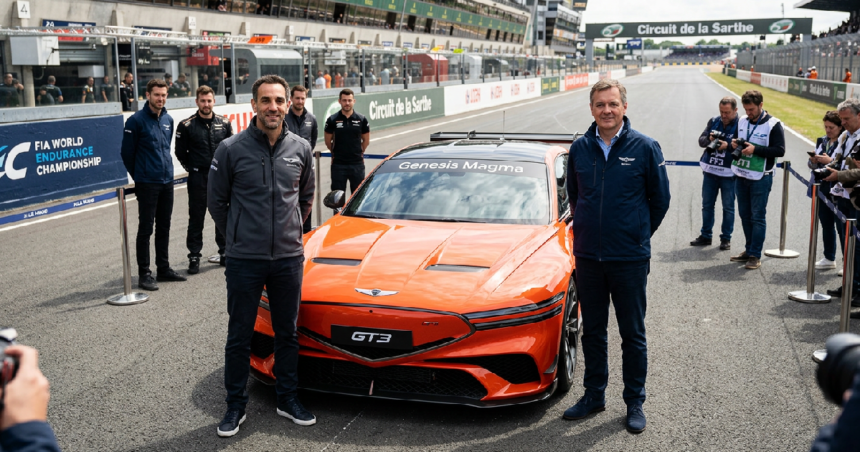
Genesis unveiled the Magma GT3 Concept car on Friday, June 12, 2026, at the Circuit de la Sarthe, signaling a major expansion of the brand’s international motorsport ambitions.
Genesis Magma Racing team principal Cyril Abiteboul and Chief Creative Officer Luc Donckerwolke introduced the track-focused machine during a press conference held on the eve of the manufacturer’s debut in the Le Mans 24 Hours. The concept car, which is not based on any existing road-going model, adheres to current GT3 technical regulations.
The timing of the reveal is no coincidence. Genesis is currently preparing for its first-ever appearance in the Hypercar class at Le Mans tomorrow, June 13, with the GMR-001 LMDh-spec entry. By showcasing the Magma GT3 Concept alongside their top-flight prototype, the Korean manufacturer is demonstrating a long-term commitment to endurance racing.
The car even appeared on Goodyear LMGT3 tires, a clear nod to the category it aims to eventually join.
While the LMDh program serves as a technological figurehead, a GT3 program would offer Genesis a platform for customer racing and a more direct link to its performance road cars. Much like how Oscar Piastri leads rain-hit practice sessions to refine Formula 1 machinery, Genesis is using the track to validate the engineering behind its “Magma” high-performance sub-brand.
Strategic shift toward a comprehensive GT3 customer program
The Magma GT3 Concept represents a “performance-first” design philosophy. Unlike most GT3 cars that are adapted from assembly-line supercars, this concept was built from the ground up to meet racing specifications. Cyril Abiteboul confirmed that while the Hypercar program remains the current clinical focus, GT3 racing has become one of the industry’s most significant success stories and a logical next step.
The car’s technical architecture reportedly leverages a mid-rear engine layout, with rumors suggesting it could be powered by a variant of the twin-turbo V8 found in the GMR-001. This powerplant is effectively two of the company’s rally-bred four-cylinder engines joined together. Such a move would streamline engineering costs and parts support across different categories of the FIA World Endurance Championship (WEC).
The brand has also focused heavily on thermal management. The Magma GT3 features a specialized rear structure designed to handle the extreme heat and aerodynamic loads of 24-hour endurance cycles. These innovations are intended to eventually trickle down into production models like the GV60 Magma, which Genesis hopes will redefine luxury electric performance.
Genesis Magma Racing integrates road and track philosophies
Luc Donckerwolke emphasized that the Magma project is about more than just trophies; it is about establishing a “sports car typology” for a brand relatively new to the luxury segment. Alongside the GT3 racer, Genesis displayed an updated Magma GT Concept featuring a completely redesigned interior. This road-going counterpart is expected to serve as the symbolic foundation for the brand’s next decade of performance.
The interior of the Magma GT Concept showcased at Le Mans features a twin-cockpit layout with an analog instrument cluster, purposefully designed to mimic motorsport timing instruments. This aesthetic choice reinforces the connection between the high-stakes environment of the Circuit de la Sarthe and the consumer experience.
The brand’s ambassador, Jacky Ickx, was also honored with a special X Gran Convertible concept featuring a bespoke green interior for the driver’s parade.
This level of brand positioning is increasingly common in professional sports, where the narrative of the athlete or team is as important as the result. For instance, in other high-stakes environments, such as com/makhachev-welterweight-title-defense-july-2026-analysis/”>Islam Makhachev targeting two-division glory, the move into a new weight class or category is a calculated step to cement a legacy. Genesis is taking a similar approach by diversifying its motorsport footprint early.
Building on Hypercar momentum at Le Mans
The reveal comes at a time of rising confidence within the Genesis camp. The GMR-001 Hypercar has already proven competitive in the 2026 WEC season, scoring championship points at Spa-Francorchamps. More impressively, during Thursday’s Hyperpole session at Le Mans, Genesis Magma Racing secured sixth and ninth positions on the starting grid, proving they can run with the established elite.
President and CEO of Hyundai Motor Company, Jose Munoz, noted that the manufacturer is “humble but hungry” as they face the world’s toughest endurance race. The data gathered from the GMR-001’s performance over the next 24 hours will directly influence the final homologation of the Magma GT3.
This iterative process ensures that when the GT3 car eventually hits the grid, it will have been forged in the highest tier of competition.
As the manufacturer continues to evolve, the “Magma” division will focus on three core principles: Unspoken Dominance, Captivating Control, and Sharpened Immersion. These are not merely marketing slogans but engineering targets. The GV60 Magma production model is already expected to feature advanced torque vectoring and performance-focused regenerative braking systems based on these racing developments.
The long-term outlook for Genesis Magma Racing
Despite the grand unveiling, Genesis has stopped short of confirming a specific date for the car’s competitive debut. Cyril Abiteboul described the GT3 Concept as “one potential future direction,” suggesting that while the appetite for a customer racing program exists, the final production and homologation timelines are still being finalized with the FIA.
Expansion into GT3 would likely see Genesis competing against established icons like Ferrari, Porsche, and Aston Martin in both the WEC and various GT World Challenge series. This would drastically increase the brand’s visibility in North America and Europe, two key markets for its luxury road cars.
The move mirrors the broader trends in sport where expansion is the primary driver of commercial growth, such as when the NBA greenlit expansion to Seattle and Las Vegas to tap into new fan bases.
For now, the focus remains on the looming start of the Le Mans 24 Hours. The Magma GT3 Concept serves as a statement of intent—a promise that regardless of the result on Sunday afternoon, the orange “Magma” livery is set to become a permanent fixture on the international racing circuit for years to come.