

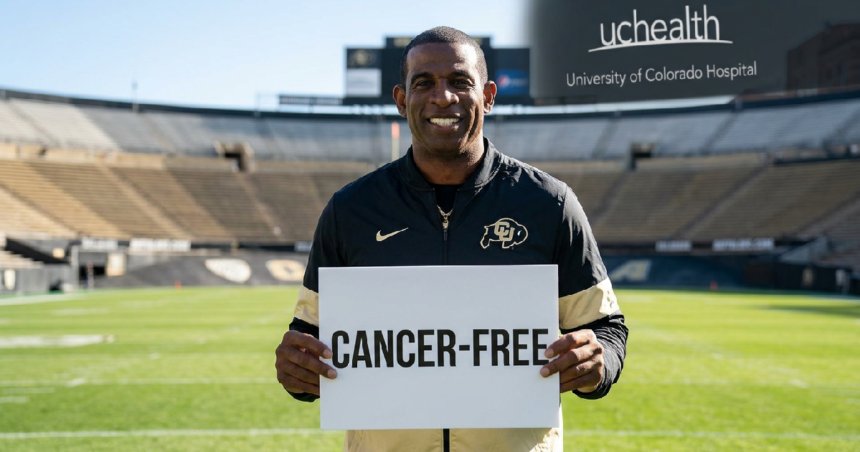
Deion Sanders, the Hall of Fame athlete and current head coach of the Colorado Buffaloes, confirmed on June 3, 2026, that he is “cancer-free” and fully restored to health following a rigorous year-long battle with bladder cancer.
Speaking during a television appearance on Good Morning America, Sanders stated he has his “swagger back” after undergoing a radical cystectomy and reconstructive surgery to defeat an aggressive form of the disease first diagnosed in the spring of 2025.
The announcement marks a triumphant milestone for the man widely known as “Coach Prime,” whose health has been a subject of intense speculation and concern within the football community.
Doctors at the UCHealth University of Colorado Hospital officially declared him “cured” on July 28, 2025, but his recent comments suggest he has finally moved past the grueling recovery phase. He credited early detection, discovered incidentally during vascular monitoring, as the primary reason he was able to beat the high-risk, non-muscle invasive cancer.
Sanders used the platform to advocate for proactive health screenings, specifically targeting a male audience that often avoids the doctor’s office. “We men, we’re not serious about our health,” Sanders said, contrasting the behavior with women who seek medical advice more readily.
He admitted that without the routine CT scan for his ongoing leg issues, the cancer likely would have progressed undetected until it reached a much more dangerous stage.
Surgical reconstruction and the road to recovery
The medical path for Deion Sanders involved a full robot-assisted laparoscopic bladder removal in May 2025. Surgeons at the University of Colorado performed a radical cystectomy, which included constructing a “neobladder” using a section of the coach’s small intestine.
This intricate procedure allowed him to maintain internal function without an external bag, though the coach has been candid about the lifestyle adjustments required by the new organ.
Writing a new chapter in his life, Sanders noted that while he is healthy, his daily routine has fundamentally shifted. He previously shared that he “cannot control his bladder” in the traditional sense and often relies on absorbent products to manage his condition.
Despite these physical changes, the clean bill of health means he can focus entirely on the sideline rather than the surgical suite during the upcoming college football season.
This medical journey follows a series of other high-profile health scares for Sanders, including several surgeries on his feet and legs due to blood clots. His resilience in the face of these challenges has become a central part of the culture he is building in Boulder.
News of his recovery coincides with a busy period for sports fans, much like how the latest sport news updates show a landscape rapidly shifting toward major summer tournaments.
Beating an aggressive non-muscle invasive cancer
Dr. Janet Kukreja, the director of urologic oncology at the CU Cancer Center, had previously emphasized the severity of the diagnosis. The specific type of non-muscle invasive bladder cancer Sanders fought carried a 50% rate of metastasis if it had reached the muscle wall.
In such cases, the five-year survival rate drops to just 10%, making the timing of his incidental discovery nothing short of miraculous.
Sanders acknowledged that the fight was mentally and physically taxing, noting that just one year ago, he was “fighting cancer” without knowing which way the prognosis would trend. The successful treatment saw his lymph nodes test negative for the disease, providing the “cure” designation that Dr. Janet Kukreja rarely uses lightly.
This victory allows Sanders to remain the face of a program that has seen massive growth since his arrival.
The stability of his health is a significant relief for the Colorado Buffaloes administration, which has seen unprecedented ticket sales and media attention under his leadership. While Seattle sports radio analysis often focuses on the professional pivot of franchises, the collegiate world has been fixated on whether Sanders could maintain the physical stamina required for a full Power Four coaching schedule.
Focus on winning the 2026 college football season
With the cancer battle behind him, Sanders is turning his attention to the gridiron, where the Buffaloes are looking to improve on their previous campaigns. When asked by Michael Strahan what he was most looking forward to in the 2026 season, Sanders’ answer was characteristically blunt: “Winning.”
He emphasized that his energy levels are back to their peak, and he is ready to “coach his butt off.”
The coach’s return to full strength is a boost for the sport, which thrives on his polarizing and high-energy persona. His presence on the recruiting trail and the sidelines has reshaped the Big 12’s competitive and commercial profile. Sanders remains a singular figure in American sports, much like how com/makhachev-welterweight-title-defense-july-2026-analysis/”>Islam Makhachev targets title glory in his own respective field by dominating through sheer force of will.
As the 2026 season approaches, the focus moves from pathology reports to depth charts. Sanders has proven he can beat the odds in multiple arenas, from being a multi-sport professional star to surviving a life-threatening oncological diagnosis.
For the “Coach Prime” faithful, the most important takeaway is that the man leading the huddle is no longer a patient, but a survivor ready for the next snap.


Для успешной торговли используются прогнозы на бинариум, которые значительно повышают шансы на прибыль.
Исходя из полученных данных, трейдеры уменьшают риски и улучшают результаты торговли.
—
Поэтому сигналы стоит использовать как дополнительный инструмент, а не единственный источник информации.