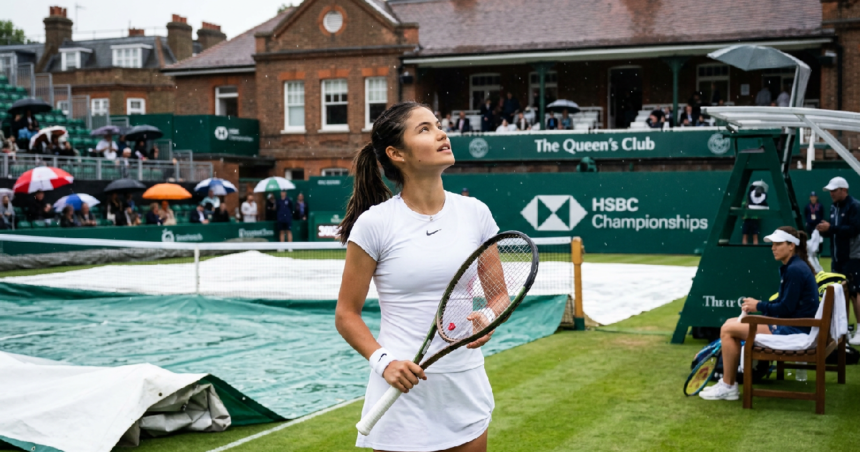
Emma Raducanu secured a place in the quarter-finals of the Queen’s Club Championships on June 12, 2026, after navigating a week of persistent rain delays in London.
The British professional tennis player defeated seventh seed Sorana Cirstea 6-4, 6-2 in their postponed second-round match, but her attempt to play a second fixture later that evening was thwarted. Earlier matches on the Andy Murray Arena ran long, forcing the cancellation of her quarter-final against lucky loser Kamilla Rakhimova for the day.
The disruption at the HSBC Championships has forced the tournament off schedule, creating a backlog that required players like Katie Boulter and Elena Rybakina to play twice in a single day. Emma Raducanu admitted that the logistical shifts were “really difficult,” particularly given the unpredictability of finding a window for play.
After her win over Cirstea, she now faces a rescheduled quarter-final against Rakhimova on Saturday, June 13, at 12:30 p.m. UTC.
Managing the emotional and physical energy required for multiple warm-ups was a recurring theme during her reflections on the week. This experience mirrors the unpredictability often seen in other sports, such as when Piastri leads rain-hit second practice sessions that disrupt carefully planned team strategies.
For Raducanu, the focus remains on recovery and refueling as she prepares for the possibility of playing two matches back-to-back on Saturday.
Emma Raducanu details the logistical difficulties of rain delays
The British number one revealed that preparing for the initial clash with Cirstea on June 11 involved constant physical readiness. “I think I did six warm-ups,” she said, referring to the attempts to get on court before the Thursday schedule was eventually declared a total washout at 6:30 p.m.
These delays force athletes into a state of flux, where maintaining muscle temperature and mental focus becomes a secondary battle against the elements.
Nutrition proved to be another hurdle. Without knowing when play would resume, Raducanu struggled to time her meals effectively. “You don’t know what to eat,” she explained. “I was having, I think I chucked down four flapjacks instead of proper food, so my stomach was definitely feeling it.”
She noted that despite these personal discomforts, she felt “really bad” for the dedicated spectators who sat under umbrellas in the rain throughout the delays.
Adapting to multiple matches in a day is a test of endurance she has not frequently encountered. She admitted that playing on a major arena under these circumstances is “emotional.” However, her recent form suggests a growing resilience.
Her performance against Cirstea followed a successful opening round where she defeated Anna Blinkova 6-0, 6-3, marking her first competitive match win since her appearance at Indian Wells in March 2026.
Historical challenges with weather disruptions in professional tennis
This is not the first time the former US Open champion has dealt with significant weather-related stress. At the Korea Open in 2025, she overcame lengthy delays and emotional mid-match struggles to defeat Jaqueline Cristian. She noted at the time that enterring a match suddenly because of rain makes adrenaline and energy feel “ordinary.”
This week’s experience at Queen’s further reinforces the maturity required to handle such interruptions on the grass-court circuit.
The backlog at Queen’s Club has drawn parallels to other high-stakes performances where mental toughness is as vital as technical skill. Similar stories of persistence have emerged recently in other disciplines, notably when Fils’ Miami semi and Cromwell Aintree target plans dominated the sports narrative with displays of grit under pressure.
For Raducanu, the immediate goal is to win her quarter-final quickly to preserve energy for a potential semi-final against American teenager Iva Jovic.
Iva Jovic reached the semi-finals after a three-set victory over Amanda Anisimova. If Raducanu defeats Rakhimova, she will return later on Saturday to face the American for a spot in the final.
The British star emphasized her pride in her performance against Cirstea and her commitment to recovering as best as possible for the Saturday double-header. “I just want to… refuel, and try and give my best to get back out there,” Raducanu concluded.
The impact of scheduling on the grass-court season
Persistent rain serves as a constant threat during the British grass-court swing, as seen earlier at the Nottingham Open in 2024. During a semi-final against Katie Boulter at that event, Raducanu won a marathon tie-break involving 28 points before the match was suspended due to rain and bad light.
Such interruptions place an immense strain on the tournament schedule and the physical health of the competitors.
At Queen’s, rigid television contracts and court limitations prevent matches from being easily moved. This forces players like Raducanu to remain in a constant state of readiness. After a season hampered by illness, this run in London represents a critical phase in her build-up to Wimbledon.
Staying fit remains the priority as she looks to build consistency and move back up the rankings following her hiatus earlier this year.
The match against Rakhimova on the Andy Murray Arena will be the first of many hurdles on a congested Saturday. If the weather holds, the day will determine if Raducanu can reach the final at Queen’s Club.
For a player who has previously been in tears during rain-delayed matches in Seoul and Dubai, this week is a testament to her ability to navigate the complex emotional landscape of professional tennis when the schedule collapses.