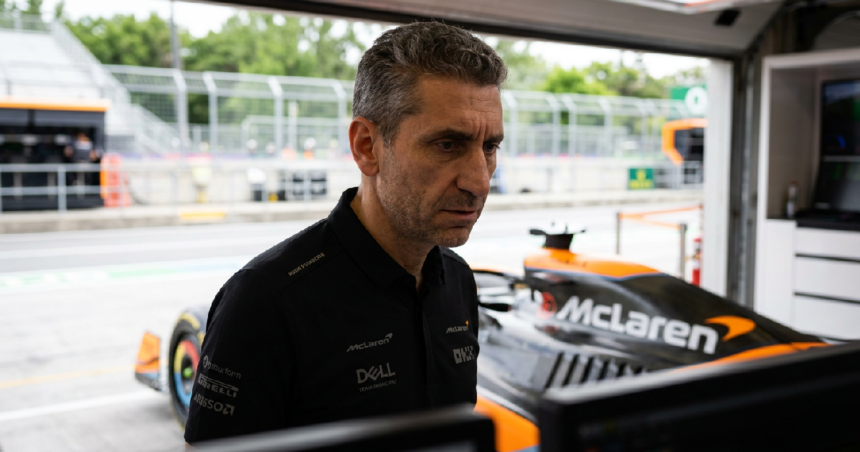
McLaren Team Principal Andrea Stella has admitted that the recent race weekends in Montreal and Monaco served as a “reality check” for the team after a lack of pace and reliability hindered their progress.
Speaking following the Monaco Grand Prix on June 10, 2026, Stella noted that despite the optimism following a double podium in Miami, the team’s trajectory has not proven to be linear. Lando Norris retired in Montreal due to gearbox issues, and McLaren faced further difficulties in Monaco where both performance and reliability were found wanting.
The team introduced the second part of its Formula 1 upgrade package in Montreal, yet the results have not met expectations on the track. Stella emphasized that McLaren has not been fast enough, particularly regarding race pace.
The “reality check” applies to a broader assessment of the car’s current state, where the technical staff are struggling to find the right balance between outright speed and mechanical durability across various high-downforce circuits.
Reliability has become a central concern for the Woking-based outfit as they navigate issues in multiple areas of the vehicle. While Oscar Piastri leads the team’s testing programs when the car is functional, Lando Norris has suffered from significant mechanical setbacks.
In Montreal, his race ended prematurely due to a gearbox failure, while at Monaco, the team grappled with power unit problems that claimed valuable track time during Friday’s sessions.
Mechanical failures and reliability assessments at McLaren
The frequency of technical glitches has prompted a rigorous performance and reliability assessment within the team. Andrea Stella mentioned that the power unit has been a primary area of concern, though issues have appeared “pretty much in all areas of the car.”
These failures are being viewed as symptomatic of a project that is still “relatively young,” requiring close cooperation with Mercedes HPP to find lasting solutions.
While the team understands the reliability issues in isolation and believes they can be fixed, the volume of problems remains a hurdle. Previous successful seasons have set a high bar, but current struggles are preventing the drivers from maximizing their potential. As Latest Sport News Updates often show, the competitive nature of the 2026 season leaves no room for such consistent hardware failures.
The lack of consistency is particularly frustrating given the flashes of speed the car has shown previously. Stella still hopes for a “2024 scenario” where the team stages a late-season comeback. However, he admitted that the trajectory in 2024 was more convincing from both a reliability and performance standpoint than what the team is currently experiencing on the grid.
Struggles with aerodynamic load and tyre operating windows
On the performance side, the Monaco Grand Prix highlighted a significant deficiency in aerodynamic load. According to Stella, the car lacks the necessary grip because it does not generate enough downforce on high-downforce circuits. This creates a secondary problem regarding the 2026 Pirelli tyres, which have proven difficult for McLaren to manage on smooth tarmac surfaces like those found in Canada and the principality.
The 2026 tyres are relatively stiff and require high temperatures to operate within their optimal window. Because Pirelli developed these tyres to handle the massive downforce levels predicted for the season finale in Abu Dhabi, they have been somewhat conservative.
For a team like McLaren that is currently lacking in load, the tyres remain too robust and fail to reach the temperature needed for peak performance.
This technical disconnect means the car is not getting the tyres to operate in the regime where they perform best. Stella noted that the “long list” of performance and reliability hurdles must be addressed if they are to remain competitive in the championship.
The team must find a way to generate more heat through the rubber while simultaneously resolving the mechanical gremlins that have plagued Lando Norris’s recent outings.
Future outlook and the hunt for a 2024 turnaround
Despite the current setbacks, the team remains focused on a mindset of recovery. The comparison to the 2024 season is a recurring theme within the garage, though the hurdles appear more numerous this time. In 2024, the development curve was supported by a more stable mechanical platform. Today, McLaren must divide its resources between basic hardware fixes and complex aerodynamic refinements to catch the frontrunners.
Success in the coming weeks will depend on whether the engineering team can translate these “reality check” findings into concrete lap time. Just as Orioles and Phillies lead their respective fields through consistent execution, McLaren knows that finding a reliable baseline is the only way to salvage their title aspirations.
The pressure is on to prove that the earlier podium success was more than a fleeting moment of form.