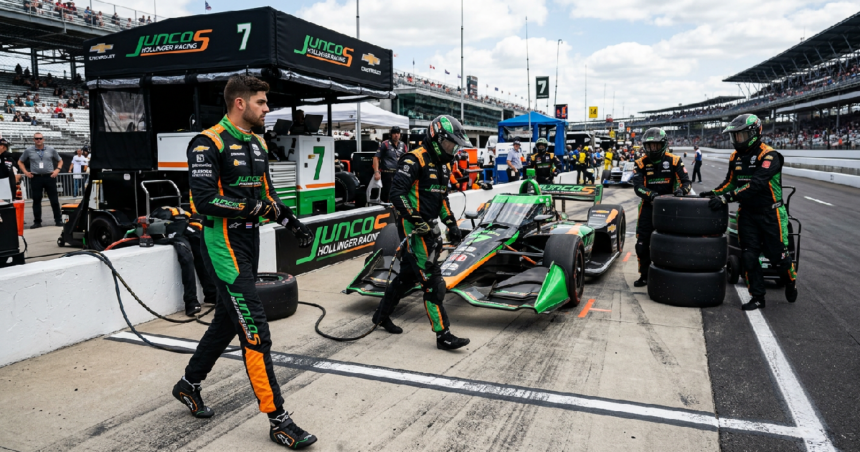
In the high-stakes environment of IndyCar racing, the difference between a podium finish and a mid-pack result often evaporates in the handful of seconds a car spends stationary. For Juncos Hollinger Racing (JHR), the pits were historically a source of concern rather than an advantage. However, recent developments suggest a shift in the team’s operational DNA, as Rinus VeeKay and his crew have reportedly managed to transform their service speed from a weakness into a tactical edge.
This transformation appears to have been born from a concerted effort to improve the synchronization between the driver’s entry and the mechanics’ execution. In a series where the field is frequently separated by less than a second in qualifying, the ability to “overcut” or “undercut” rivals during a pit cycle is an essential way to gain track position. The recent progress seen by the team mirrors the technical focus required in other elite racing series, such as when Piastri leads rain-hit second practice at Suzuka, where marginal gains in difficult conditions define a team’s trajectory.
Engineering an Operational Shift at Juncos Hollinger
For several seasons, JHR worked to match the efficiency of the more established “Big Three” teams. While their raw pace on road courses was often evident, they frequently lost time during mandatory stops, forcing their drivers to make up the deficit under green-flag conditions. This cycle put immense pressure on tire management and fuel strategy.
The addition of Rinus VeeKay to the lineup is widely viewed as a catalyst for growth. The driver is known for his precision when hitting his “marks” in the pit box. By consistently stopping within a narrow margin of accuracy, he allows the tire changers to begin their work without hesitation. It sounds minuscule, but in a sport measured in fractions of a second, it is a vital component of success. Paddock observers have noted that the crew has responded to this consistency with a newfound confidence, reportedly moving their stationary times closer to the front-runners of the grid.
Refining the Driver-Crew Connection
The technical aspect of a pit stop is only half the battle; the psychological component is equally vital. Previously, the JHR crew often faced the pressure of being the underdog. Now, there is a visible change in their composure in the lane. There are indications that the team has prioritized a constructive atmosphere during practice drills, focusing on the mechanics of the movement rather than the pressure of the clock.
VeeKay’s role in this synergy involves providing a stable platform and communicating clearly over the radio regarding car adjustments before entering the lane. This ensures the crew is prepared for any specific changes required. Just as a veteran presence can stabilize a roster in other sports—similar to how Luke Littler leads technical drills for England teammates to raise the collective standard—VeeKay’s arrival is believed to have encouraged every member of the crew to refine their processes.
Strategic Flexibility Through Execution
Having a capable pit crew changes how a race engineer views the entire event. When a team is confident they can execute a stop efficiently, they can afford to be more aggressive with their strategy calls. They no longer have to wait for a “clear air” gap that might never come; they can instead rely on the crew to help them leapfrog the competition during the stops.
This mechanical reliability provides a safety net that has reportedly allowed JHR to challenge for positions they previously struggled to maintain. The development of the pit stop into a competitive tool has provided the team with opportunities for better track position that were once out of reach. The “choreography” of the four tire changers, the air-jack operator, and the fueler is now described as a practiced routine rather than a frantic scramble.
Broader sporting contexts show that performance peaks are often about this kind of specialized preparation. Whether it is a driver hitting his marks or how Price overcomes Littler in high-stakes Berlin showdown through composure, the ability to perform under pressure is what separates the contenders from the rest of the field.
Looking Toward Future Challenges
As the schedule moves toward high-speed ovals, the importance of pit execution will only intensify. At major events where pit entry speeds are high and the margins for error are non-existent, JHR’s operational improvements will face their ultimate test. A single error during a stop can end weeks of preparation in an instant.
But the trends observed so far this year suggest that JHR is no longer operating on the back foot. They appear to have moved from a defensive posture to an offensive one. For Rinus VeeKay, having a crew that can match his on-track intensity means that the potential for what this independent team can achieve has likely been raised. They are increasingly in a position to dictate the terms of the battle in the one place where the driver usually has the least control.