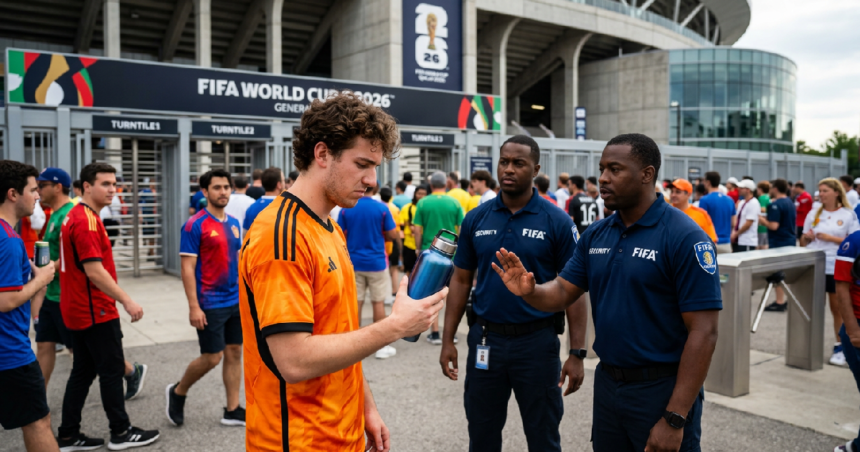
FIFA has sparked widespread controversy by banning fans from bringing reusable water bottles into stadiums during the 2026 World Cup, reversing a previous pledge that would have allowed attendees to stay hydrated during the summer heat.
This sudden policy shift, announced on Wednesday, prohibits spectators from carrying even empty, transparent bottles into match venues across North America. The decision has drawn sharp criticism from supporters and safety advocates who fear for fan welfare in what is expected to be one of the hottest tournaments on record.
The International Federation of Association Football (FIFA) had initially stated that fans could enter match grounds with one empty, reusable container of up to a litre in capacity. This original guideline was seen as a sensible concession to the extreme summer temperatures across Canada, Mexico, and the United States.
Many of the 16 host stadiums are modern facilities equipped with water fountains designed specifically for bottle refills, but those amenities will now be largely inaccessible to fans unless they purchase official containers inside.
Organisers are justifying the move on security grounds, citing concerns that fans might throw full bottles onto the pitch or into other sections of the crowd. While stadium safety is a standard priority for major tournaments, critics point out a glaring inconsistency in the logic.
These same venues hosted matches during last summer’s Club World Cup where water bottles were permitted without major incident, leading many to question the sudden pivot following latest sport news updates regarding the tournament’s logistical planning.
Commercial interests versus fan safety at the 2026 World Cup
The U-turn has led to accusations that FIFA is prioritising concession sales and merchandise over the health of its audience. By banning personal bottles, spectators will be forced to rely on purchasing beverages within the stadium.
This mirrors a contentious strategy seen during the 2019 Women’s World Cup in France, where personal bottles were confiscated and fans were encouraged to buy “collectible” cups co-branded by organisers and corporate sponsors.
And there is little doubt that the heat will be a significant factor for the 48-team tournament. Meteorologists have already warned that 2026 could be the hottest World Cup in history, with temperatures in host cities like Dallas, Houston, and Monterrey frequently exceeding 35 degrees Celsius in June and July.
Managing hydration is not just a matter of comfort; it’s a critical safety issue for thousands of traveling fans who may not be accustomed to such intense humidity and high heat indexes.
FIFA’s refusal to adopt more flexible measures has further frustrated the common supporter. Standard stadium practice in most European leagues involves allowing bottles of a certain size provided the caps are removed. This compromise prevents the containers from being used as pressurized “missiles” while still allowing fans to drink.
Instead, FIFA has opted for a total prohibition, effectively forcing fans to pay a premium for water that is otherwise freely available at stadium fill-stations.
Logistical challenges and infrastructure at North American venues
The ban is particularly jarring because of the infrastructure available at the selected venues. Most NFL and MLS stadiums were designed with sustainability in mind, featuring high-flow water stations to reduce single-use plastic waste.
By barring the entry of reusable containers, the organisers are effectively rendering this green infrastructure useless for the duration of the tournament. It also creates a scenario where fans must wait in long concession lines just to obtain a vessel for water.
The move comes at a time when the governing body is already under fire for the soaring costs of attendance. Between World Cup travel chaos involving price hikes and the ticketing structure, the water ban is seen by many as another “hidden tax” on the average fan.
For a family of four, the cost of buying several official drinks per match over the course of a long afternoon in the sun can add a substantial burden to an already expensive trip.
While the focus remains on the stands, there is currently no word on whether similar restrictions will affect any match-day operations for staff or volunteers.
Players, naturally, will have access to high-grade hydration, but the contrast between the elite conditions on the pitch and the restrictive environment in the stands is growing sharper as the tournament draws closer.
This policy represents a significant PR hurdle for Gianni Infantino’s administration as they try to market the most expansive World Cup ever held.
Looking ahead to potential policy adjustments before kick-off
Public pressure often forces a rethink in the build-up to global events, but FIFA has traditionally been slow to move once security protocols are codified. Fans are already looking at other major sporting events for comparison, such as how tennis tournaments or the Olympics handle extreme heat.
If the opening matches result in heat-related medical incidents, the “safety” argument used to justify the bottle ban will likely crumble under legal and public scrutiny.
There is also the question of how this affects the 2026 tournament’s stated sustainability goals. FIFA has frequently touted its commitment to reducing the environmental footprint of the World Cup.
Forcing 50,000 to 100,000 people per match to use disposable or “souvenir” cups instead of their own long-term reusable bottles seems directly at odds with those green credentials. For now, fans are advised to prepare for high stadium prices and to stay hydrated before passing through the security gates.
This development follows other major footballing shifts, including concerns over player contracts as the Mo Salah future at Liverpool remains a talking point in the club world. However, for those heading to North America in 2026, the immediate concern isn’t the transfer market, but how to stay safe in the sun. FIFA’s update on Wednesday has made that task considerably more difficult and expensive.