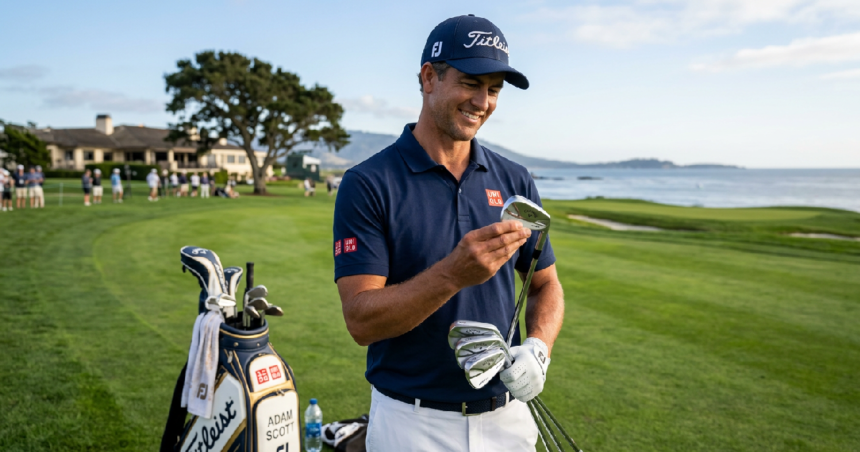
Adam Scott has reportedly overhauled his iron setup, moving away from his long-standing preference for custom Miura blades to incorporate a new set of Callaway irons. The former Masters champion, who has operated as an equipment free agent for several years, is known for his donor-like meticulousness when selecting gear. This latest switch marks a definitive change from the bespoke Miura AS-1 blades that have been a staple of his bag during recent competitive appearances.
The move comes as Scott continues to experiment with various manufacturers to maintain his competitive edge on the PGA Tour. While he has previously found success with a mix of Titleist and TaylorMade woods, his iron play has often relied on the forged precision of Japanese craftsmanship. However, reports from industry insiders indicate that the Australian is now gaming Callaway hardware, likely seeking a different launch profile and turf interaction as the professional golf calendar intensifies.
Scott’s willingness to pivot between brands is a hallmark of his late-career strategy. Since moving away from a full equipment staff contract, he has frequently tweaked his “What’s In The Bag” (WITB) setup. This flexibility allows him to adapt to specific course conditions and internal performance data, even if it means benching traditional favorites. This level of technical autonomy is increasingly common among elite veterans, similar to how Salah faces career defining choice as he weighs his professional options, where the freedom to make independent decisions can influence longevity at the highest level.
Shift in Iron Preferences and Technical Specifications
The transition toward Callaway suggests a desire for modern performance over pure traditionalism. While the previous Miura set offered a classic blade feel that Scott has favored for a long time, the new irons are expected to provide additional ball speed or more predictable launch conditions in the long-to-mid iron range. Scott has recently utilized utility clubs to bridge the gap between his woods and scoring irons, and introducing Callaway irons into the heart of his set indicates a broader reconfiguration of his yardage gapping.
Equipment observers have noted that Scott’s new irons are expected to be paired with his preferred Project X LZ 6.5 shafts. This combination of a high-tech head with a familiar shaft profile suggests he is looking for a specific flight window. It is a calculated adjustment, but one that Scott feels is necessary to compete against the increasing power seen across the professional game. Much like the way Orioles and Phillies lead 2026 World Series forecasts through strategic roster moves, Scott is building a specialized lineup of clubs to handle diverse course layouts.
Driving and Fairway Wood Strategy
While the iron change is a major development, the rest of Scott’s metalwood setup remains a blend of different technologies. He has recently leaned on the Titleist GT2 driver, a club that reportedly provides the stability he requires for his high swing speeds. Interestingly, he also continues to carry a TaylorMade mini-driver, a choice that highlights his preference for specific head shapes and versatility when playing from the tee on tighter holes.
His loyalty to certain fairway woods, such as preferred TaylorMade models, appears to remains intact. These clubs offer him the high-launching flight needed for attacking par-5s, complementing the new iron setup. Scott is meticulously curating a versatile kit designed to perform under major championship pressure. These technical pivots are a significant talking point, much like how Fils Miami Semi and Cromwell Aintree Target have dominated recent sporting headlines.
Short Game Precision and Putter Adjustments
Around the greens, Scott remains largely loyal to the Titleist Vokey family, utilizing a mix of standard and prototype grinds. These wedges provide the specialized spin control he requires for the firm, fast conditions typical of the tour. His wedge play has remained a consistent strength, even as his long-game tools have undergone several changes in recent seasons to keep up with evolving ball technology.
The putter continues to be one of the most discussed clubs in his bag. After years of experimenting with various long-neck and broomstick models, Scott has largely settled into the L.A.B. Golf Mezz.1 Max. This “lie-angle balanced” technology is designed to keep the face square throughout the stroke, a solution Scott turned to for greater stability. The distinctive look of the Mezz.1 has become a fixture in his hands, providing the confidence he needs on the greens.
Impact on Scott’s Performance Outlook
This iron change arrives at a critical juncture in the calendar. Scott is clearly searching for the perfect “feel” to complement his still-elite ball-striking statistics. Some analysts argue that frequent equipment changes can affect consistency, but Scott has proven he is comfortable functioning as a “gear head” who prioritizes incremental performance gains over brand loyalty.
Recent form indicates that Scott remains a formidable threat on both the DP World Tour and PGA Tour. His transition to Callaway irons will be watched closely by equipment enthusiasts and competitors alike. If the change yields a victory in the coming months, it could signal a successful new chapter for the veteran. The golf world will get its first extended look at the new setup in the coming weeks. For now, Adam Scott remains a high-profile free agent, proving that performance data and personal preference often outweigh the lure of traditional endorsement contracts in the modern era.