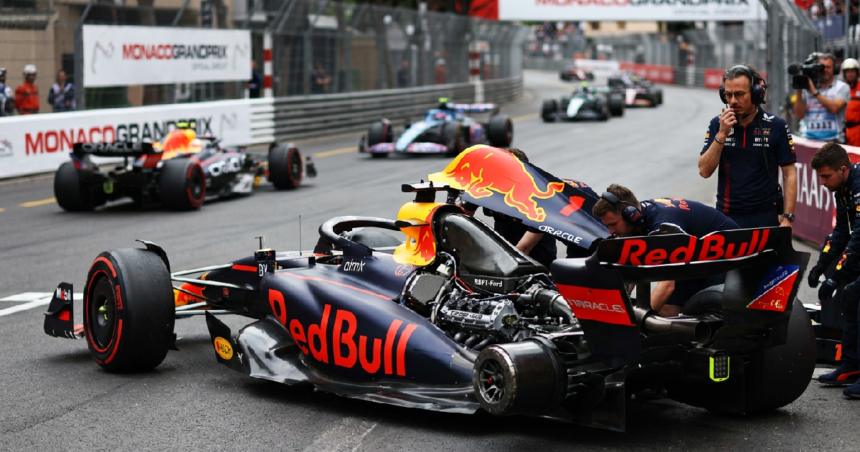
Red Bull Racing has identified an engine failure as the primary cause behind Max Verstappen’s early retirement from the Monaco Grand Prix on Sunday, June 7, 2026. After qualifying on the front row in second place, the Dutch driver’s car suffered an immediate power loss at the start of the race.
The team has since confirmed that the hardware in question was already scheduled for replacement before next week’s Spanish Grand Prix in Barcelona.
The mechanical trouble surfaced early, with Max Verstappen reporting “anomalies” and inconsistent RPM targets during the formation lap. As he released the clutch to begin the race, the power unit “dropped dead” and bogged down completely. This left his car nearly stationary on the grid while the rest of the field, led by pole-sitter Kimi Antonelli, navigated around him at high speed.
Max Verstappen managed to limp around the circuit but reported the engine sounded “awful” and lacked the power required to go full throttle. He retired to the pits at the end of the opening lap. While technical issues often cause disruptions during practice sessions, this failure at the start-line cost the team a significant opportunity on a weekend where they showed competitive pace.
Laurent Mekies clarifies engine strategy and failure cause
Red Bull Team Principal Laurent Mekies confirmed that the team has identified the specific issue, which developed during the pre-start procedures. “It developed on the formation lap and it gave him or us no chance,” Laurent Mekies explained after the race. The Team Principal also issued an apology to the driver for the technical failure on a weekend where the car showed high potential.
The failure involved the very first power unit allocated to Max Verstappen for the 2026 season. Laurent Mekies noted that Red Bull had already planned to switch to a fresh unit for the Barcelona race. Monaco is not considered a power-sensitive circuit, leading teams to often utilize older hardware there before introducing new components for the high-speed requirements of the Circuit de Barcelona-Catalunya.
Because the change was already part of the team’s seasonal roadmap, the scheduled installation of a new power unit should not incur any grid penalties. This logistical transition is critical as the championship moves into a phase with higher mechanical demands. These high-stakes technical showdowns reward teams that can balance outright speed with consistent reliability across a long calendar.
Max Verstappen describes terrifying start-line stall
The driver provided a vivid account of the moments following the engine failure, admitting he feared a major collision. “I was just praying that everyone would go right,” Max Verstappen said, describing how he had to steer with only the friction of his wheels while having no power. He expressed frustration at the lack of consistency in the RPM targets before the engine finally died.
On the team radio, the driver’s reaction was blunt, questioning the reliability of the system after it “bogged down completely” upon clutch release. Red Bull Powertrains-Ford is currently facing a unique regulatory environment in its first year as a manufacturer. The FIA has provisionally designated the unit as the benchmark for the 2026 era, which carries specific developmental consequences.
Under the Additional Development and Upgrade Opportunities (ADUO) regulations, Red Bull will not be permitted to introduce performance updates. Their rivals at Mercedes and Ferrari have been rated more than 2% and 4% behind the benchmark respectively, granting them opportunities for development that Red Bull currently lacks.
This places a massive premium on the team’s ability to solve reliability concerns without the luxury of performance-based re-designs.
Looking ahead to the Spanish Grand Prix
The focus now shifts to Spain, where the team must verify if the Monaco failure was a isolated component fault or a deeper systemic issue. The Barcelona-Catalunya circuit provides a complete contrast to the tight streets of Monte Carlo, demanding peak performance from every aspect of the 2026-spec hybrid power units.
Red Bull must ensure a flawless debut for Max Verstappen’s second engine to keep pace in the standings.
Despite the setback, the team remains confident in the base package of the Red Bull-Ford engine. With the cause of the Monaco DNF located, the engineers in Milton Keynes are working to ensure the hardware gremlins do not resurface. The upcoming race in Spain will serve as the first true test of the “benchmark” engine under sustained high-speed loads over a full race distance.