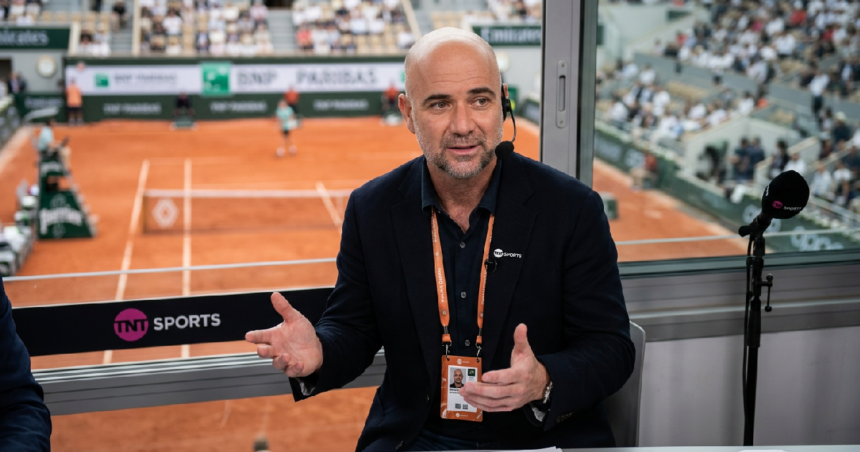
Tennis legend Andre Agassi questioned the mental preparation of Jakub Mensik following the Czech teenager’s decision to hire a mental coach immediately before his Roland Garros semi-final against Alexander Zverev.
Speaking on TNT Sports after the match, Agassi suggested that making such a significant change to his support team at the penultimate stage of a Grand Slam could have backfired for the 20-year-old prospect.
Alexander Zverev eventually triumphed in four sets to secure his place in the final, despite an inspired third-set fightback from the young Mensik.
The critique from the eight-time Major winner focused on the timing of the addition to Jakub Mensik’s camp.
Andre Agassi, who joined the TNT Sports broadcast team specifically for the business end of the Paris tournament, expressed his disbelief that a player would look for new psychological guidance just hours before the biggest match of his career.
He argued that the pressure of a semi-final is a time for familiar comfort rather than New Age interventions.
Agassi’s “brutal honesty” has become a hallmark of his punditry in 2026. This latest comment follows his earlier assessment of Jannik Sinner, where he pointedly criticized the Italian’s physical conditioning during a difficult exit. While others in the media often offer sympathy to young players, Agassi remains focused on the elite mental and physical standards required to win the sport’s biggest prizes.
Andre Agassi questions Jakub Mensik’s mental coach decision
Addressing the pre-match reports, Andre Agassi was blunt about the strategic error he believes Jakub Mensik committed. He stated that in his view, the semi-finals of a Grand Slam are not the time for tactical or psychological experiments.
He joked that “you’re supposed to bring in your mom at that stage” to watch the match rather than a professional coach tasked with re-wiring a player’s mindset under intense pressure.
Agassi elaborated on the risks for the technical staff involved in such a late arrival. He noted there is almost no upside for a mental coach entering the fray at that specific moment, as the player’s routine is already established.
This brand of direct analysis is becoming common in tennis coverage, much like how Rousey vs Carano debates once dominated discussions about the psychological evolution of combat sports athletes.
Sam Querrey, also appearing on the TNT Sports panel, backed Agassi’s perspective. Querrey highlighted that Jakub Mensik has been “flawless” throughout the tournament, overcoming exhaustion in his second-round match and fighting back from a 6-0 set loss against Alex De Minaur. Both veterans agreed that changing a winning formula when a player is already displaying such resilience was an unnecessary gamble.
Alexander Zverev overcomes Mensik’s third set resurgence
On the court, Alexander Zverev appeared largely untroubled by any psychological shifts in his opponent’s camp during the early stages. The German took a commanding two-set lead, using his experience to dictate play and keep the 20-year-old at bay. However, the contest shifted when Jakub Mensik required a medical time-out in the third set, which seemed to spark a renewed intensity in his game.
Jakub Mensik roared back to claim the third set, temporarily stalling Zverev’s progress toward the final. Despite the momentum shift, Alexander Zverev remained composed. He effectively closed the match in the fourth set, proving that he was prepared for the fluctuations inherent in best-of-five-set tennis. The performance cemented Zverev’s status as the heavy favorite heading into Sunday’s final match.
In his on-court interview, Alexander Zverev was gracious toward his opponent’s breakthrough run. He remarked that Jakub Mensik had beaten “unbelievable players” over the past two weeks and admitted the teenager provided his toughest challenge of the tournament so far. Much like how Price overcome Littler in recent high-stakes darts competitions, the established veteran’s experience eventually told against the surging newcomer.
Zverev’s path to the French Open final
The focus now shifts to the championship match where Alexander Zverev will face Flavio Cobolli. Supporters and analysts have noted that Zverev has looked remarkably steady throughout the fortnight, avoiding the late-match collapses that have plagued his previous Grand Slam campaigns. Some fans argue that his path has been made easier by the early exits of Novak Djokovic and Jannik Sinner.
The tactical fallout from the semi-final will likely center on Mensik’s future coaching structure. While the loss was disappointing, his run to the final four marks him as the brightest star in Czech tennis.
For Agassi, the lesson for Mensik is clear: consistency in the inner circle is as vital as the serve or the forehand when the lights are brightest in Paris. It remains to be seen if other latest sport news updates will follow this trend of late-tournament coaching additions.
As the final weekend of Roland Garros concludes, the debate sparked by Andre Agassi serves as a reminder of the fine margins in professional tennis. Whether it is a mental coach or a change in routine, every decision is magnified on the red clay of Paris.
For now, Zverev moves on, while Mensik leaves with a wealth of experience and a piece of pointed advice from one of the game’s greats.