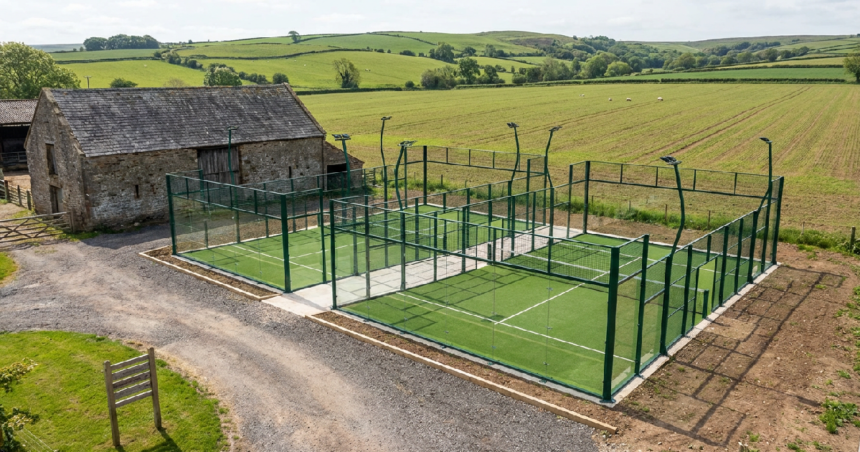
The intersection of traditional agriculture and the world’s fastest-growing racket sport has reached a new milestone. Local authorities have granted planning permission for the installation of padel tennis courts at a working farm, marking a shifting trend in how rural land is utilized to meet the surging demand for the sport. The decision reflects a broader movement within the tennis industry to expand infrastructure away from traditional city-based clubs and into multipurpose recreational spaces.
Diversification through the Padel Boom
Rural landowners are increasingly looking toward leisure and sports as a means of diversifying their income streams. By repurposing land that may no longer be viable for high-intensity farming, estate owners are finding that the footprint of a padel court offers a high-yield alternative. Unlike traditional tennis, which requires significantly more space, padel is played on an enclosed court roughly a third of the size of a standard lawn tennis surface.
The approval of these courts suggests that planning committees are becoming more receptive to the idea of sport-driven diversification. In this specific case, the project is expected to integrate into the existing farm environment without disrupting the surrounding landscape. The development typically involves high-specification glass walls and synthetic turf, which are designed to be relatively low-impact compared to industrial or residential construction.
Meeting the Infrastructure Deficit
The demand for padel in the United Kingdom and across Europe has consistently outstripped the supply of available courts. Governing bodies and private investors have noted that the lack of facilities remains the single biggest bottleneck for the sport’s growth. While urban centers have seen a flurry of activity—leveraging old warehouses and retail parks—the move into rural and farm-based settings opens a new demographic of players.
For the local community, this move provides access to modern sports facilities that are often concentrated in metropolitan hubs. The development at the farm is expected to include multiple courts, potentially accompanied by basic amenities like parking and a small pavilion. It’s a model that has seen success in Spain and the Nordics, where the sport has reached near-saturation levels, and the UK is now following a similar trajectory.
But the expansion isn’t without its hurdles. Planning applications for padel courts often face scrutiny regarding noise levels—specifically the distinctive ‘pop’ sound the ball makes against the carbon-fiber rackets—and the impact of floodlighting on rural night skies. However, the successful approval of this farm project indicates that these concerns can be mitigated through strategic placement and modern acoustic fencing.
A Sustainable Model for Rural Sport
As the sport continues to shed its image as a niche pastime, projects like the farm-based courts become bellwethers for future developments. The integration of sports facilities into agricultural settings creates a multi-use environment that can support local employment and promote physical activity in underserved areas. It also provides a steady revenue source that is not dependent on crop yields or livestock market fluctuations.
Looking ahead, the success of this facility will likely encourage other farm owners to consider similar applications. With the Lawn Tennis Association (LTA) continuing to back the expansion of padel through its development grants and strategic partnerships, the “farm-to-court” model could become a staple of the British sporting landscape. The focus now shifts to the construction phase and the eventual integration of the courts into the local competitive circuit.
Frequently Asked Questions
Why are padel courts being built on farms rather than in town centers?
Farms often have the necessary physical space and existing infrastructure, such as access roads and outbuildings, that make development more cost-effective. Additionally, urban land is becoming increasingly expensive and scarce, leading developers to look at rural diversification as a viable alternative for meeting the high demand for courts.
Does a padel court at a farm affect the environment or wildlife?
Planning approvals usually come with strict conditions regarding light pollution and noise. Modern padel facilities use directional LED lighting to minimize “spill” into the atmosphere and often employ acoustic glass or fencing to ensure that the surrounding environment—and any nearby livestock—is not significantly impacted.
Is padel tennis different from the tennis we see at Wimbledon?
Yes, it is played on a smaller court with glass walls that the ball can bounce off, much like squash. The rackets are stringless and made of composite materials, and the serve is underarm. It is generally considered easier for beginners to pick up than traditional tennis, which has contributed to its rapid global growth.