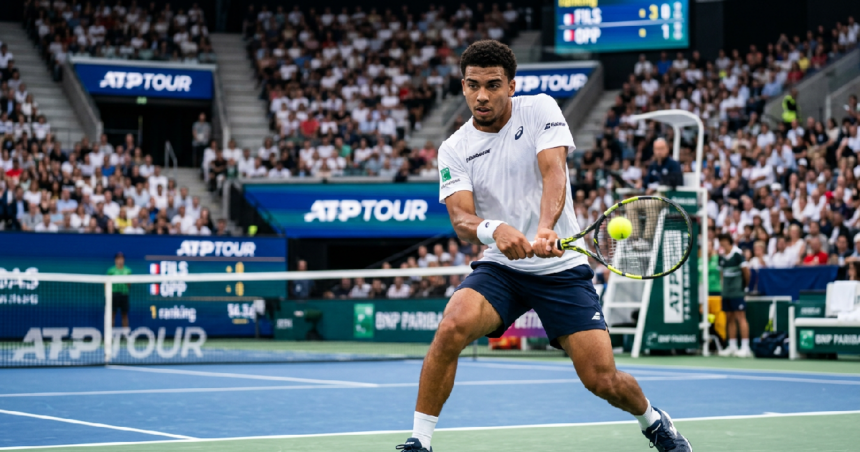
Arthur Fils is rapidly becoming one of the most talked-about names in the sport as he continues to climb the ranks of elite professional tennis. The young Frenchman, whose arrival on the ATP Tour was met with significant expectation, has transitioned from a promising prospect to a genuine threat on any surface. His recent run of form underscores a shift in the hierarchy of the men’s game, where the younger generation is no longer just competing but is reportedly starting to dictate the outcome of major tournaments.
Fils brings a physical, high-octane style of play that has become his trademark. It isn’t just about the power from the baseline; it is the way he manages transitions and defends under pressure that has caught the eye of analysts. In an era where the professional circuit is often dominated by players with exceptional height and reach, Fils relies on explosive movement and a heavy forehand that can push defensive players deep behind the baseline.
Establishing Presence Within the Next Generation
The rise of Fils comes at a time when French tennis has been searching for a new standard-bearer. After a long period of relying on a core group of established veterans, the focus has shifted to a fresh wave of talent. Fils appears to be a frontrunner in that charge, showing a level of tactical maturity that is often uncommon in such young players. His ability to adjust his game plan mid-match, particularly in high-pressure situations, suggests he has the mental fortitude required for a sustained career at the top level.
And while much of the attention in the sporting world often gravitates toward high-stakes moves in other disciplines, such as when Manchester United secure major defensive signings, the internal progression within the ATP rankings can be just as impactful for the sport’s global economy. For Fils, every deep run in a Masters 1000 event or a Grand Slam not only improves his seeding but also alters the draw dynamics for the established stars at the top of the game.
Surface Versatility and Technical Growth
What makes Fils particularly dangerous is his adaptability across different playing conditions. Traditionally, many French players have been viewed as clay-court specialists or flair-based players who might struggle with the consistency required for hard-court grinds. Fils, however, has proven that his game translates well across different environments. His compact backhand and improved serve have made him a difficult opponent on faster surfaces, where he can take time away from his rivals.
His progress has not gone unnoticed by his peers on the tour. Some highly-ranked players have reportedly remarked on the difficulty of playing against his high-margin, heavy-spin game. It is a style that forces opponents to play one extra ball, often leading to unforced errors from those who try to end points too quickly. This strategic discipline is rare for a player of his experience and indicates a high level of coaching and preparation behind the scenes, similar to how Arthur Fils’ deep runs in major tournaments have been attributed to rigorous conditioning.
Navigating the Pressures of the ATP Tour
The life of a touring professional is as much about managing the schedule as it is about hitting tennis balls. For Fils, the challenge now lies in consistency. Maintaining a high level of play over a long, demanding season is the true test of an elite player. We have seen many young athletes burst onto the scene only to struggle with physical setbacks or the fatigue of the constant travel required by the ATP calendar.
Recent developments in the sports world highlight how quickly momentum can build. Fils has been careful with his scheduling, reportedly opting for a mix of top-tier events and targeted training blocks. This measured approach appears to be paying off, as he looks fresher than many of his counterparts during the middle stages of the calendar. This type of career management is becoming standard for those with long-term ambitions at the pinnacle of the sport.
Building a Brand Beyond the Court
Beyond his technical skills, Fils is beginning to carry himself with the aura of a protagonist. In tennis, charisma often translates to crowd support, which can be a decisive factor in close matches. Whether he is playing in Paris or on the hard courts of North America, he has shown an ability to engage the audience and use that energy to fuel his performance. This star potential is something the tour is eager to promote as it looks to build new rivalries for the future.
As the tennis season progresses, the scrutiny on Fils will only increase. No longer a dark horse, he will enter tournaments with a higher profile. How he handles the pressure of being a player to watch, rather than an underdog, will define the next phase of his career. If his recent performances are any indication, he is preparing for the responsibility. The evolution of the ATP circuit remains a compelling narrative, aligning with the latest updates surrounding the Miami Open and international events. For Arthur Fils, the goal is to maintain his upward trajectory and challenge for the major titles that have long been the domain of a select few.