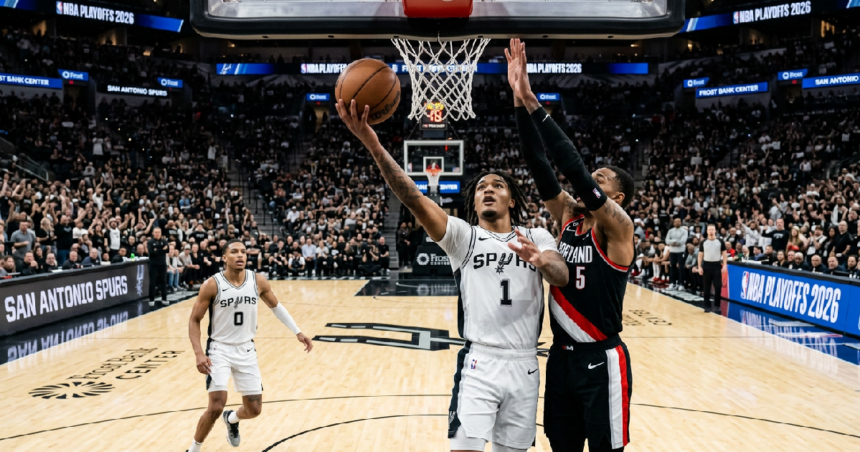
Stephon Castle and Dylan Harper combined to lead the San Antonio Spurs to a significant postseason victory over the Portland Trail Blazers on April 25, 2026. The win gives San Antonio a commanding edge in the series as they managed to withstand a late surge from the Trail Blazers, eventually securing a double-digit win behind a relentless offensive display from their young core.
The win puts the Spurs in a strong position as they found tactical solutions for Portland’s defensive rotations that had stalled their rhythm in previous matches. Castle was active from the opening tip, finding lanes to the basket and punishing the Trail Blazers from the perimeter. His ability to facilitate in transition allowed San Antonio to maintain a tempo that reportedly wore down the Portland starters by the final quarter.
Portland struggled to contain the multi-dimensional attack of the Spurs, particularly when the bench units were on the floor. While the Trail Blazers have shown defensive resilience throughout the season, they lacked the scoring depth on this occasion to match the output provided by the San Antonio reserves. The game serves as another example of San Antonio’s successful rebuilding strategy, which focuses on versatile guards who can play across multiple positions.
Stephon Castle Leads the Charge for San Antonio
Castle’s offensive outburst was characterized by timing as much as volume. Every time the Trail Blazers threatened to cut the lead to single digits, Castle responded with a driving layup or a composed mid-range jumper. His performance underscored why he has become a focal point of the Spurs’ offensive identity. He showed a level of maturity in his shot selection that often eludes younger players in high-pressure playoff environments.
The Spurs’ coaching staff has clearly boosted the responsibility of their primary playmaker, and the results are following suit. Beyond the scoring, Castle’s presence on the floor demanded double teams, which opened up the floor for his teammates. This loss will be particularly frustrating for Portland, who had hoped to use their home-court atmosphere to even the series. Instead, they find themselves searching for ways to stop a backcourt that is playing with high confidence.
The intensity of the game mirrored the high stakes seen in other major sports this month. Just as Israel Adesanya and Joe Pyfer prepare for a high-stakes encounter, the Spurs had to remain disciplined to avoid a late-game collapse against a desperate Portland side. The focus remained on tactical precision during the closing minutes to ensure the lead remained intact.
Dylan Harper Provides the Clinical Edge from the Bench
The secondary story of the night was undoubtedly Dylan Harper. Contributing heavily as a reserve is a difficult feat, but doing so while also being active on the glass suggests a complete performance. Harper’s energy in the first half allowed the Spurs to build their initial cushion, and his rebounding prevented Portland from getting second-chance opportunities during their third-quarter surge.
Harper’s chemistry with the second unit has become a vital asset for San Antonio. He played with a physical edge that seemed to catch the Trail Blazers off guard, winning contested balls and converting them into fast-break points. His high-level production ensured that there was no drop-off in quality or defensive intensity when the Spurs’ starters took their scheduled rests.
Such bench depth is becoming a hallmark of modern championship contenders. This shift in organizational focus on depth is similar to how Premier League clubs like Manchester United seek expensive defensive reinforcements to ensure they have the personnel to compete across all fronts. For the Spurs, Harper represents that necessary insurance policy in the postseason.
Portland Trail Blazers Search for Defensive Answers
For the Trail Blazers, the loss exposes gaps in their perimeter defense. While they managed to stay competitive for long stretches, they could not find a way to neutralize both Castle and Harper simultaneously. When they shifted their focus to stop Castle’s penetration, Harper found space on the wings. It was a tactical puzzle that Portland’s coaching staff failed to solve over the four quarters.
The Trail Blazers will likely need to adjust their rotations ahead of the next game if they hope to prolong their postseason run. Relying solely on the starting lineup to carry the scoring load has proven difficult against a Spurs team that rotates effectively and shares the ball. The pressure is now squarely on Portland’s leadership to find a response before the series returns to San Antonio.
And while the focus remains on the hardwood, the broader sporting world continues to watch major shifts in other leagues, including the reported NBA expansion plans for Seattle and Las Vegas, which could alter the competitive landscape in the coming years. For now, Portland must focus on the immediate threat of a Spurs team that looks increasingly comfortable as the favorite.
Outlook for the Remainder of the Series
The playoff series remains in Portland for the next matchup, providing the Trail Blazers with another opportunity to utilize their home advantage. San Antonio, however, looks like a team that has found its rhythm. If Castle continues to score with this level of efficiency and the bench maintains its production, the Spurs will be difficult to beat in a seven-game series.
San Antonio is expected to stick with their current game plan, emphasizing pace and transition scoring. Portland will likely experiment with different defensive looks, possibly utilizing a zone to slow down the paint penetration, though that risks leaving shooters open on the perimeter. The tactical chess match continues as both teams prepare for a critical next encounter.