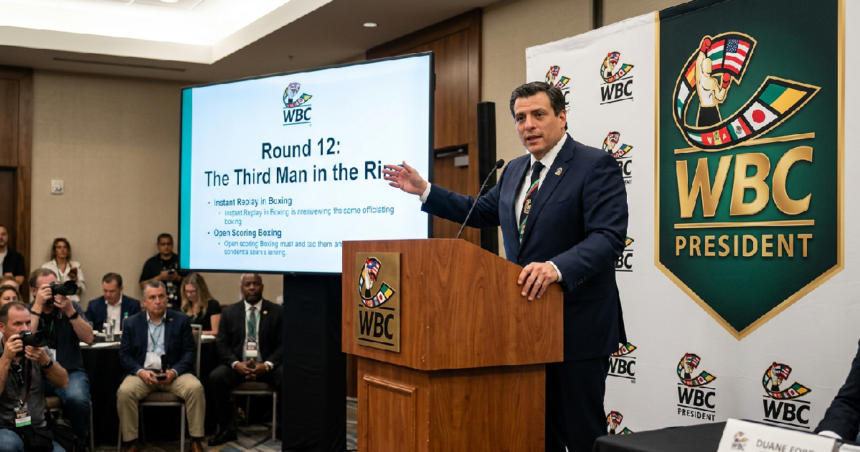
World Boxing Council (WBC) President Mauricio Sulaimán has detailed a vision for the future of boxing officiating in an address titled “Round 12: The Third Man in the Ring,” published on June 12, 2026.
The commentary highlights the critical role of the referee as the protector of a fighter’s physical integrity and addresses the ongoing friction between sanctioning bodies and local commissions regarding technological reforms.
Mauricio Sulaimán argued that while referees are often viewed as the “villains” of the sport by passionate fans, their primary directive is to stop a contest “one punch too early, rather than one punch too late.”
The timing of these remarks follows a period of heightened scrutiny for officials across various global sports. Mauricio Sulaimán noted that just as baseball has introduced reviews for ball-and-strike calls, boxing must confront its inherent resistance to change.
He emphasized that the safety of the athlete is paramount, even when it clashes with the “human factor” that many traditionalists believe should remain untouched. This debate mirrors broader shifts in athletic regulation, such as when Olympic officials bar transgender athletes to maintain specific competitive standards.
A recent point of contention cited by Mauricio Sulaimán involved British referee Mark Lyson, who reportedly stopped a bout between Oleksandr Usyk and a fighter named Rico just one second before the end of the 11th round.
While some observers questioned the timing of the stoppage so close to the bell, the WBC President defended the official’s autonomy. He stated that a referee is not a timekeeper but a savior whose focus must remain entirely on the contenders’ health, noting that a single punch can alter a life regardless of the clock.
The push for open scoring and instant replay in boxing
The WBC has been at the forefront of several historical shifts in the sport, including the reduction of championship bouts from 15 to 12 rounds and moving weigh-ins to the day before a fight.
Currently, the organization is advocating for three specific rules that remain unaccepted in several major jurisdictions, notably the United States and the United Kingdom. These include the implementation of instant replay to correct missed calls, a 30-second warning signal to intensify action, and the use of open scoring.
Open scoring involves revealing the judges’ official scores to the corners after the 4th and 8th rounds. Mauricio Sulaimán argues this transparency allows teams to adjust their strategy rather than fighting in the dark.
However, the decentralized nature of the sport remains a hurdle, as local commissions often maintain their own autonomous rules despite the existence of “Unified Rules of Boxing.” This fragmentation means that while com/nba-expansion-seattle-vegas-approved-2026-update/”>NBA greenlights expansion to Seattle and Las Vegas under a central framework, boxing officiating remains subject to the specific locale of the bout.
To address these discrepancies, Mauricio Sulaimán highlighted a recent training session at WBC University led by Duane Ford. The masterclass focused on referee mechanics, guidelines, and procedures. By ratifying these mechanics among dozens of officials, the WBC aims to standardize the way high-stakes matches are handled globally.
Better training is viewed as a way to reduce the controversy that often follows decisive officiating calls in championship matches.
Historical evolution of the 10-point must system
Mauricio Sulaimán also provided a historical context for how the role of the “third man” has changed since the sport’s origins in ancient Egypt and the early betting matches of England. Originally, referees were only present to ensure the audience did not interfere in the combat.
Eventually, they became the sole official, raising the hand of the winner at their own discretion. Today, the WBC mandates that referees should not act as judges, allowing them to focus entirely on fighter safety while three ringside judges use the 10-point must system.
The evolution of scoring has moved from 1-0 round tallies and 20-point amateur scales to the current system where the winner of a round receives 10 points and the loser typically gets 9, 8, or 7.
Mauricio Sulaimán noted that a score of 6 is the minimum, and draws are extremely rare in modern professional boxing. This structure is intended to ensure a definitive result, much as a Manchester United 100m transfer agreement would require rigid contractual clarity to be successful.
An anecdote shared regarding the late José Sulaimán and legendary referee Arthur Mercante further illustrated the need for clear communication. During a difficult fight for Ricardo “Finito” López against Rosendo Álvarez, a language barrier prevented Arthur Mercante from understanding a doctor’s instruction to stop the fight.
This failure sparked the creation of the green and red card system by Don Miguel Acuña, which allows medical professionals to communicate non-verbally with referees during the heat of a match.
Addressing jurisdictional challenges in world championship bouts
The WBC President admitted that the “greatest resistance to change” often comes from the administrative layer of the sport. Because each state in the U.S. is autonomous, some commissions choose not to respect the unified rules, leading to inconsistencies in how title fights are managed.
Mauricio Sulaimán maintains that the WBC will continue to enforce its protocols where it has jurisdiction, focusing on technological aids like instant replay to eliminate human error.
As officiating continues to be a lightning rod for criticism across football, baseball, and soccer, the WBC’s stance is that boxing cannot afford to lag behind.
By advocating for universal standards and the integration of technology, Mauricio Sulaimán hopes to move the sport toward a fairer future where the outcome is decided strictly by the athletes’ performance and the officials’ ability to execute standardized rules.
The ultimate goal remains the protection of the fighters who risk their lives every time they step into the ring.