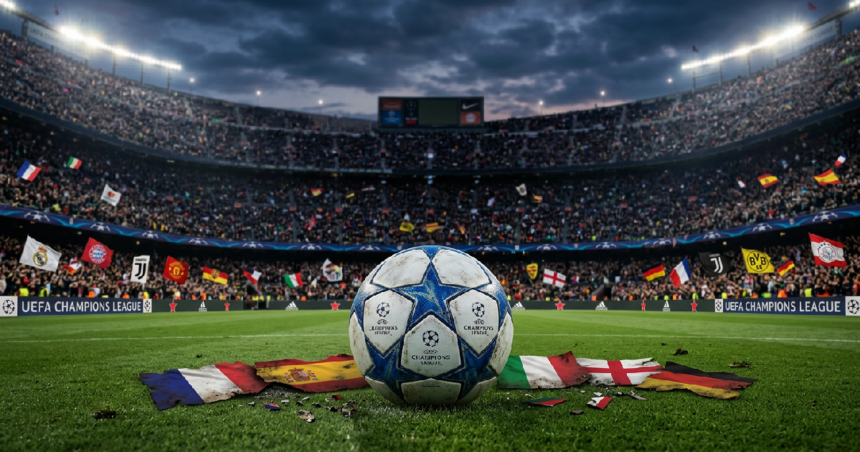
The lights of the Champions League have never been brighter, but for many who have spent decades following the European game, the glare is starting to feel artificial. What was once the pinnacle of meritocratic competition has morphed into a closed-circuit television show for the continent’s wealthiest institutions. The tournament that defines the sport’s quality has, ironically, begun to drain the very soul from the clubs and leagues that sustain it.
The widening gap in European competition
It is no longer a secret that the Champions League has become a financial fortress. The revenue distribution models favored by UEFA over the last decade have created a feedback loop where the same dozen clubs qualify every year, collect their television checks, and use that capital to ensure they never face a real threat of domestic displacement. This isn’t just a problem for the clubs sitting outside the elite; it’s a problem for the product itself.
We see the same group stages, the same quarter-finalists, and the same tactical patterns. By the time we reach the knockout rounds in April, the sense of jeopardy has often been sanitized. The underdog stories that used to define the European Cup—the triumphs of Steaua București, Red Star Belgrade, or even the Porto of 2004—feel like artifacts from a prehistoric era. In today’s climate, a team from outside the “Big Five” leagues winning the trophy is practically a mathematical impossibility.
How the new format dilutes the stakes
The recent shift toward the “Swiss Model” for the league phase was marketed as a way to provide more “big games” earlier in the calendar. In reality, it has added a layer of bloat to an already congested schedule. By increasing the number of matches, UEFA has ensured that a single loss no longer carries the weight it once did. The peril of a traditional four-team group created tension from the opening whistle. Now, the goal is often volume over variety.
This expansion also puts an immense physical strain on the players. We are seeing more soft-tissue injuries and burnout among the world’s best talent because the calendar has no breathing room. When the stars are too exhausted to perform at their peak, the “soul” of the game—the technical brilliance and high intensity—is the first thing to suffer. As clubs shift strategy as the summer transfer window looms, many are looking for squad depth over starting quality just to survive the European schedule.
A roadmap for structural restoration
Restoring the soul of the Champions League requires more than just a change in the knockout bracket; it requires a fundamental rethink of how wealth is shared. If the goal is to save the pyramid, the first step must be a drastic increase in “solidarity payments” to teams that do not qualify for the competition. This would help prevent domestic leagues from becoming one-team or two-team processions.
Furthermore, we need to reconsider the entry requirements. While the “Champions” League hasn’t been exclusively for champions since the late 1990s, allowing fifth-place teams from top leagues to qualify while champions of smaller nations navigate four rounds of qualifying is a slight against the tournament’s heritage. A cap on the number of teams from a single nation would immediately diversify the competition and force “superclubs” to actually earn their place rather than relying on a coefficient safety net.
The role of the fans in a changing era
The disconnect between the boardroom and the terraces has never been wider. While executives chase “emerging markets” and digital engagement, the local fans who travel to midweek away games are being priced out and ignored. To fix the Champions League, fans must be treated as stakeholders rather than customers. This means mandatory ticket price caps for away supporters and a commitment to maintaining traditional kick-off times that don’t solely cater to global television audiences.
Without these changes, the Champions League risks becoming a repetitive exhibition series. It may still be profitable, and it may still attract the highest television ratings, but it will continue to lose the emotional resonance that made it the greatest club competition on earth. The soul of football isn’t found in the balance sheet; it’s found in the belief that on any given night, any team has a chance to make history.
Frequently Asked Questions
Will the Champions League ever return to a straight knockout format?
It is highly unlikely in the current commercial climate. Television broadcasters pay for a guaranteed number of matches, and a straight knockout format carries too much risk for the biggest clubs to exit early, which would devalue the rights packages.
Does the new league format help smaller clubs?
While it gives more teams the opportunity to play more games, the financial gap remains so large that smaller clubs struggle to compete over a longer league phase compared to a short group stage. The format favors squad depth, which only the wealthiest teams possess.
What is the biggest threat to the Champions League’s future?
The most immediate threat remains the specter of a breakaway Super League. While initial attempts failed, the ongoing tension between UEFA and the continent’s biggest clubs regarding revenue control suggests that the current structure of European football is still very much in flux.