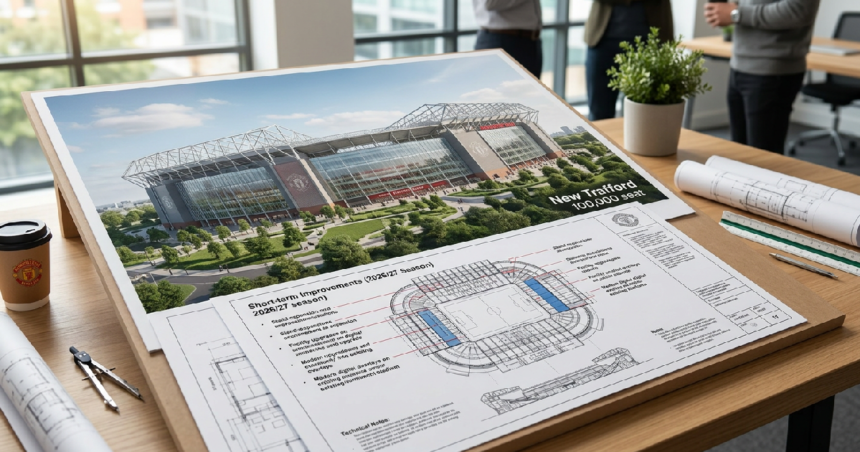
Manchester United has taken a major step toward its long-term infrastructure goals after securing the majority of a 25-acre site in Trafford Park to facilitate a proposed 100,000-seat stadium. The club aims to move into the new world-class venue, provisionally referred to as “New Trafford,” by the 2030-31 season. With an estimated project cost of £2 billion, the development is set to become the largest club stadium in the United Kingdom.
While the “Old Trafford Regeneration” project represents the future, the club is also implementing short-term upgrades at its current home for the 2026/27 campaign. These changes aim to mitigate long-standing issues at the historic ground, which has served as the club’s home since 1910. The move reflects a dual-track strategy of maintaining current standards while preparing for a transformative relocation.
Securing land for the 100,000-seat New Trafford stadium
The vision for a new stadium gained significant momentum in June 2026 when Manchester United acquired vital land from Indurent, a Blackstone portfolio company. The 25-acre plot is situated roughly 350 meters north-west of the existing Old Trafford. This acquisition is the cornerstone of a plan to build a facility that would be the second-largest football stadium in Europe, trailing only Barcelona’s Camp Nou.
Current proposals suggest a seating capacity of approximately 100,000, though gross capacity could reach as high as 104,000. To ensure financial sustainability, the club has allocated 15.5% of the total seating for hospitality services. This project is not a mere expansion but a complete rebuild designed to modernize Manchester United’s matchday infrastructure for the next century.
The £2 billion price tag reflects the massive scale of the undertaking. Much like how the NBA greenlights expansion to Seattle and Las Vegas to tap into new markets, United is betting on a high-capacity venue to meet global ticket demand. The new site offers the spatial freedom that the current stadium lacks, allowing for advanced architectural designs that are impossible on the restricted current footprint.
Short-term upgrades for the 2026/27 season at Old Trafford
Recognizing that a move is years away, the club is prioritizing immediate comfort for fans still visiting “The Theatre of Dreams.” Old Trafford’s current capacity stands at 74,244 following minor architectural adjustments completed in October 2025. However, the ground has not seen substantial redevelopment since 2006, leading to well-documented problems including rodent sightings and a leaking roof.
For the 2026/27 season, Manchester United is introducing several technological and facility enhancements. These include “frictionless kiosks” and additional self-service bars intended to speed up service throughout the concourses. A new digital communication system will also be activated to improve information flow to supporters during matchdays.
These upgrades represent the club’s effort to manage its current assets while preparing for the 2030-31 transition. This period of change is a critical juncture for the institution. Just as Manchester United secure £100m deal to reshape defense on the pitch, the leadership is attempting to fortify the club’s physical foundations to remain competitive with Europe’s elite.
The historical context and need for regeneration
The current Old Trafford has been the club’s iconic home for over 115 years, but the limitations of the aging structure have become increasingly apparent. Previous attempts to expand the South Stand were famously complicated by the proximity of the adjacent railway line. By shifting 350 meters north-west, the “New Trafford” project bypasses these geographic constraints.
The “Old Trafford Regeneration” branding suggests that the project will have implications reaching beyond the stadium walls. By developing the 25-acre Trafford Park site, the club can create a centralized hub that potentially integrates academy or women’s team facilities while revitalizing the surrounding commercial district.
Progress on the planning phase is now moving toward the 2030-31 target. While supporters will have to wait several years for the final product, the land acquisition in June 2026 confirms that the project has moved from a conceptual vision to a concrete development plan. The focus remains on delivering a venue that matches the club’s global stature while preserving its local heritage.
Related coverage: Cole Palmer’s contract and market value in 2026 · Premier League 2026/27 opening weekend predictions