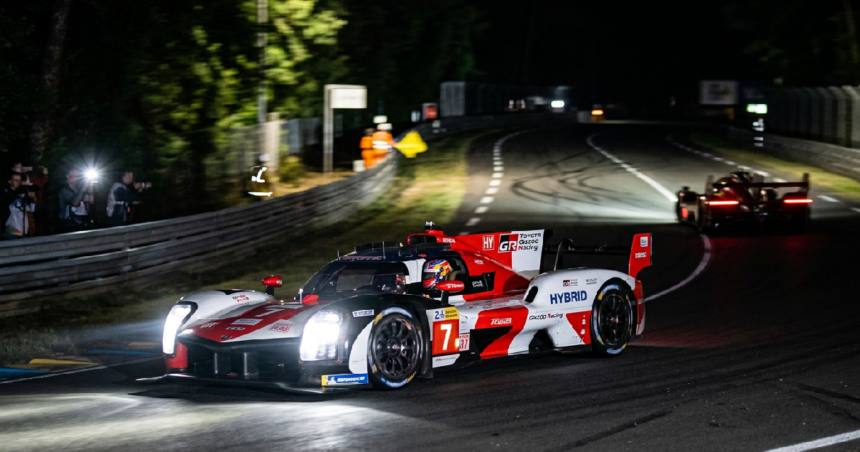
Kamui Kobayashi set the fastest lap for Toyota Gazoo Racing during the second free practice session (FP2) of the 2026 24 Hours of Le Mans on Wednesday night. Driving the #7 Toyota GR010 Hybrid, Kobayashi recorded a 3m26.096s flyer in the closing moments at the Circuit de la Sarthe.
The performance came after his teammate, Nyck de Vries, lost control earlier in the session at the Dunlop chicane, spinning over the kerbs and leaving debris on the track.
The #7 Toyota spent the majority of the two-hour night session in the garage following the incident but returned to the track for the final stages. Kobayashi eventually surpassed the previous benchmark of 3m26.316s set by Robert Kubica in the #83 AF Corse Ferrari 499P.
By the time the chequered flag fell, the Toyota had secured the top spot by a margin of 0.220 seconds over the #83 Ferrari crew.
The night session, which ran from 10:00 PM to midnight, was frequently interrupted by incidents that necessitated full-course yellows and slow zones. This struggle for clean running mirrors the disrupted practice sessions seen in Formula 1, where limited green-flag time forces teams to adapt their programs quickly.
At Le Mans, these night-time laps are critical for drivers to calibrate themselves to the darkness ahead of Saturday’s race.
Incidents and technical troubles at Le Mans
Chaos defined the opening 30 minutes of the session as multiple cars hit trouble across various classes. The #44 Proton Oreca became beached at Arnage, triggering a Full Course Yellow (FCY). Soon after, the #22 United Autosports LMP2 car came to a halt near Indianapolis, resulting in double yellow flags.
These stoppages prevented most teams from finding a consistent long-run rhythm during the first half of the evening.
Mechanical reliability also proved a concern for several high-profile entries. The #101 WTR Cadillac, which finished third fastest with a 3m26.387s, suffered an engine shutdown as Filipe Albuquerque rolled into the pitlane.
The #12 Jota Cadillac also struggled as Louis Deletraz slowed towards the end of the session with technical problems, following an earlier tire puncture for the car. Even the session leaders were not immune, as the #8 Toyota suffered a rear-left puncture.
Under the floodlights, the ability to maintain car integrity is as vital as raw speed. This operational precision is a common theme in high-stakes environments, such as when technical drills lead to team leadership in other sporting disciplines. For the Hypercar field, surviving the night practice without major structural damage is the primary objective before Thursday’s Hyperpole sessions.
Ferrari and Cadillac track top Hypercar times
Reigning champion Robert Kubica held the lead for much of the session’s second hour. His 3m26.316s lap placed the satellite #83 AF Corse entry ahead of the factory Ferrari AF Corse cars, with the #50 and #51 Ferraris finishing 11th and 16th respectively.
The #101 WTR Cadillac maintained its place in the top three despite its late-session engine scare, finishing just 0.291 seconds off Kobayashi’s leading pace.
The middle of the top ten featured a variety of manufacturers showing competitive pace. Victor Martins moved the #36 Alpine A424 into fourth place late in the session, while the #19 Genesis GMR-001 took sixth place after a lap from Paul-Loup Chatin.
Harry Tincknell was among the drivers for the #007 Aston Martin Valkyrie that ended the session in eighth, trailing the seventh-placed #8 Toyota of Sebastien Buemi.
BMW M Team WRT rounded out the top ten with their pair of M Hybrid V8s. Sheldon van der Linde led the #20 car to ninth, while Dries Vanthoor recovered from a spin at the Esses to place the #15 car tenth. The density of the field is evidence of the com/latest-sport-news-updates-miami-open-world-cup-aintree-2026/”>intense global competition across sport, as less than one second separated the top nine entries in the Hypercar class.
Panis Racing and BMW lead support classes
In the LMP2 category, the #29 Forestier by Panis Oreca 07 established a significant gap at the front. Louis Rousset clocked a 3m33.645s, finishing more than a second faster than the #4 CrowdStrike by APR Oreca.
The class saw its own share of drama when Richard Verschoor got the #30 Duqueine Team Oreca LMP2 stuck in the gravel trap at the Dunlop chicane, causing a slow zone.
The LMGT3 class was topped by the #32 WRT BMW M4 GT3. Darren Leung set the benchmark time of 3m55.132s during the first hour of running, which remained unbeaten for the rest of the night. Rui Andrade brought the #61 Iron Lynx Mercedes-AMG GT3 into second place, while Richard Lietz guided the #92 Manthey Porsche 911 GT3 to third in class.
With FP2 concluded, the attention of the paddock shifts to Thursday’s track action at the Circuit de la Sarthe. This includes a final three-hour practice session (FP3) in the afternoon followed by the Hyperpole session at 8:00 PM CEST. These sessions will determine the final starting grid for the 24-hour race, which is scheduled to begin at 4:00 PM CEST on Saturday, June 13.