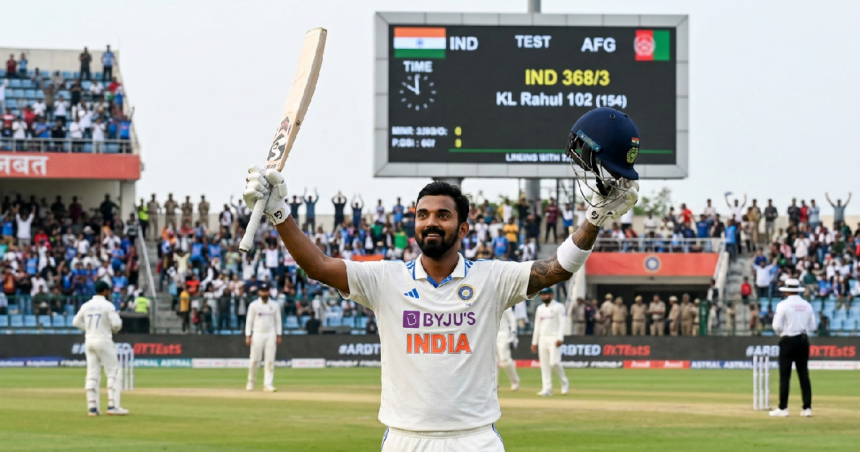
India opening batsman and vice-captain KL Rahul revealed he made a deliberate tactical choice to maintain his aggressive intent after scoring a century against Afghanistan on Day 1 of the one-off Test match.
Playing at the Maharaja Yadavindra Singh International Cricket Stadium in Mullanpur on Saturday, June 6, 2026, KL Rahul anchored India to a dominant 368/3 at stumps. The century marks a successful transition for the batsman, who recently finished a prolific Indian Premier League (IPL) campaign where he scored 593 runs.
The centurion noted that he consciously tried not to restrict his shots despite the longer format’s traditional demands for caution. KL Rahul reached his 12th Test hundred off 165 deliveries, an innings punctuated by 11 boundaries. His performance was part of a relentless Indian batting display that saw captain Shubman Gill also reach three figures, ending the day unbeaten on 103.
“Sometimes you sit and overanalyse and try to play completely differently to T20 cricket,” KL Rahul said following the day’s play. He explained that his focus during the week leading up to the match was to avoid the mental trap of over-correcting his natural scoring instincts.
The approach paid dividends as he shared a 139-run second-wicket partnership with Sai Sudharsan, who missed out on a century after falling for 81.
KL Rahul century anchors India against Afghanistan in Mullanpur Test
India’s decision to bat first after winning the toss proved wise as the surface at the new Mullanpur venue offered consistent bounce. While Yashasvi Jaiswal fell early for 24, KL Rahul remained composed even after surviving a reprieve on 16 runs.
Afghanistan’s fielders failed to review a caught-behind appeal, which television replays later suggested had taken a thin edge. This let-off allowed the vice-captain to settle into a rhythm that balanced his T20 fluency with the discipline required for the red-ball game.
The heat in New Chandigarh presented a physical challenge for the players, with temperatures often reaching exhausting levels. KL Rahul admitted to feeling the strain but credited his training for helping him manage the switch in formats.
He highlighted the importance of playing to the merit of the ball rather than forcing a defensive shell, a strategy that helped him navigate the spells from Mohammad Saleem Safi and Ziaur Rahman.
The tactical shift in Indian cricket often mirrors the high-stakes pressure seen in other major sports, much like how Islam Makhachev targets two-division glory when pushing his physical limits. For KL Rahul, the goal was proving that a modern batsman can dominate across all three formats without sacrificing his identity.
He finished his stint at the crease with a strike rate that kept the scoreboard moving, ensuring Afghanistan’s bowlers could never settle into defensive lines.
Shubman Gill and Rishabh Pant extend Indian dominance
Following KL Rahul’s dismissal by Ziaur Rahman shortly after reaching his milestone, Shubman Gill took over the mantle of the aggressor. Gill’s century was particularly significant as it was his first as the full-time Test captain.
He displayed a wide array of strokes, including 11 fours and a six, to finish the day on 103 not out. His partnership with Rishabh Pant, which stood at an unbroken 121 by the close of play, effectively shut Afghanistan out of the contest.
Rishabh Pant provided the final flourish of the day, reaching a half-century off just 70 balls. His 50* included three sixes, punishing an Afghanistan attack that began to tire as the 85-over mark approached.
The visitors, playing only their 13th Test match, found it difficult to contain the run rate after the initial breakthrough by Mohammad Saleem Safi, who finished the day with figures of 2-50.
This match is serving as a vital preparation tool for India’s upcoming schedule. Just as Fils Miami Semi and Cromwell Aintree Target capture the attention of fans elsewhere, the Indian team is focused on refining their technical skills before series against Sri Lanka and New Zealand.
The presence of debutant Manav Suthar in the squad suggests a forward-thinking selection policy aimed at broadening the talent pool.
Technical adjustments and the T20 to Test transition
The primary narrative surrounding India’s performance was the ease with which their stars moved from the high-octane IPL to the rigours of Test cricket. KL Rahul was particularly pleased with this aspect of his game, noting that he didn’t feel frustrated by playing more shots than he “ideally” would have in the morning session.
He emphasized that being aware of which shots were safe for the Mullanpur wicket was more important than total restraint.
The scoreboard at stumps on Day 1 reflected India’s clear superiority:
- India First Innings: 368/3 in 85 overs
- KL Rahul: 100 (165 balls)
- Shubman Gill: 103* (143 balls)
- Sai Sudharsan: 81 (104 balls)
- Rishabh Pant: 50* (70 balls)
As the match moves into the second day, India will look to Gill and Pant to further inflate the total before unleashing their bowling attack. For Afghanistan, the challenge remains one of endurance and discipline.
While they had moments of success, particularly the dismissal of the set KL Rahul, they will need sharp early wickets on Sunday to prevent India from batting them out of the game entirely.