By Edward Morton
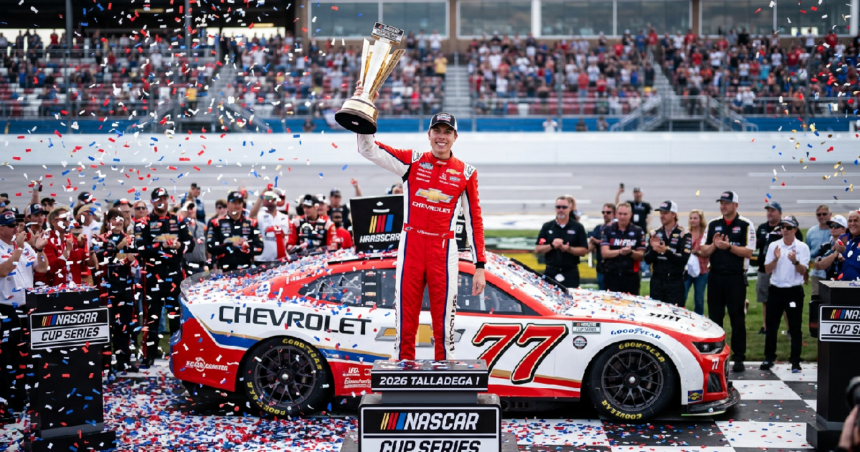
Carson Hocevar achieved a career milestone by securing his first victory in the NASCAR Cup Series at Talladega Superspeedway. The driver of the No. 77 Chevrolet emerged from a typical afternoon of pack racing that featured significant attrition and a high-stakes drafting battle that was not decided until the final sprint to the checkered flag. Hocevar led a group that included Chris Buescher and Alex Bowman across the stripe as several other hopefuls saw their chances vanish in a massive late-race accident.
The event followed the familiar pattern of superspeedway competition, where maintaining track position often takes a backseat to surviving the inevitable “Big One.” Reports from the track indicated that a substantial portion of the field was caught in a multi-car melee during the middle portion of the race, which effectively eliminated several prominent contenders and former series champions. This high rate of attrition left a thinner pack to battle for the win, rewarding those who were able to navigate the debris and chaos.
High Attrition Dominates the Talladega Narrative
Talladega has long been known for its volatility, and the 2026 spring race proved no exception as a large-scale collision reportedly damaged or retired nearly two-thirds of the starting field. Among those reportedly caught in the wreckage were several heavy hitters from the Hendrick Motorsports and Team Penske stables. The cleanup required an extended period, shifting the race’s dynamic from a tactical chess match to a test of endurance for the remaining drivers.
Before the chaos reshaped the leaderboard, Ryan Preece reportedly showed strong pace by winning the first segment of the race. However, his day ended in disappointment following a separate incident. Ross Chastain also demonstrated strength throughout the afternoon, consistently running near the front and managed to avoid the worst of the wreckage to secure a top-five position. Much like the weather disruptions seen recently in Formula 1, the ever-changing conditions of the draft and the high-speed risks at Talladega forced crew chiefs to modify their fuel and tire strategies in real-time.
Hocevar Holds Firm in Final Lap Shuffle
The closing stages saw Hocevar using defensive lane-blocking techniques to keep a charging pack at bay. With the draft providing a significant speed advantage to those trailing, the leader was forced to watch his mirrors constantly while managing the air around his car. Despite intense pressure from Chris Buescher’s Ford and the Chevrolet of Alex Bowman, Hocevar maintained his composure to stay ahead as the pack crossed the finish line behind a final-lap accident that scrambled the order of the top ten.
Buescher’s runner-up finish marks another strong performance for the RFK Racing driver in drafting scenarios, while Bowman’s podium finish provides a much-needed points boost for his squad. Other drivers finding safety in the top ten included Chase Elliott and Zane Smith, both of whom capitalized on the late-race carnage to climb the standings. The intensity of these closing moments mirrored other high-pressure environments in professional sports, such as when Price overcame Littler in a high-stakes showdown earlier this spring. In both scenarios, the winner was decided by a calm approach during a moment where the margin for error was non-existent.
Shift in Momentum for the Cup Series Field
While Hocevar celebrates his breakthrough, many of the sport’s established stars are left to assess the damage to their primary cars. Christopher Bell was a notable presence at the front for a large portion of the day, showing the strength of the Toyota racing contingent. However, he was reportedly among those shuffled back or caught in the late-race contact, finishing well outside the top ten. Denny Hamlin likewise showed flashes of dominance by leading several segments before getting caught in the turbulence of the pack.
The mix of veteran savvy and youthful aggression at the front of the field suggests a deepening talent pool within the premier division. This trend of younger competitors stepping into high-pressure roles is becoming more common across the sporting world, much like how younger athletes are now leading technical drills in other professional disciplines. For Hocevar, the win likely secures his place in the postseason conversation, fundamentally altering the trajectory of his campaign.
Managing the Fallout and Looking Ahead
The aftermath of the large-scale accident will likely dominate conversations in the garage as teams prepare for the next round of the schedule. With many organizations losing multiple cars to terminal damage, the logistical strain on the shops will be considerable. The performance of the Ford and Chevrolet camps at Talladega suggests they have currently found a slight edge in the drafting packages, leaving Toyota teams searching for answers regarding their late-race durability and cooling.
As the series moves away from the unpredictable nature of superspeedways, the focus will return to traditional intermediate tracks where aerodynamic efficiency and raw horsepower are more decisive. For Hocevar and the No. 77 team, the challenge will be to translate this momentum into consistent performance at venues where survival is not the primary objective. For the rest of the field, the race served as a stark reminder that at Talladega, no lead is safe until the checkered flag is in the air.