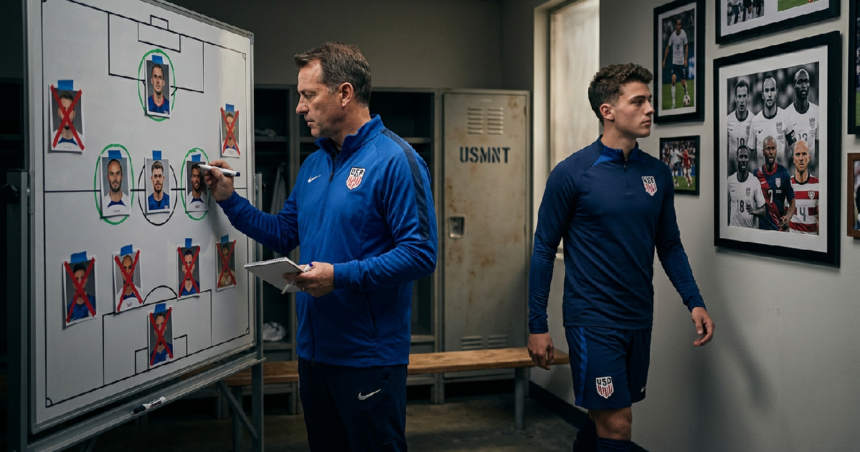
Several high-profile members of the United States Men’s National Team (USMNT) face a growing threat to their inclusion in the upcoming World Cup roster as shifting form and emerging domestic talent reshape the national pool. Long considered automatic selections for the tournament, veteran stars who featured heavily in previous cycles are now reportedly seeing their status questioned by the coaching staff. This internal evaluation marks a significant departure from the stability seen during the last qualifying campaign, as the technical team prioritizes current performance over historical contributions.
The transition toward the home tournament has introduced a competitive environment within the squad. While a core group remains untouchable, the periphery of the roster is in a state of flux. Players who were once staples of the starting eleven now find themselves fighting for minutes or, in some cases, struggling to earn a call-up to recent training camps. This trend reflects a broader shift in the American soccer landscape, where the gap between seasoned European-based professionals and rising stars is narrowing.
Recent reports suggest that the technical staff is particularly concerned with lack of playing time at the club level. Several senior figures in the squad have seen their roles diminished at their respective European clubs, leading to a visible rustiness during international windows. This lack of match sharpness has opened the door for younger, more active players to make their case. The pressure is mounting as the latest sport news updates concerning the World Cup indicate a sharpening focus on tactical flexibility and physical durability.
Pressure Mounts on European Based Veterans
The struggle for playing time in top-tier European leagues has traditionally been a badge of honor for USMNT players, but it is now becoming a liability for some. Managing a roster for a major tournament requires players who are not only talented but also match-fit. When senior players spend months on the bench in the Premier League or Bundesliga, their ability to perform under the intense physical demands of a summer tournament can be compromised.
Coaches have reportedly expressed that no spot is guaranteed, a sentiment that has sent ripples through the veteran contingent. And while experience is valued, it cannot compensate for a lack of competitive rhythm. This development has put even some of the most recognizable faces in American soccer on notice. The squad depth is currently seen as being at a high point, meaning the penalty for club-level stagnation is often more severe than it has been in previous years.
The Rise of Domestic Competition
The growth of professional standards within the domestic structure has provided the national team with viable alternatives to struggling overseas pros. Several young prospects have utilized recent tournament opportunities to prove they can handle the international stage. These players offer a level of hunger and fitness that is sometimes lacking in veterans who are nearing the end of their peak years.
This domestic surge is forcing a re-evaluation of the “lock” status for many players. In previous cycles, an American playing in a top-five European league was almost certain to make the plane. Today, the coaching staff is looking at data-driven metrics and specific tactical fits. As Salah faces his own career defining choices elsewhere in the global game, the American stars are learning that professional stability is the only way to ensure a spot on the world stage.
Tactical Shifts and Systemic Requirements
Systemic changes within the USMNT setup have also contributed to the precarious position of certain “locks.” The current tactical approach demands high-intensity pressing and quick transitions, favoring players with elite recovery speed and lateral mobility. Some veterans, despite their technical proficiency, are finding it difficult to meet these physical benchmarks as they age.
Furthermore, the emergence of versatile multi-positional players is making specialized veterans redundant. If a younger player can cover both fullback and midfield roles, they become a more attractive inclusion for a tournament squad with limited spaces. This emphasis on utility is a direct threat to those who have built their international careers on a singular, fixed position.
Impact of Injury and Longevity Concerns
Durability has become a central theme in roster discussions. A few players who were previously considered essential have struggled with recurring muscle injuries, leading to questions about whether they can survive the grueling schedule of a month-long tournament. The risk of using a roster spot on a player who might be unavailable for half the group stage is a gamble the coaching staff seems less willing to take.
This cautious approach is understandable given the stakes of a tournament on home soil. The staff is reportedly prioritizing players with consistent medical histories in recent seasons. For a veteran coming off a major surgery, the road back to the national team is steeper than ever before. Even as major clubs reshape their rosters with massive investments, the USMNT is focused on the reliability of its human capital.
Establishing the Final Roster Hierarchy
As the countdown to the tournament continues, the windows for players to prove their worth are closing. The upcoming continental friendlies and competitive matches will serve as the proving ground. For those on the bubble, these matches are not just team exercises but individual auditions. The transition from a “lock” to a “bubble player” is often a slow decline, but the final omission from a squad is always a sudden shock.
Expect the coaching staff to continue rotating the squad in the short term to get a final look at fringe candidates. The message to the veterans is clear: past service is respected, but current form is the only currency that matters. The coming months will determine which of the former certainties will actually walk out onto the pitch when the tournament begins.