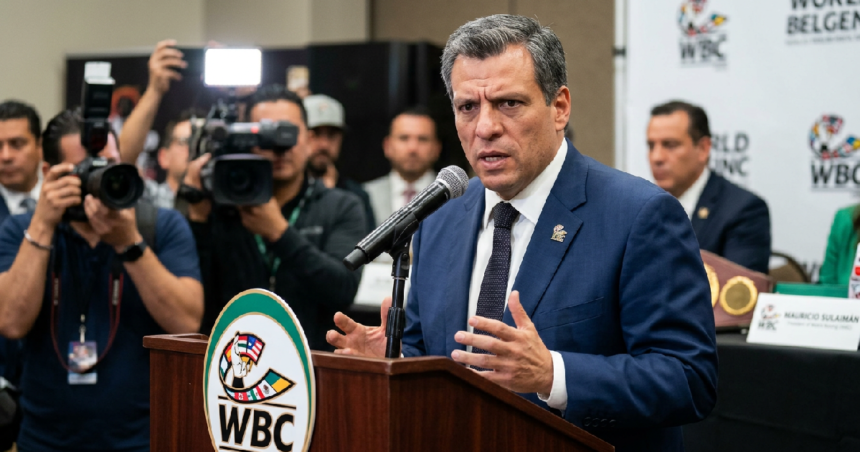
WBC President Mauricio Sulaimán has reportedly voiced sharp criticism of Terence Crawford following the fighter’s decision to exit the sport. In recent comments that have circulated through boxing media circles, Sulaimán reportedly characterized the move as an act of avoidance, particularly in light of unresolved financial and administrative disputes between the champion and the governing body. The friction stems from Crawford’s recent high-profile victory over Saul ‘Canelo’ Alvarez, a bout that left the fighter with an undefeated professional record but sparked a public fallout regarding sanctioning fees.
The tension has been building since Crawford’s win at Allegiant Stadium. Following that performance, the fighter reportedly expressed dissatisfaction with the traditional sanctioning body system, suggesting that championship belts functioned more as expensive accessories than symbols of merit. While Crawford reportedly settled financial obligations with several other major organizations, various reports indicate he declined to pay the WBC, despite the organization’s claims that it offered to reduce its standard fee structure to accommodate the massive scale of the event.
Sulaimán’s strong language appears to be a direct reaction to Crawford’s public dismissal of the WBC’s prestige and his decision to walk away while holding significant leverage. By retiring at the pinnacle of his career, Crawford effectively removed the possibility of the WBC collecting fees for one of the largest fights in history. Just as Makhachev targets two-division glory in the UFC, boxing’s elite are increasingly evaluating whether the financial cost of maintaining multiple world titles aligns with their personal career goals.
Financial Disputes and the Value of Championship Belts
The root of the animosity lies in the shifting perception of what constitutes a “real” champion in the modern era. Crawford has argued in public forums that independent rankings and fan recognition carry more weight than the “alphabet” titles that dominate the sport. He has reportedly favored publications like The Ring, which do not charge the heavy percentages associated with the major sanctioning bodies. This stance represents a direct challenge to the business model that Sulaimán has overseen for years.
The WBC maintains that it attempted to find a middle ground by offering a significant reduction in the fees typically owed for a bout of this magnitude. However, Crawford reportedly viewed these payments as an unnecessary tax on his achievements. For a man who has dominated across multiple weight divisions, the refusal to pay was a statement of independence. Sulaimán’s criticism seems to target this administrative defiance rather than Crawford’s physical courage, though the choice of words has been widely condemned by the fighter’s supporters.
The timing of this rift is particularly notable as the sport moves toward a model dominated by individual brands and cross-promotional mega-fights. Top-tier athletes are increasingly questioning the necessity of paying for four separate belts to prove they are the best in their weight class. This situation mirrors other sports where stars reach a crossroads; for instance, Salah faces a career-defining choice regarding his next move, but Crawford has already chosen a path that prioritizes his autonomy over traditional boxing politics.
The Changing Super Middleweight Landscape
With Crawford’s departure from the active roster, the WBC is now left to navigate the future of the super middleweight division without its biggest star. Reports suggest the organization is looking toward potential contenders like David Benavidez and Dmitry Bivol to fill the void. Yet, the fallout from the Crawford-Alvarez fight continues to loom over the division, as it was one of the most commercially successful boxing events in recent years.
The administrative challenge is heightened by the finality of Crawford’s exit. While many champions stay for a farewell tour or a lucrative rematch, Crawford’s public break with the sanctioning bodies suggests a reconciliation is unlikely. Much like the latest sports news updates from tennis and football show a shift toward athlete-led decision-making, Crawford’s retirement serves as a blueprint for others to prioritize their financial interests.
Critics of the WBC’s stance point out that questioning the bravery of a multi-division world champion is a difficult narrative to maintain. Crawford’s technical brilliance in the ring has been lauded by fans and analysts alike, and his victory over Canelo was widely seen as a career-defining performance. To the boxing public, the dispute over sanctioning fees remains a secondary concern compared to the legacy he built during his active years.
The Evolving Business of Championship Boxing
The ongoing feud highlights a growing trend where elite athletes realize they hold the majority of the leverage in negotiations. In an era where a fighter’s social media reach and personal brand can outweigh the prestige of a specific belt, the WBC may find its influence waning. The “cowardly” label may ultimately reflect the frustration of an organization losing its grip on the sport’s biggest names.
Looking forward, the WBC faces the difficult task of proving its belts are still the ultimate prize. If more champions follow Crawford’s example—winning the titles to establish their status and then discarding them to avoid the associated costs—the traditional power centers of boxing will be forced to evolve. For now, the public trade-off between Sulaimán and Crawford remains a stark reminder that the most significant battles in modern boxing often take place in the boardroom rather than the ring.