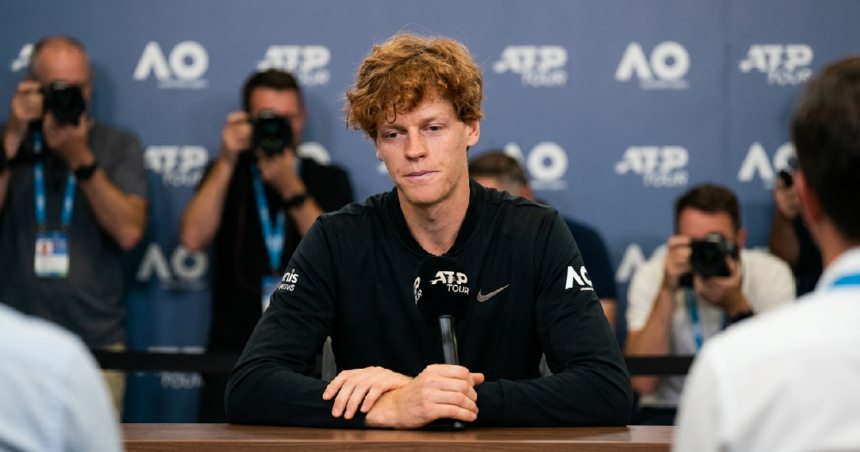
Jannik Sinner, the reigning Australian Open champion and world number two, has offered a rare glimpse into the formative years of his career, revealing a period of profound struggle that stands in stark contrast to his current dominance on the ATP Tour. In a candid Q&A session, the Italian star admitted that during his early transition into the sport, he “never won anything,” a realization that forced him to change his perspective on competition and growth.
The admission comes at a time when Sinner appears almost invincible. With a trophy cabinet that has grown rapidly over the last twelve months, many observers have assumed his trajectory was a simple straight line toward the top. But Sinner’s reflections suggest a much more arduous path, highlighting the psychological resilience required to move from a multi-sport background into the professional tennis grind.
From the Slopes to the Baseline
Unlike many of his peers who were groomed for tennis from the age of five, Sinner famously split his time between the court and the ski slopes. A champion skier in his youth, he eventually chose tennis because it offered more room for error. In a race, one mistake meant the end; in tennis, you can lose points and still win the match. However, that transition was far from smooth.
During the recent Q&A, Sinner noted that his early days on the circuit were defined by frequent losses. He described a lack of silverware that might have discouraged less determined athletes. This period of “winning nothing” wasn’t just about a lack of trophies, but about an inability to find his rhythm against players who had been specializing in tennis for years longer than he had. It’s a grounded perspective that explains much of the humility Sinner carries today.
This early adversity likely fueled the work ethic that has become his trademark. Rather than being discouraged by the lack of immediate success, Sinner and his team—then led by Riccardo Piatti—focused on a long-term developmental cycle rather than chasing junior ranking points. This “slow-burn” approach is now paying massive dividends as he routinely outlasts opponents in deep-court rallies.
The Mental Shift That Defined a Champion
Sinner’s willingness to discuss these failures serves as a reminder that the “Next Gen” stars aren’t merely products of talent, but of strategic patience. He explained how those early losses taught him to appreciate the process of improvement over the outcome of a single match. By the time he reached the semi-finals of the Miami Open recently, that mental callus was evident.
His recent form is a testament to that evolution. While he may not have won as a junior, he is making up for it now. His rivalry with Carlos Alcaraz and his recent breakthroughs against Novak Djokovic have shifted the hierarchy of men’s tennis. But even as the wins pile up, Sinner remains focused on the “struggle” that got him here. He frequently mentions that he is still learning, a sentiment that echoed throughout his latest interview.
The Italian’s rise isn’t just about his thunderous forehand or his improved serve; it’s about the fact that he was comfortable being a “loser” for a period of time to become a winner eventually. This stoicism has helped him remain calm in high-pressure situations, such as coming back from two sets down in a Grand Slam final.
What This Means for the Remainder of 2026
As the tour shifts toward the clay-court season and eventually the grass of Wimbledon, Sinner’s reflections provide a roadmap for his mindset. He isn’t playing with the pressure of a “prodigy” who must maintain a perfect record. Instead, he plays like someone who knows exactly how hard it is to earn a single victory.
For young players coming up through the ranks, Sinner’s story is a powerful antidote to the “instant success” culture of modern sports. If a world number one can spend his early years winning nothing, it validates the idea that development isn’t always reflected in the scoreline. With the French Open on the horizon, Sinner appears more prepared than ever to add more “somethings” to a trophy collection that was once entirely empty.
Frequently Asked Questions
Was Jannik Sinner a professional skier before tennis?
Not exactly a professional, but he was a champion-level junior skier in Italy. He won a national championship in giant slalom at age eight and remained a top-tier competitor until he decided to focus exclusively on tennis at age 13, because he felt tennis allowed for more mental strategy and recovery from mistakes.
Who were Sinner’s early coaches during his struggle?
Sinner’s move to Bordighera to train at Riccardo Piatti’s academy was the turning point. Piatti is credited with building the technical foundation of Sinner’s game. In more recent years, he has added Darren Cahill to his team, who has helped refine the tactical and psychological aspects of his play.
How many Grand Slams has Jannik Sinner won?
As of early 2026, Sinner is a Grand Slam champion, having secured his maiden title at the 2024 Australian Open. He has since established himself as a consistent threat in the later stages of all four majors and has risen to the top two of the ATP rankings.