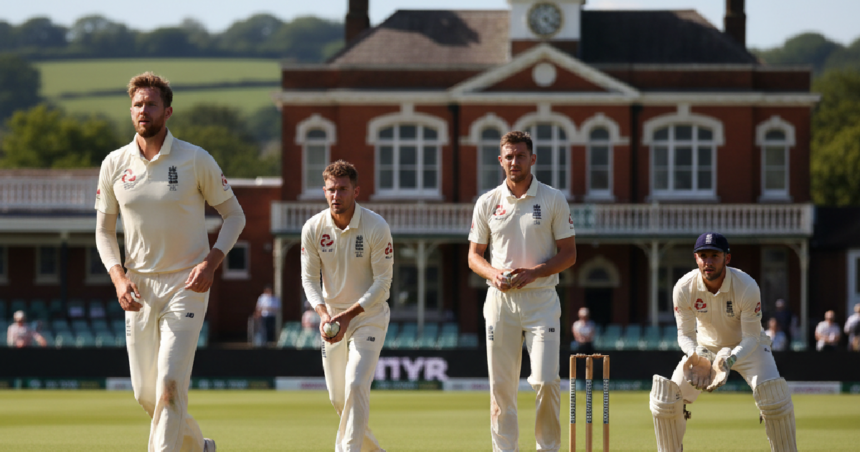
As the English domestic season moves into its critical opening phase, the national selectors are narrowing their focus on a specific group of high-performers. England’s Test reset is no longer just a concept; it is a revolving door of talent where traditionalists and “Bazball” enthusiasts are being weighed against the harsh requirements of the international stage.
Rob Key and Brendon McCullum have made it clear that character and specific skill sets often outweigh raw statistics. However, with several senior spots under scrutiny and the bowling department requiring a fresh injection of pace and variety, the names currently circulating in the halls of the ECB represent a blend of proven quality and untapped potential.
Robinson and Cook lead the bowling queue
The conversation around England’s seam attack invariably returns to Ollie Robinson. Despite fitness concerns that have plagued his recent tours, Robinson remains arguably the most skillful operator in the country. When his pace is up and his rhythm is settled, his ability to extract bounce and movement makes him an automatic selection. But the “when” has become the sticking point. The selectors are looking for consistency in his physical conditioning as much as his line and length.
Pushing hard for that same spot is Essex’s Sam Cook. Long regarded as the premier “heavy wicket” taker in the County Championship, Cook has spent the last year proving he can transition his skills to the Kookaburra ball and flatter decks. His accuracy is metronomic, and while he may lack the searing pace of a Mark Wood, his ability to set up a batter is reminiscent of James Anderson in his prime. If Robinson wavers, Cook is the most logical successor for the role of the controlled, relentless seamer.
Rehan Ahmed and Calvin Harrison offer spin variety
In the spin department, the focus remains on development. Rehan Ahmed has already tasted the highs of Test cricket, becoming the youngest man to take a five-wicket haul on debut for England. Since then, his trajectory has been about refinement. The leg-spinner still possesses the “X-factor” that McCullum craves, but there is an acknowledgement that his red-ball control needs to tighten to survive long spells against top-tier opposition.
Interestingly, Calvin Harrison has emerged as a genuine contender for the secondary spin role. The Nottinghamshire all-rounder provides a different profile—tall, extracting steep bounce, and capable of holding an end. His rise suggests that England are looking beyond the traditional “rip it both ways” spinners and considering how height and trajectory can unsettle international batters. Harrison’s ability with the bat also fits the mold of the lower-order depth England feels is non-negotiable.
Fresh blood in the batting ranks: Rew and Tribe
The most intriguing developments are occurring in the middle order. James Rew has been the standout young batter in domestic cricket for two seasons. The Somerset wicketkeeper-batter is a throwback in terms of temperament but perfectly modern in his shot selection. He possesses a calmness at the crease that belies his age, and his ability to score hundreds when the pressure is on has moved him to the front of the queue should any vacancies appear in the top six.
And then there is Asa Tribe. The Jersey-born talent has been making waves with a fearless approach that aligns perfectly with the current England ethos. Tribe’s rise is a testament to the widening net the ECB is casting. He represents the “new breed”—aggressive, multi-format ready, and unafraid of reputations. While James Rew offers stability and an elite glovesman option, Tribe offers the explosive scoring potential that can take a game away from an opponent in a single session.
The road to the next Test summer
England’s selection policy has shifted away from simply picking the highest run-scorers. They are looking for “ceiling”—the level a player can reach when the pressure is highest. This creates a fascinating dynamic for the likes of Sam Cook and James Rew, who are traditionalists at heart but are being asked to play with an elevated sense of risk.
For Robinson and Ahmed, the challenge is about proving their reliability over five days. The talent is undisputed, but the “Bazball” era demands performers who can withstand the physical and mental toll of high-intensity cricket without their levels dropping. As the championship rounds progress, every spell from Cook and every innings from Rew will be dissected by a selection panel that is increasingly looking toward the future.
Frequenty Asked Questions
Is Sam Cook fast enough for Test cricket?
While Sam Cook isn’t a 90mph bowler, his success is built on elite control and an ability to move the ball both ways. England have often prioritized skill over raw pace for home conditions, and Cook’s record in the County Championship suggests he can be effective even on flatter pitches through sheer persistence.
Where does James Rew fit if Jamie Smith keeps the gloves?
James Rew is being viewed primarily as a top-tier batter who happens to keep wicket. Much like Jonny Bairstow or Alec Stewart in the past, his batting is strong enough to earn a spot on its own. He could easily slot into the middle order as a specialist batter, providing long-term security for the post-Stokes era.
Why is Calvin Harrison suddenly in the conversation?
Harrison offers a unique physical profile for a spinner. At his height, he presents a different challenge to batters compared to Rehan Ahmed. After England struggled to find a consistent partner for Jack Leach, Harrison’s all-round utility and defensive control have made him a very attractive option for the selectors.