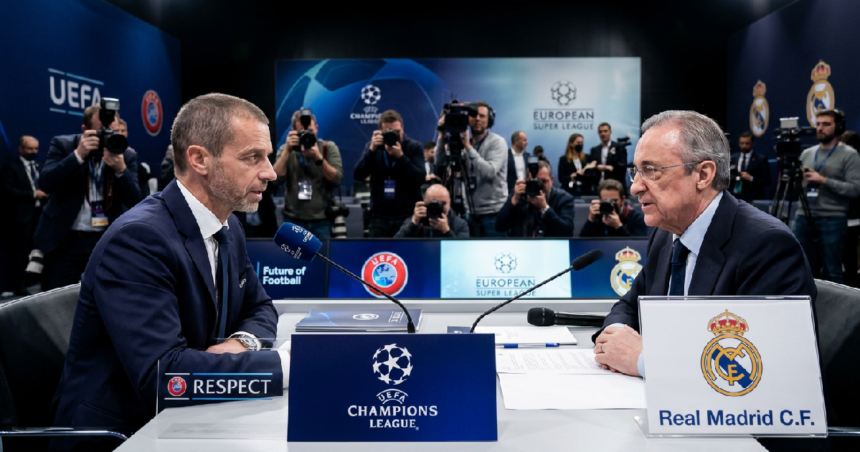
The long-simmering tension between the established order of European football and its most ambitious rebels has flared once again. In a series of sharply worded communications, UEFA and Real Madrid have traded blows over the future of the European Super League (ESL), both claiming to be acting “for the good of football.”
At the heart of the latest dispute is a fundamental disagreement over governance, revenue distribution, and the very meritocracy of the sport. Real Madrid, led by president Florentino Pérez, remains the most vocal proponent of a breakaway competition that would fundamentally alter the Champions League model. UEFA, European football’s governing body, has countered with a staunch defense of the status quo, bolstered by support from the European Club Association (ECA) and domestic leagues.
Real Madrid defends the breakaway vision
Real Madrid’s latest stance reinforces the club’s belief that the current European model is stagnant. The Spanish giants argue that the sport is losing its grip on younger audiences and that high-profile, consistently competitive matches between the continent’s elite are the only way to ensure financial sustainability.
In their communications, the club has often pointed to the “monopoly” held by UEFA over continental competitions. For the Madrid board, the Super League isn’t just about more money; it’s about control. They view the current system as one where those who generate the most revenue have the least say in how it is managed. By pushing for an independent structure, Madrid claims they are safeguarding the future of the sport against mismanagement and external financial pressures that often favor state-backed clubs.
But this vision remains deeply polarizing. While Madrid speaks of “innovation,” critics see an attempt to create a closed shop that would destroy the “Pyramid” system—the tradition where any small club can theoretically dream of reaching the pinnacle of European glory through on-pitch performance.
UEFA hits back at ESL rhetoric
Aleksander Čeferin’s UEFA has not taken the challenge lightly. Their response has been framed as a crusade to protect the “European Sports Model.” This model is built on open competition, promotion and relegation, and financial solidarity, where profits from the top-tier competitions are trickled down to grassroots levels across 55 member associations.
UEFA’s statement suggests that the Super League is a project driven by self-interest and a “disregard for the fans.” They maintain that any competition sanctioned outside of their framework would lead to the eventual collapse of domestic leagues, as the gulf in wealth would become insurmountable. To address some of the criticisms, UEFA has already begun implementing its own revamped Champions League format, though this too has faced criticism for being a “Super League Lite” by adding more fixtures to an already congested calendar.
The governing body has also leaned heavily on the recent legal interpretations from European courts. While a previous ruling suggested that UEFA cannot simply block new competitions, it also affirmed that UEFA has the right to set rules for participation in its own tournaments. In short: clubs are free to start a Super League, but they might have to leave the Champions League and domestic leagues behind to do it.
A stalemate with no clear exit
The timing of these statements is no coincidence. As the [Clubs Shift Strategy as Summer Transfer Window Looms](/premier-league-recruitment-summer-2026-strategy-analysis), the financial disparity between the Premier League and the rest of Europe is becoming a primary talking point. Real Madrid sees the ESL as the only tool capable of countering the Premier League’s television revenue dominance.
And yet, the project struggles for partners. While Juventus and Barcelona have historically stood with Madrid, the “Big Six” in England have largely retreated due to massive fan backlash and the threat of government intervention. Without the English market, the Super League loses a significant portion of its commercial appeal.
The “good of football” remains a subjective term. For UEFA, it means protecting the collective. For Real Madrid, it means ensuring the survival and dominance of the world’s most historic institutions. As long as these two definitions remain at odds, the shadow of a breakaway will continue to loom over every Champions League draw and league meeting.
The impact on fans and players
Lost in the corporate jargon and legal threats are the people who actually play and watch the game. Players have expressed increasing concern over the number of matches being added to the schedule. Whether it’s a revamped Champions League or a new Super League, the result is the same: more football, less recovery time, and potentially lower quality of play due to fatigue.
Fans, meanwhile, remain wary. The 2021 protests showed that the “customer” still values tradition, local derbies, and the risk of failure over a guaranteed spectacle. The next few months will likely see both sides attempt to win the “hearts and minds” battle, but the core issue remains a legal and financial tug-of-war that shows no sign of ending.
European Super League FAQ
Is the Super League actually happening this year?
No. While Real Madrid continues to advocate for the project, there is no scheduled start date. The project is currently in a legal and organizational phase, seeking more club members before it can realistically launch.
Can UEFA ban clubs that join the ESL?
The legal situation is complex. While UEFA cannot “arbitrarily” block new leagues, they are allowed to have rules regarding their own competitions. If a club joins a breakaway league, UEFA could potentially prevent that club from participating in the Champions League or the Euros.
Why does Real Madrid want this so badly?
Primarily to close the financial gap with the English Premier League and state-funded clubs like PSG and Manchester City. Madrid believes a club-run competition would generate significantly higher broadcasting revenue than the current UEFA-run model.