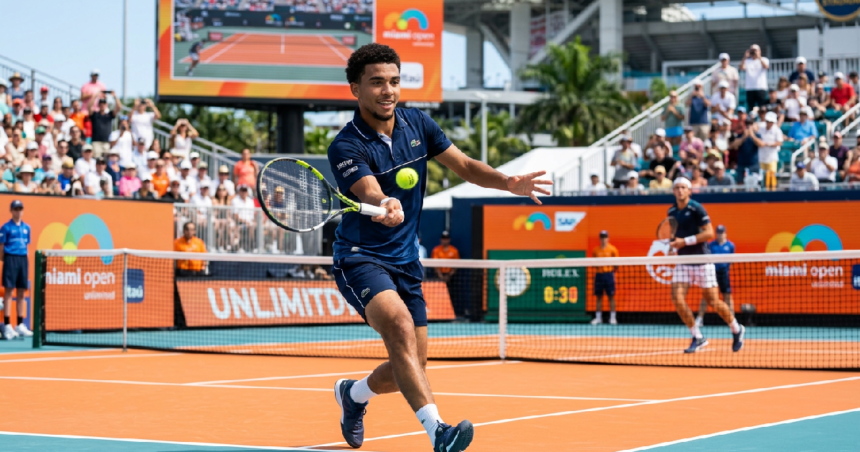
The business end of the Miami Open has arrived, and the narrative has shifted from early-round upsets to a tactical battle between the tour’s established elite and a surging generation of young talent. With the semi-finals set, the spotlight burns brightest on Arthur Fils, whose explosive run through the bracket has captivated the Hard Rock Stadium crowd, even as veteran observers begin to pick at the seams of his aggressive style.
Fils has been the story of the fortnight. His blend of raw power and court coverage has overwhelmed opponents who previously considered themselves superior baseline grinders. But as the stakes rise, the margin for error thins. Former world number one and television analyst Jim Courier has been vocal about the Frenchman’s positioning, noting that against the world’s top five, a predictable patterns of play can become a liability.
Tactical Battles Define the Miami Semi-Finals
The upcoming semi-final clash represents more than just a shot at a Masters 1000 trophy; it is a litmus test for the “power-first” philosophy. Analysis of recent matches suggests that while Fils possesses the heaviest forehand in the remaining draw, his tendency to sit deep behind the baseline during defensive transitions could be exploited. Jim Courier identifies tactical flaw in Fils ahead of Miami Open semi-final, specifically citing his recovery time after being pulled wide.
On the other side of the bracket, the consistency of the veterans is being tested. We’ve seen a shift in how the top seeds are approaching the humid Miami conditions. Instead of engaging in the marathon baseline rallies typical of the early 2020s, there is a concerted effort to shorten points. Serve-and-volley frequencies are up slightly compared to the previous year, a necessary adjustment as the court surface continues to play relatively slow this season.
The State of the ATP and WTA Rankings
The results in Florida are set to cause a significant shuffle in the rankings come Monday. For the younger players, a deep run here provides the points cushion needed to secure high seeding for the upcoming clay-court swing in Europe. The transition from the hard courts of North America to the red dirt of Monte Carlo and Madrid is notoriously difficult, and momentum is often the only thing that carries over.
In the women’s draw, the story remains one of dominance and the struggle to break it. The top three seeds have largely held firm, showcasing a level of mental fortitude that was missing from the mid-2020s landscape. The power hitting has been relentless, but it’s the variety — the drop shots and tactical lobs — that has separated the semi-finalists from the rest of the pack. Fans and analysts alike are monitoring these Miami Open semi-finals as a bellwether for the French Open favorites.
Looking Ahead to the Clay Swing
Once the final ball is struck in Miami, the tennis world pivots instantly. The physical toll of the “Sunshine Double” — Indian Wells and Miami — often leads to high-profile withdrawals from the first few clay events. Trainers are reportedly working overtime this week to manage the nagging injuries that inevitably crop up after a month of high-intensity hard-court tennis.
The question for Arthur Fils and his contemporaries is whether their games translate to the dirt. High-bouncing balls and longer rallies favor those with the most stamina and the best “Plan B.” If Fils can shore up the tactical gaps identified by the likes of Courier, he remains a dark horse for the major titles later this summer. If not, the veterans of the tour will likely continue their stranglehold on the business end of Sundays.
Frequently Asked Questions
Who is favored to win the Miami Open men’s title?
While the odds fluctuate with every match, the top seeds remain the favorites due to their experience in best-of-three-set formats. However, Arthur Fils has become the “people’s favorite” due to his high-risk, high-reward style of play that keeps fans on the edge of their seats.
How will the Miami Open results affect the French Open seeds?
Success in Miami is crucial because it offers 1,000 ranking points to the winner. This can be the difference between being ranked 8th or 12th, which determines whether a player has to face a top-four seed in the quarter-finals or the fourth round in Paris.
What tactical changes are analysts seeing this year?
There is a notable increase in “plus-one” tennis — where players look to end the point on the very first ball after the serve. Analysts have also noted that defensive movement is becoming more specialized, with players like Fils being scrutinized for how they reset their feet after a wide sprint.