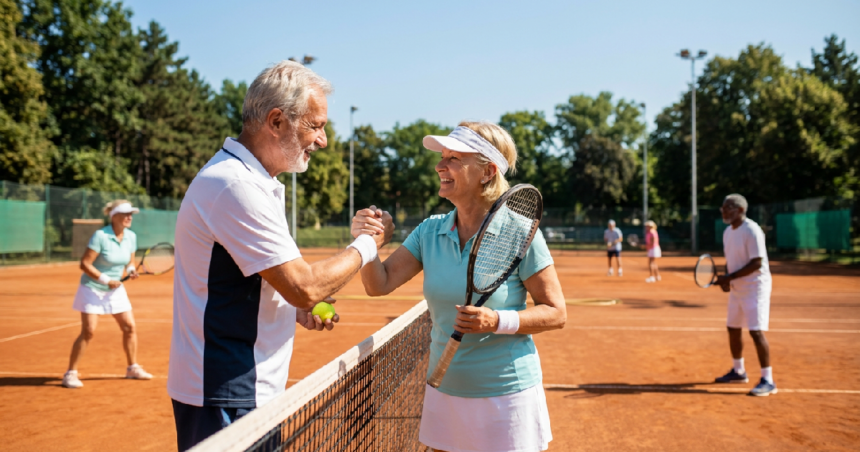
For decades, the medical community has touted the benefits of cardiovascular exercise, but recent longitudinal data and sports science research are highlighting a specific advantage held by racket sports. New findings suggest that playing tennis could be the single most effective physical activity for extending human life expectancy, potentially adding up to a decade to a player’s lifespan compared to sedentary individuals.
The research, which has gained significant traction among sports health analysts this week, points toward a unique combination of physical exertion, mental engagement, and social interaction that is rarely found in solo pursuits like running or cycling. While most forms of exercise offer a health “dividend,” tennis appears to be the gold standard for longevity.
Beyond the heart rate: The social connectivity factor
One of the most compelling aspects of the recent data is the emphasis on social interaction. Tennis is inherently a social sport; you cannot play it alone. Experts suggest that the “social glue” required to arrange matches, switch sides of the net, and engage in post-match conversation provides an emotional stimulus that rivals the physical benefits.
Loneliness is increasingly recognized as a major health risk factor in aging populations. By providing a consistent community, tennis clubs and local leagues create a recurring social touchpoint that mitigates isolation. This isn’t just about getting the heart rate up into the aerobic zone; it’s about the neurochemical benefits of human connection that occur during a doubles match or a friendly set of singles.
Tactical thinking and cognitive preservation
Tennis is often described as “chess at 100 miles per hour.” Unlike the repetitive motion of a treadmill or a stationary bike, tennis requires constant split-second decision-making. Players must calculate ball trajectory, positioning, and opponent movement simultaneously.
This “open-skill” environment—where the situation is constantly changing—is thought to be a primary driver in maintaining cognitive function. Keeping the brain sharp through tactical planning and hand-eye coordination helps build a cognitive reserve that may ward off age-related decline. For many players in their 60s and 70s, the mental battle of the game is just as important for longevity as the physical sprint to the net.
Interval training built into the game
From a purely physiological standpoint, tennis is a natural form of High-Intensity Interval Training (HIIT). Use of the sport’s stop-start nature—brief bursts of maximal effort followed by short recovery periods—mirrors the exact type of training cardiologists recommend for heart health. This improves VO2 max and metabolic efficiency more effectively than “steady-state” exercise like jogging at a constant pace.
And because the intensity is baked into the fun of competition, players often push themselves harder than they would in a gym setting. It’s easier to find the motivation to chase down a drop shot when there’s a point on the line than it is to grind out a final kilometer on a rowing machine.
Adapting for the long haul
The “ten-year advantage” isn’t reserved exclusively for elite athletes. The sport’s scalability is a key factor in why it contributes so heavily to long-term health. Players who might find singles too taxing as they age often transition to doubles, which reduces the court coverage required while maintaining the balance and coordination benefits.
We are seeing more “centenarian athletes” in the tennis world than in almost any other sport. By focusing on low-impact movement and technical skill, tennis allows for a level of participation that can span eight decades of a human life. It’s a rare sport where a grandfather can competitively share the court with a grandchild, creating a multi-generational bridge that encourages activity at every stage of life.
Frequently Asked Questions
Do I need to play at a high level to see these longevity benefits?
Not at all. The health benefits are tied to the physical movement and social interaction, not your ranking or technical prowess. Whether you’re hitting slow-paced rallies or playing competitive sets, the heart rate variability and social connection remain the same.
Is there a risk of injury for older players picking up the sport?
Like any sport, there are risks, particularly concerning joints. However, playing on softer surfaces like clay or grass can mitigate the impact on knees and ankles. It’s always a good idea to focus on a proper warm-up and perhaps take a few lessons to ensure your technique doesn’t put undue strain on your elbows or shoulders.
How often do I need to play to see an impact on my lifespan?
Research suggests that even two to three hours of tennis per week can provide significant health gains. The key is consistency over years rather than intensity over weeks. The most “durable” players are those who make the sport a permanent fixture of their weekly social and physical routine.