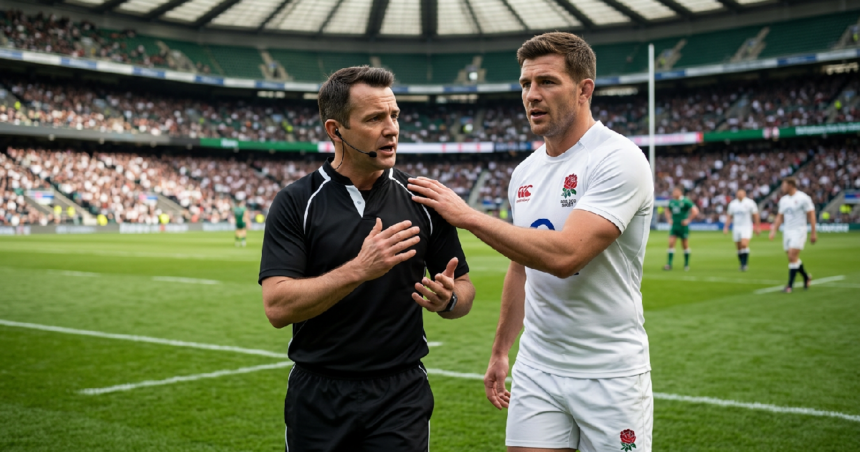
The intensifying debate over referee safety and the psychological toll of elite officiating has taken a poignant turn following an public appeal from a high-profile rugby referee. In a move that has resonated across the sport, the official detailed the personal struggles that arise when high-stakes matches go awry, prompting an immediate show of solidarity from prominent figures, including a senior England international.
Rugby has long prided itself on the mantra of “respect the official,” but the digital age has tested that foundation to its breaking point. This latest development highlights a growing rift between the traditional values of the game and the modern reality of social media vitriol and intense scrutiny that follows any perceived error on the pitch.
The human cost of the whistle
When professional referees speak out about their mental well-being, the rugby world generally stops to listen. This particular appeal wasn’t just about a missed knock-on or a scrum penalty; it was a candid admission of how the weight of the role can become unbearable when “things go wrong.” The pressure to be perfect in an 80-minute window, where split-second decisions are dissected by dozens of television cameras, has reached a fever pitch.
Referees are often the loneliest figures in the stadium. While players have teammates and coaches to shield them after a loss, a referee who makes a controversial call frequently finds themselves isolated. The official in question noted that the margin for error has narrowed significantly, while the volume of criticism has reached unprecedented levels. It is a stark reminder that beneath the uniform is a professional attempting to manage an increasingly chaotic and fast-paced environment.
England star joins the conversation
Perhaps the most significant aspect of this story is the intervention of an England star, who stepped forward to bridge the gap between players and officials. By publicly supporting the referee’s plea for assistance and empathy, the player has highlighted a necessary shift in how the rugby community views the men and women in the middle.
This gesture is more than just a polite social media post. It represents a growing awareness among the game’s elite that the sustainability of professional rugby depends on the retention of quality officials. If the environment becomes too toxic, the pipeline of talent entering the refereeing profession will inevitably dry up. The England international’s involvement adds a layer of weight to the discussion, signaling to fans and pundits alike that the “us versus them” mentality is detrimental to the sport’s health.
Addressing the culture of scrutiny
The issues raised aren’t occurring in a vacuum. World Rugby has been grappling with the balance of officiating technology, such as the TMO (Television Match Official), and the autonomy of the on-field referee. Rather than making the job easier, some argue the presence of constant review has actually increased the pressure on officials to be flawlessly accurate, leading to more “paralysis by analysis.”
When a referee admits they need help after a match goes sideways, it is an indictment of the current support structures. While match observers provide technical feedback, the emotional and psychological infrastructure appears to be lagging behind. The sport is now at a crossroads: it can continue to treat referees as functional components of the game, or it can start treating them as human participants who require the same mental performance coaching as the athletes themselves.
A turning point for officiating
The fallout from this appeal is likely to spark a broader review of how officials are protected from online abuse and how they are supported internally by their respective unions. The fact that a prominent referee felt the need to voice these concerns publicly suggests that private channels may not be sufficient to address the scale of the problem.
But the intervention from the England camp provides a glimmer of hope. It suggests a culture of mutual respect is still possible, even under the blinding lights of international rugby. As the sport moves forward, the focus will likely shift from just “getting the call right” to ensuring the person making the call is equipped to handle the consequences of being human in a high-pressure world.
Common questions regarding rugby officiating
Why is referee scrutiny increasing in rugby?
The combination of high-definition slow-motion replays and the immediate feedback loop of social media has made every mistake visible to millions instantly. Fans and analysts now have more tools to critique a referee than the referee has to make the initial decision.
How can the rugby community better support officials?
Reducing the public vitriol is a start, but structural changes are also needed. This includes providing better mental health resources, professionalizing the feedback loop, and players taking a public stand against the harassment of officials, as we have seen in this latest instance.
Does technology like the TMO help or hurt referees?
It is a double-edged sword. While it helps find the “correct” technical answer, it often undermines the referee’s authority and adds to the duration and tension of a match. Many officials feel it adds a layer of pressure to be perfect that didn’t exist in the pre-digital era.