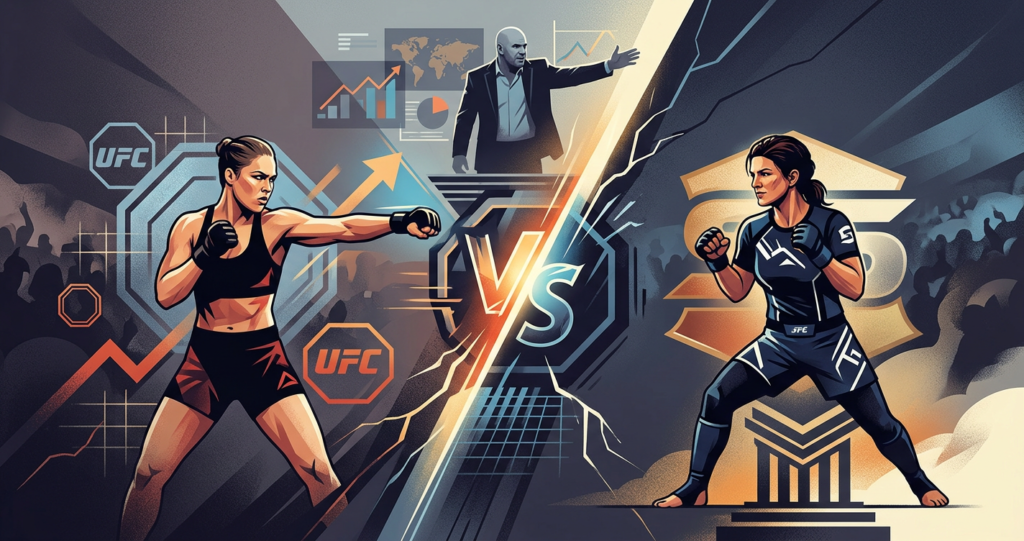
The quest for a definitive “Mount Rushmore” of women’s mixed martial arts usually begins and ends with two names: Ronda Rousey and Gina Carano. While modern champions like Amanda Nunes have arguably surpassed both in terms of technical skill and longevity, the cultural impact of the Rousey and Carano eras remains the benchmark for the sport’s commercial success. As Dana White prepares for a massive shift in his promotional empire, the debate over who truly built the house of women’s MMA has resurfaced with fresh intensity.
It isn’t just about who hit harder or who sold more pay-per-views. It’s about the fundamental DNA of the UFC as it exists today. Carano was the proof of concept; Rousey was the global explosion. But as the promotion looks toward 2027 and the potential realization of long-held expansion goals, including [Dana White Sets 2027 Target for Zuffa Boxing Launch](/dana-white-confirms-zuffa-boxing-launch-2027-timeline), the blueprints laid by these two pioneers are being scrutinized for what they can teach the next generation of promoters.
The Carano Blueprint and the Strikeforce Catalyst
Before the UFC even considered a women’s division—back when Dana White famously said “never”—Gina Carano was the face of the movement. Her 2009 headliner against Cris Cyborg under the Strikeforce banner wasn’t just a fight; it was a moment that forced the industry to take female athletes seriously as main-event draws.
Carano brought a level of mainstream charisma that the sport had lacked. She transitioned from Muay Thai to MMA with a style that was accessible and fan-friendly. Crucially, she proved that a woman could be both a high-level athlete and a commercial powerhouse. The UFC didn’t “build” women’s MMA; they acquired it when they bought Strikeforce, essentially inheriting the momentum Carano had generated even after she stepped away for Hollywood.
And yet, Carano’s era was brief. It was characterized by a lack of infrastructure. There were no deep rankings, no standardized weight classes, and little support from the sport’s most powerful brokers. She operated on an island, making her accomplishments perhaps even more impressive given the headwinds she faced.
Rousey and the UFC Machinations
If Carano was the pioneer, Ronda Rousey was the conqueror. When White finally relented and brought Rousey into the UFC in 2013, he didn’t just give her a platform; he gave her the full weight of the Zuffa marketing machine. Rousey didn’t just win fights; she finished them in seconds, creating an aura of invincibility that rivaled Mike Tyson’s peak.
The “Rousey Era” saw women’s MMA move from a curiosity to a cornerstone of the UFC brand. Her dominance allowed the promotion to build entire divisions around her, creating opportunities for names like Miesha Tate, Holly Holm, and eventually Amanda Nunes. But Rousey’s reign was also inherently tied to the UFC’s specific promotional style—aggressive, personality-driven, and occasionally volatile.
Rousey benefited from a structured ecosystem that Carano never had. By the time Rousey arrived, the UFC had established broadcast deals and a global footprint. But Rousey brought something the UFC couldn’t manufacture: an Olympic pedigree and a polarizing “Rowdy” persona that transcended the sport. She wasn’t just an MMA star; she was a pop-culture phenomenon.
The Evolution of the “White House” Strategy
Looking at the current state of the UFC, it’s clear that the promotion has moved into a post-superstar phase. While they still crave names like Conor McGregor or Jon Jones, the “White House” strategy now focuses on the “three letters” being bigger than any individual fighter. This is a direct evolution from the Rousey years, where the promotion realized that relying too heavily on one person creates a vacuum when they inevitably lose or retire.
The UFC has diversified. We see this in their cautious but steady approach to matchmaking and their expansion into new markets. While the sport waits for the next global crossover star, the infrastructure built during the Rousey era remains the backbone of the company. However, the influence of Carano’s “pure” martial arts background is still felt in the technical evolution of the bantamweight and strawweight divisions.
The upcoming year is expected to be a period of significant transition for the organization. As rumors of major roster overhauls circulate, [Clubs Shift Strategy as Summer Transfer Window Looms](/premier-league-recruitment-summer-2026-strategy-analysis) in other sports, the UFC is similarly looking at how to refresh its talent pool to maintain the frenetic pace of its schedule.
Comparing the Cultural Footprint
Who reigns supreme? If the metric is technical progression and institutional stability, the Rousey era wins. She forced the gates open and lived through the pressure of being the sole standard-bearer for an entire gender in the world’s toughest promotion. The UFC as we know it—a billion-dollar entity—is built on the pay-per-view buys she generated during her peak.
But if the metric is “the fighter who changed the narrative,” a strong case remains for Carano. She convinced a skeptical public (and a skeptical UFC President) that women belonged in the cage. Without the Carano-Cyborg era, there is no Rousey-Tate.
The current crop of champions owes a debt to both. While they may have better wrestling or more technical striking, the paths they walk were cleared by the charisma of Carano and the competitive fire of Rousey. As the sport moves toward 2027, the focus is shifting away from these legendary figures and toward a more decentralized, global talent pool. But the shadows of these two women still loom large over every championship fight.
Frequently Asked Questions
Did Ronda Rousey and Gina Carano ever fight?
No, they never met in the cage. While there were frequent rumors of a “superfight” during Rousey’s championship reign—and Dana White famously tried to book the match multiple times—Carano ultimately stayed in retirement to focus on her film career, leaving one of MMA’s biggest “what-if” scenarios unanswered.
Who had the better win-loss record in their prime?
Rousey had a more dominant statistical run, successfully defending her UFC title six times and finishing almost all of her opponents in the first round. Carano was undefeated until her final career fight against Cris Cyborg, but she competed in a much less developed era of the sport with fewer high-level opponents available.
How did their careers impact the UFC’s financial value?
Rousey was a massive driver of the $4.2 billion sale of the UFC to WMG-IMG (now Endeavor) in 2016. She was one of the few fighters who could consistently draw over one million pay-per-view buys. Carano’s impact was more about proving the viability of the product, which helped Strikeforce remain a competitive number-two promotion until its eventual acquisition by Zuffa.