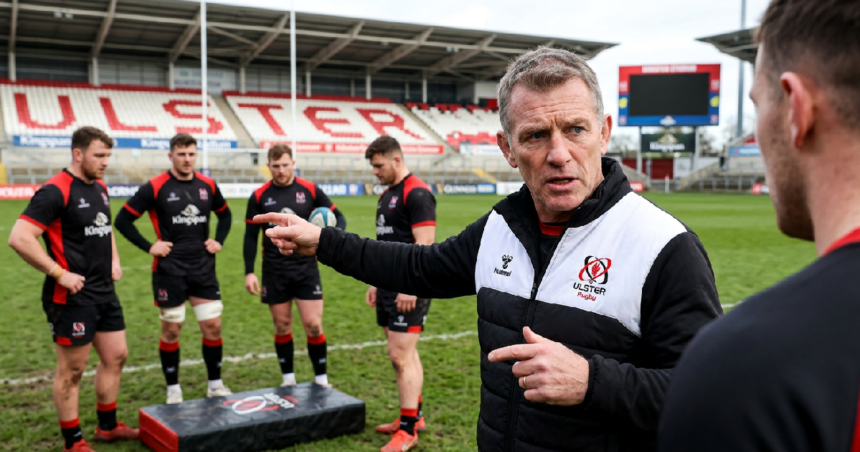
Richie Murphy has laid the challenge down to his Ulster squad following their latest outing, insisting that the province must solve their ongoing issues with ball retention if they are to compete with the URC’s elite. The head coach did not pull any punches in his assessment, highlighting how unforced errors and a lack of breakdown discipline are undermining his side’s tactical ambitions.
The Northern Irish side has shown flashes of the expansive, high-tempo rugby Murphy wants to instill since he took the reins, but those moments are frequently interrupted by spills in contact and isolated runners. For a team trying to bridge the gap to the top four, these technical lapses are becoming a source of mounting frustration within the coaching setup.
Breakdown struggles stalling Ulster momentum
Ulster’s ability to build phases has been a hallmark of their best performances in years past, yet currently, the sequence often breaks down before they can stress the opposition’s defensive line. Murphy pointed to the quality of possession as a primary concern. It isn’t just about losing the ball; it’s about the areas of the pitch where those turnovers are occurring.
When you cough up the ball in the middle third, you aren’t just losing an attacking opportunity — you are inviting immediate pressure onto a defensive line that hasn’t had time to reset. Murphy noted that his players are often working hard but not necessarily working smart at the ruck. Supporting players are arriving a fraction of a second too late, or taking poor angles, allowing savvy opposition flankers to play for the “holding on” penalty.
The transition from the previous coaching era to Murphy’s more fluid style requires a high level of technical proficiency. If the ball isn’t recycled cleanly within two seconds, the defensive line becomes a wall. Right now, Ulster’s ruck speed is inconsistent, fluctuating between lightning-quick ball and stagnant, contested restarts that favor the defender.
Richie Murphy demands better individual accountability
System goals only go so far; at some point, the responsibility falls on the person carrying the leather. Murphy’s comments suggested that individual decision-making under stress remains a work in progress. Players are perhaps trying to do too much in contact rather than prioritizing the security of the ball for the next phase.
And it’s not just the forwards who are under the microscope. The backline has been guilty of loose passes and poor handling in transition. In a league where the margins between a home playoff berth and an away trip to South Africa are razor-thin, these “soft” turnovers are the difference between a winning streak and a mid-table struggle.
Training sessions in Belfast this week are expected to focus heavily on “collision winning” and the secondary movement after a tackle. Murphy wants his players to be more aggressive in the contact zone, ensuring that when they go to ground, they do so on their own terms, providing the scrum-half with a clear target.
The road ahead for the Kingspan outfit
The timing of Murphy’s critique is tactical. Ulster are entering a crucial stretch of the season where squad depth and clinical execution will be tested. With several high-stakes fixtures on the horizon, the coaching staff knows they cannot afford to gift-wrap possession to opponents who have the clinical edge to punish every mistake.
There is also the matter of confidence. A team that trusts its ability to hold the ball for 10 or 15 phases is a dangerous one. Currently, Ulster look like a team that is playing with a degree of anxiety, perhaps worried that the mistake is just around the corner. Murphy’s task is to rebuild that “keep-ball” mentality that once made Ravenhill a fortress where visiting teams were starved of the ball for long periods.
If they can tighten up their discipline at the breakdown and improve their handling under pressure, the talent is certainly there to challenge the likes of Leinster and Glasgow. But as Murphy clearly stated, it all starts with keeping hold of the ball.
Frequently Asked Questions
Why is Richie Murphy focusing specifically on ball retention?
Murphy believes that Ulster are creative enough to score against anyone, but they are currently beating themselves. By losing the ball early in sequences, they exhaust their own defense and fail to put sustained pressure on the opposition. It’s about efficiency and controlling the game’s rhythm.
Is this a new problem for Ulster this season?
While Ulster have always been an attacking side, the inconsistency in their breakdown work has become more apparent under the new tactical system. The higher tempo Murphy demands requires even better ball security, which has exposed some underlying technical flaws in the squad’s contact work.
How can Ulster fix these issues before the next match?
Fixing ball retention usually involves a mix of technical drills—focusing on the “long place” after a tackle—and improving the “latch” from supporting players. It also requires a mental shift to value possession more highly than trying to force a miracle offload in heavy traffic.