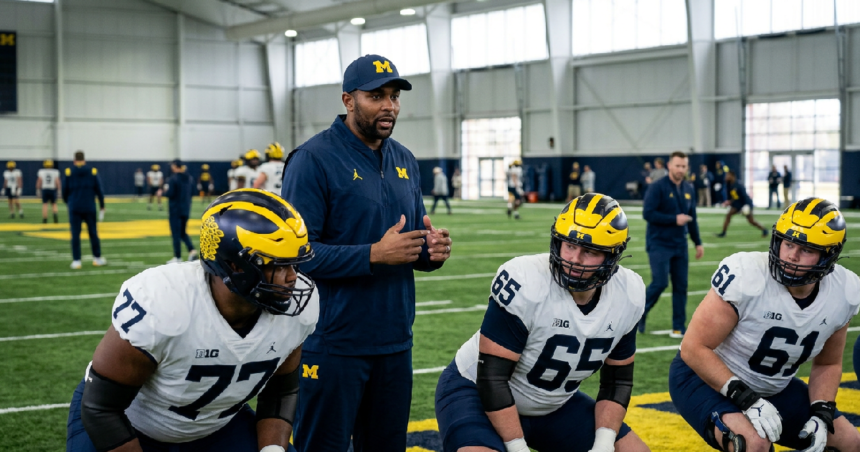
Michigan football is entering a pivotal stretch of its spring practice schedule, and the focus in Ann Arbor has shifted squarely onto the shoulders of the offensive line. As Sherrone Moore prepares for his debut season as the permanent head coach, the task of replacing several key starters from the national championship-winning unit is proving to be the most pressing storyline of the spring.
The Wolverines have long built their identity on a dominant ground game and physical presence at the point of attack. However, with several mainstays heading to the NFL, the coaching staff is currently shuffling personnel to find the right combination before the spring game. Reports from Schembechler Hall suggest that while the talent level remains high, the chemistry and communication that defined the 2023 campaign are still very much works in progress.
Establishing the New Guard in the Trenches
Replacing veteran leadership is never easy, especially when those players were the engine behind a historic title run. Sherrone Moore, who previously served as the offensive coordinator and line coach, knows this culture better than anyone. But the transition from a specialized role to the head whistle means he is now overseeing the broader implementation of the 2026 tactical scheme.
The coaching staff has been rotating several underclassmen at both tackle positions. Coaches are looking for more than just physical prowess; they are hunting for the “mean streak” that has become a Michigan trademark. So far, the interior of the line looks more settled than the edges, though various combinations are being tested to ensure depth following a year where injuries were relatively sparse.
And it isn’t just about blocking. The offensive line’s performance will directly dictate the success of the ongoing quarterback competition. Without a clean pocket or a reliable running lane, evaluating the new signal-callers becomes a near-impossible task for the Michigan staff.
The Quarterback Question Marks
With J.J. McCarthy’s departure, the void at quarterback is the most discussed topic among the maize and blue faithful. The spring period is usually a time for experimentation, but the sense of urgency feels heightened this year. Several players are vying for the starting nod, each bringing a slightly different profile to the offense.
One candidate offers superior mobility and a threat in the RPO (run-pass option) game, while another has impressed the staff with his arm talent and ability to make vertical throws during 11-on-11 drills. Sources close to the program indicate that no one has truly pulled away in the race yet. The staff appears comfortable letting this battle bleed into the late summer, much like previous competitions in the Harbaugh era.
But the lack of a clear front-runner places even more pressure on the wide receivers. This group needs to prove they can create separation against a Michigan defense that remains one of the fastest and most aggressive in the Big Ten. The defensive secondary, led by returning standouts, has reportedly won the majority of the battles during recent scrimmages.
Wink Martindale Adjusts to the College Game
On the other side of the ball, defensive coordinator Wink Martindale is implementing his own nuances into an already elite system. While Michigan’s defensive architecture hasn’t undergone a total overhaul, Martindale’s penchant for aggressive pressure and complex blitz packages is starting to show during spring sessions.
The players have reportedly taken well to his NFL-style approach. The challenge for the offense during these practices is simply keeping up with the speed of the defense’s decision-making. If the defense continues to dominate the line of scrimmage as they have in early sessions, it may be a sign that Michigan’s defensive identity will remain the most reliable part of the team heading into the 2026 season.
The integration of new coaching staff members has been described as seamless on the defensive side, but the true test will come when these schemes are faced with the diverse offensive looks presented by a revamped Big Ten schedule later this year.
Looking Toward the Spring Game
The upcoming spring game will offer the first public look at where this team stands. It won’t provide all the answers — spring games rarely do — but it will reveal the fundamental execution of the second-and-third-string players who are expected to provide depth.
For Moore, the priority remains health and fundamental consistency. While fans want to see explosive plays and a clear-cut starting quarterback, the coaching staff is more interested in seeing five linemen work as a single unit and the defense maintaining its gap integrity. The “Smash” identity isn’t going anywhere, but the personnel executing it will look very different when the stadium lights come on in August.
Frequently Asked Questions
Who is leading the Michigan quarterback battle?
Currently, there is no definitive starter. The coaching staff is rotating multiple players, including those with starting experience elsewhere and highly-touted underclassmen, to evaluate who manages the huddle most effectively under pressure.
How is Sherrone Moore handling his first spring as head coach?
Moore has maintained much of the program’s existing structure but has brought a renewed focus on individual development at the line of scrimmage. Observers note that the intensity of practice has remained high, mirroring the “Pro Blue” environment established previously.
Are there many injuries affecting Michigan’s spring practice?
The team has kept specific injury reports private, but several key players have been seen in limited roles or “non-contact” jerseys. This is standard practice in the spring to ensure veteran players are healthy for the grueling fall schedule.