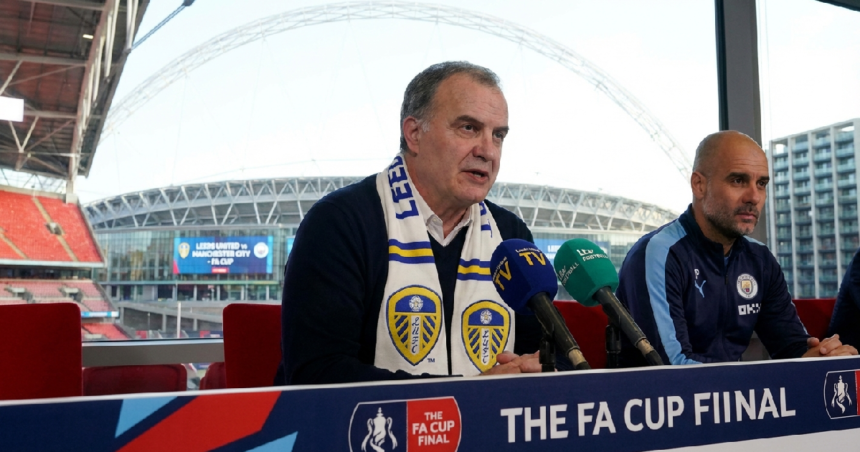
Leeds United could be heading back to Wembley without playing another minute of qualifying football, provided a specific set of circumstances involving Manchester City falls into place over the coming weeks. While a return to the national stadium would usually signal a shot at major silverware or promotion, this particular scenario comes with a significant caveat: the Yorkshire club would remain ineligible for European competition regardless of the outcome.
The situation hinges on the complex intersection of domestic cup results and the redistribution of European spots. For Leeds, the path to Wembley is rooted in the administrative and logistical fallout of the season’s final stages. While supporters might relish another trip to the capital, the lack of a continental carrot underlines the current gulf between the Championship’s elite and the Premier League’s established powerhouses.
How the Manchester City scenario impacts Leeds United
The potential return to Wembley for Daniel Farke’s side is tied directly to the performance and scheduling of Manchester City in the domestic cup circuit. In the event that City progresses to the latter stages of multiple competitions, the resulting fixture congestion often forces the FA to utilize secondary venues or reschedule traditional curtain-raisers. Reports suggest that Leeds, as a high-profile club with a massive traveling support, have been identified as the primary candidate to fill a slot in a high-profile exhibition or rescheduled fixture at the national stadium.
This isn’t about a late-season promotional playoff or a sudden FA Cup resurgence. Instead, it reflects the logistical reality of managing the English football calendar when a single team like Manchester City dominates the deep ends of every tournament. If City’s schedule becomes untenable, Leeds appears to be the “guaranteed” partner for a specific Wembley event designed to satisfy broadcast requirements and commercial obligations.
And yet, this invitation carries no weight in the eyes of UEFA. Because Leeds United are currently competing in the second tier of English football, their participation in such an event—even if they were to win a trophy associated with it—does not grant them the licensing required for the Europa League or Conference League.
The European eligibility roadblock
The governing bodies are quite clear on this: European spots are earned through specific league placements or by winning major trophies like the FA Cup while maintaining a top-flight license. Even if the stars align for a Leeds United appearances at Wembley, the club faces a technical barrier. Championship clubs rarely meet the “Financial Sustainability” criteria required for immediate entry into European competition unless they have secured promotion to the Premier League first.
For Farke and his squad, the focus remains firmly on the league table. While a trip to Wembley provides a financial boost and a day out for the fans, it is more of a distraction from the primary objective of returning to the top flight. Recent shifts in recruitment strategy, as seen in the changing landscape of summer transfers, suggest that clubs like Leeds are prioritizing long-term squad depth over the fleeting prestige of a cup run or a one-off Wembley appearance.
What this means for the Elland Road faithful
Leeds fans have a complicated relationship with Wembley. For many, the stadium is synonymous with the heartbreak of playoff finals or the glory of past eras. The idea of returning there “by default” or through a Manchester City scheduling conflict is met with mixed emotions. On one hand, Elland Road sells out every week, and the demand for tickets at a neutral 90,000-seat stadium would be astronomical. On the other, many see it as a hollow fixture without the reward of a trophy or a seat at Europe’s top table.
The reality of modern football is that the schedule is increasingly dictated by the success of a few clubs. As City continues to fight on all fronts, the ripples are felt all the way down the pyramid. Leeds United happens to be the club most likely to benefit—or suffer, depending on your perspective—from the resulting chaos.
Looking ahead to a busy spring
As the season enters its final month, the administrative wheels are spinning behind the scenes. The FA is expected to confirm the details of this potential Wembley fixture once Manchester City’s participation in European semi-finals is solidified. For Leeds, the task is to ignore the noise and ensure that if they do go to Wembley, it is a celebratory lap on the way back to the Premier League, rather than a consolation prize for a season spent in the shadows of the elite.
Frequently Asked Questions
Why would Leeds go to Wembley because of Manchester City?
It comes down to scheduling conflicts. If Manchester City reaches multiple finals or experiences major fixture congestion, Leeds United has reportedly been lined up to participate in a specific event or exhibition at Wembley that requires a high-attendance club to remain commercially viable.
Could Leeds qualify for the Europa League through this?
No. Because of their current status in the Championship and the specific nature of this scenario, Leeds would not be eligible for a UEFA license for the upcoming season, regardless of the match result at Wembley.
Is this a competitive match or a friendly?
While technically classified under specific competition rules, it functions more as a high-stakes exhibition or a rescheduled trophy match. It would be a senior fixture, but one without the traditional prize of European qualification attached to it.