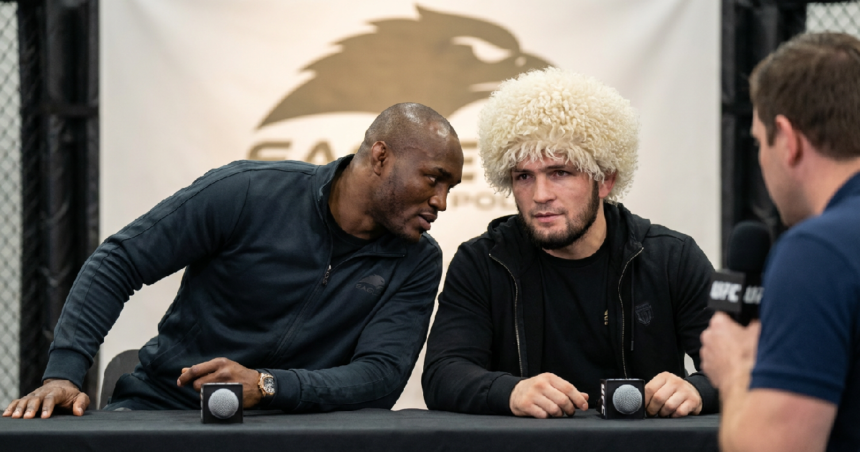
The debate surrounding Khabib Nurmagomedov’s historical stance on women’s participation in mixed martial arts has been reignited, this time with former welterweight king Kamaru Usman entering the fray. Addressing recent criticisms directed at the retired undefeated champion, Usman offered a measured defense that suggests the backlash often overlooks the cultural and religious context governing Nurmagomedov’s worldview.
Nurmagomedov has long been a polarizing figure regarding the role of women in combat sports. Since his retirement, his comments regarding the lack of female fighters in his promotion, Eagle FC, and general critiques of women’s MMA have frequently drawn the ire of fans and contemporary female athletes. However, Usman, who shared a close professional relationship with Khabib under the management of Ali Abdelaziz, argues that the public often judges these comments through a Western lens that doesn’t necessarily apply to everyone.
Usman Highlights Cultural Nuance in Khabib Comments
Speaking on his “Pound 4 Pound” podcast, Usman suggested that there is a fundamental misunderstanding of where Nurmagomedov is coming from. He noted that for someone raised in the mountainous, deeply traditional region of Dagestan, the idea of women competing in a blood sport like MMA clashes with deep-seated protective instincts and religious values.
Usman pointed out that while the modern MMA fan expects a universal standard of equality in the Octagon, the reality of global perspectives is more fragmented. He argued that Khabib’s reluctance to promote women’s fighting isn’t necessarily rooted in a belief that women are incapable, but rather a belief that they shouldn’t have to endure such physical trauma. It is a distinction that Usman feels is often lost in the headlines.
But the defense hasn’t been without its detractors. Critics argue that regardless of cultural upbringing, the growth of the sport requires inclusion. The UFC has thrived on the back of superstars like Ronda Rousey and Amanda Nunes, proving that the female divisions are not just commercially viable but technically elite. By dismissing women’s roles in the cage, Khabib’s critics say he is alienating a massive portion of the fighting community.
The Impact of Eagle FC and Fighter Perspectives
The controversy is not merely theoretical. When Nurmagomedov launched Eagle FC on a more global scale, he was direct about his decision not to include female weight classes. At the time, he claimed there were not enough “good” female fighters available, though many saw this as a convenient excuse to avoid scheduling matches that conflicted with his personal beliefs.
Usman’s intervention comes at a time when the UFC is pushing harder into Middle Eastern markets, including regular events in Saudi Arabia and Abu Dhabi. In these regions, the conversation around women’s sports is evolving rapidly, yet remains sensitive. Usman noted that criticizing someone for their convictions, even if they are unpopular in the United States or Europe, can be a form of cultural myopia.
And yet, many female fighters have expressed disappointment. To them, Nurmagomedov is one of the greatest to ever do it, and his endorsement—or lack thereof—carries immense weight. When a figure of his stature suggests that the cage is no place for a woman, it reinforces barriers that athletes from Zhang Weili to Alexa Grasso have spent years breaking down.
A Clash of Fighting Ideologies
What this latest exchange highlights is the growing rift between the sport’s traditionalist wing and its progressive mainstream. Nurmagomedov represents a specific, disciplined philosophy often referred to as the “Father’s Plan,” which prioritizes specific social hierarchies and religious adherence. Usman, while more integrated into the Western media machine, clearly retains a deep respect for those traditional roots.
As the sport continues to globalize, these clashes are likely to become more frequent. The UFC remains a broad tent, but as fighters like Usman speak up, it becomes clear that the internal politics of the gym and the training room are far more complex than the binary “right or wrong” narratives often found on social media.
For now, Nurmagomedov remains firm in his coaching and promotional roles, unlikely to be swayed by the latest round of digital discourse. Usman’s defense provides a rare bridge between two very different worlds, even if it doesn’t solve the underlying tension regarding gender in the world’s toughest sport.
Frequently Asked Questions
What did Khabib Nurmagomedov say about women in MMA?
Khabib has made several comments over the years suggesting that women should “finish their husband” at home and that there aren’t enough high-level female fighters to justify divisions in his promotion, Eagle FC. He has consistently opted not to include women’s bouts on his fight cards.
Why did Kamaru Usman defend him?
Usman focused on the importance of understanding cultural differences. He argued that Khabib’s views are a product of his upbringing in Dagestan and his religious beliefs, which emphasize protecting women from physical harm rather than a malicious desire to exclude them.
Has Eagle FC ever hosted a women’s fight?
Since its rebranding and expansion under Khabib Nurmagomedov, Eagle FC has notably lacked a female roster. While other major promotions like the UFC, PFL, and Bellator have robust women’s divisions, Khabib has remained steadfast in his decision to keep his promotion male-only for the time being.