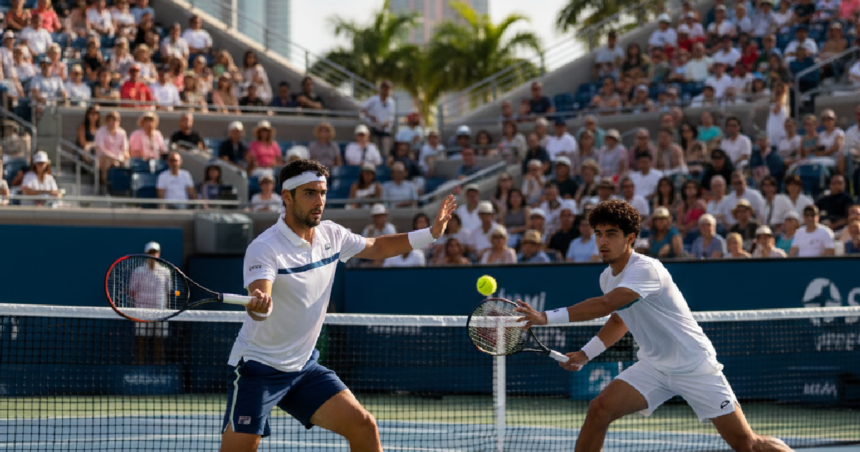
The transition from junior tennis to the professional circuit is rarely a smooth ride, but Rafael Jodar is currently navigating those choppy waters under the brightest of spotlights. In a high-stakes encounter that has captured the attention of the Miami Open crowds, the Spanish teenager faced a grueling test of patience and tactical acumen against the seasoned Dusan Lajovic.
Jodar, who arrived in Florida with a reputation bolstered by his recent successes on the ITF circuit, found himself in a tactical chess match. Lajovic, a veteran notorious for his heavy kick serve and reliable one-handed backhand, represents exactly the kind of “gatekeeper” opponent that young players must learn to dismantle if they harbor ambitions of breaking into the ATP’s top tier.
Jodar struggles to break the Lajovic rhythm
From the opening games, it was clear that Lajovic intended to use his experience to dictate the tempo. While Jodar possesses the raw power and aggressive baseline game that has become the hallmark of the modern Spanish school, he struggled early on to handle the variety of speeds coming from the other side of the net. Lajovic expertly mixed deep, looping balls with slice backhands that stayed low on the Miami hardcourts, forcing Jodar to generate his own pace from uncomfortable positions.
The physical toll of these rallies began to show as the match progressed. Jodar showed flashes of brilliance, particularly with a cross-court forehand that left Lajovic stranded on several occasions. But the consistency required to win those points back-to-back remained elusive. Lajovic’s ability to remain composed under pressure—a trait developed over a decade on the tour—ultimately proved to be the differentiator during the most critical passages of the match.
A learning curve in the heat of Miami
For Jodar, this match serves as a barometer for his current development. Tennis insiders have long pointed to his footwork as a primary strength, yet against a player of Lajovic’s caliber, even minor lapses in positioning are exploited. The Serbian veteran consistently targeted Jodar’s second serve, moving inside the baseline to take the ball early and put the youngster on the defensive immediately.
Despite the scoreboard pressure, Jodar refused to abandon his aggressive philosophy. There is a certain fearlessness in the way he approaches break points, often opting for the high-risk line shot rather than playing it safe. While that approach resulted in unforced errors today, it is the same mentality that has scouts comparing his ceiling to some of the game’s current heavyweights. He isn’t just trying to participate; he is trying to dominate, even if the execution isn’t quite there yet.
Impact on the draw and what follows
The outcome of this clash has immediate implications for the lower half of the bracket. Lajovic continues to prove that he is a dangerous floater in these Masters 1000 events, capable of upsetting seeds when the conditions suit his grinding style. For Jodar, the takeaway won’t be found in the rankings points, but in the video analysis of how Lajovic managed the “big points.”
As the clay court season approaches—a surface where both men feel naturally at home—this match provides a template for Jodar’s coaching team. The raw materials are evident: the serve has pop, and the forehand is a genuine weapon. The next step is the “ATP IQ”—understanding when to fire the cannon and when to wait for the short ball. This duel in Miami was a harsh but necessary lesson in that evolution.
Frequently Asked Questions
Is Rafael Jodar’s playing style similar to Carlos Alcaraz?
While both are aggressive Spanish players with excellent movement, Jodar’s game is currently more focused on baseline power. He doesn’t yet use the drop shot or the net-rush with the same frequency as Alcaraz, though he is clearly influenced by that modern, high-intensity style of play.
What makes Dusan Lajovic a difficult opponent for younger players?
Lajovic is a master of “junk balling” when he needs to. He can change the height and spin of the ball constantly, which prevents younger rhythm-players from getting comfortable. If you can’t handle a heavy slice or a high-looping ball to the backhand, Lajovic will exploit that all day.
Will Rafael Jodar receive more wildcards after this performance?
Tournament directors generally look for “marketable grit,” and Jodar showed plenty of that in Miami. Given his trajectory and his status as one of the top prospects in European tennis, it’s highly likely he will continue to receive entries into major qualifying draws and ATP 250 main draws throughout the summer.