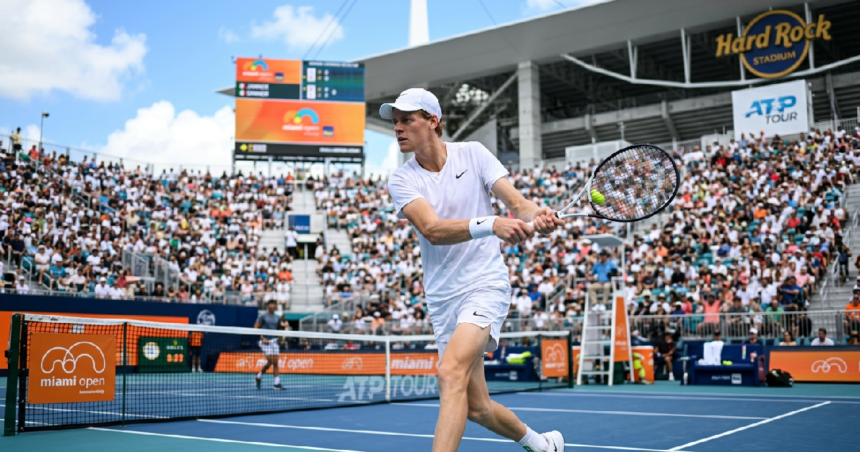
The mastery displayed by Jannik Sinner at the Miami Open has shifted from impressive to borderline clinical. As the tournament reaches its business end at Hard Rock Stadium, Sinner has once again demonstrated why he is currently the most feared ball-striker on the ATP Tour, dismantling high-level opposition with a brand of tennis that leaves very little room for error or counter-play.
Sinner’s progression through the latter stages in Florida has been characterized by a terrifying economy of motion. He isn’t just winning matches; he is suffocating opponents with a baseline depth that forces even the quickest movers into defensive shells. For those watching from the stands or the commentary booth, the sound off Sinner’s racket remains the defining characteristic of his current run—a heavy, clean thud that resonates differently than almost anyone else in the top ten.
The Evolution of Sinner’s Hard Court Dominance
What we are seeing in Miami is the continuation of a physical and tactical evolution that began in late 2023. Sinner has moved past the phase of being a “flaky” power hitter. Under the guidance of Darren Cahill and Simone Vagnozzi, his serve has become a reliable weapon rather than a liability under pressure, and his movement horizontally across the baseline has sharpened significantly.
In his recent outings, the Italian has shown a remarkable ability to take the ball on the rise, effectively taking time away from his opponents. This was particularly evident in his latest victory, where he consistently targeted the corners with a laser-like precision that made the court feel very small for the man across the net. It is this “clinical” nature—the lack of wasted energy and the ruthless conversion of break point opportunities—that has pundits suggesting he is the clear favorite to lift the trophy.
But the path to the title is rarely a straight line. Challenges remain in the draw, particularly with players like Arthur Fils showing flashes of brilliance. Former world number one Jim Courier identifies tactical flaw in Fils ahead of Miami Open semi-final, noting that while the young Frenchman has the raw tools, he may lack the consistency required to disrupt Sinner’s current rhythm.
Tactical Precision Under the Florida Sun
The conditions in Miami—often humid with a heavy breeze—can rattle players who rely on fine margins. Sinner, however, seems to have found a way to ground his game. He is hitting through the humidity, using his exceptional timing to ensure the ball doesn’t sit up in the “hitting zone” for his rivals. His backhand down the line, arguably the best in the world right now, has functioned as a primary escape valve whenever he finds himself pushed wide.
And then there is the mental side. Sinner’s demeanor on court remains remarkably flat-lined. Whether he is up a double break or facing a rare period of pressure, the expression rarely changes. This psychological resilience has become a hallmark of his 2026 campaign, allowing him to navigate the “big points” with the composure of a veteran champion.
What Lies Ahead for the Miami Open Favorite
As the semi-finals approach, the tennis world is bracing for a potential showdown that could define the early hard-court season. Sinner is no longer the underdog or the “next big thing”—he is the standard. Every player left in the draw is currently looking for a hole in a game that appears to have none.
The focus now shifts to whether his physical conditioning will hold up. The Miami heat is notorious for saping the energy of baseline grinders, but Sinner’s shorter point averages this week suggest he is managing his workload effectively. If he maintains this clinical level, he won’t just be winning titles; he’ll be rewriting the expectations for what is possible on a hard court.
Frequently Asked Questions
Is Jannik Sinner the current favorite to win the Miami Open?
Based on his current form and clinical execution in the earlier rounds, Sinner is widely considered the man to beat. His ability to handle the conditions at Hard Rock Stadium and his recent win-loss record on hard courts make him the statistical frontrunner.
How has Sinner’s game changed in the last year?
The most notable improvements have been in his serve consistency and his defensive movement. He is no longer just an aggressive baseliner; he can now extend rallies and wait for the right moment to strike, showing much better point construction than in previous seasons.
Who are the biggest threats to Sinner in the remaining draw?
While Sinner is in peak form, the late rounds of a Masters 1000 event are always volatile. Players with high-variance games or extreme power can cause trouble if they have a “hot” day, but Sinner’s tactical discipline makes him very difficult to upset over three sets.