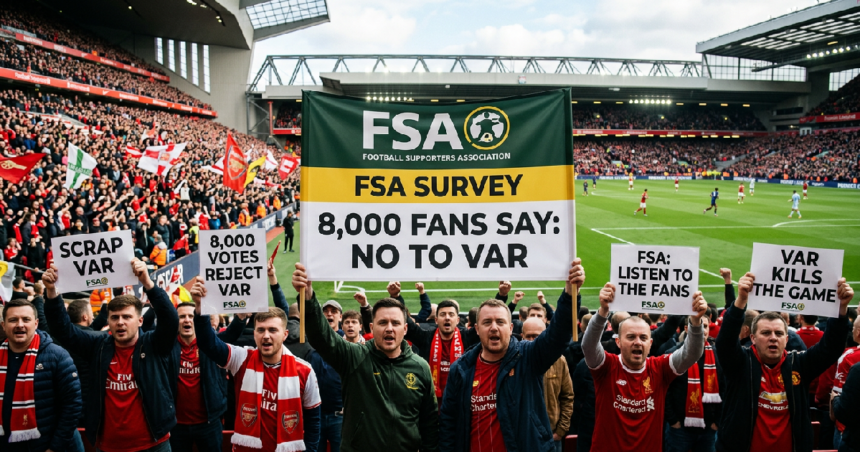
The English game’s governing bodies are facing a renewed crisis of confidence after a comprehensive study revealed a stark disconnect between match-going supporters and the current implementation of Video Assistant Referees (VAR). A survey conducted by the Football Supporters’ Association (FSA), which gathered the opinions of 8,000 fans, suggests that the technology is draining the traditional enjoyment of the sport for a vast majority of those in the stands.
The findings, released today, Monday, March 30, 2026, paint a picture of a matchday experience fundamentally altered by lengthy delays and a lack of communication within the stadium. This latest data arrives at a critical juncture as leagues across Europe weigh the long-term viability of the current system against the mounting frustration of the ticket-paying public.
Pressure Mounts on PGMOL as Fan Dissatisfaction Peaks
The FSA’s investigation is one of the most significant litmus tests of supporter sentiment since technology was first introduced to the Premier League. The data indicates that clear communication—or the total lack thereof—is the primary driver of the current backlash. Fans reported a persistent feeling of being “left in the dark” while officials in Stockley Park review footage, with those inside the stadium often having less information than viewers watching at home.
While the Premier League and the Professional Game Match Officials Limited (PGMOL) have previously defended VAR on the grounds of increased accuracy, the FSA survey suggests that many supporters would prefer a return to human error if it meant the reinstatement of spontaneous goal celebrations. The “wait for the check” has become a reviled part of the modern stadium ritual, effectively neutering the most cathartic moments in football.
And it’s not just about the wait times. The survey highlights a perceived inconsistency in how the “clear and obvious” threshold is applied. For many of the 8,000 respondents, the technology has failed to deliver the objectivity it promised, instead shifting the debate from on-pitch errors to subjective interpretations of slow-motion replays.
Beyond the Premier League: A European Trend
The sentiment captured by the FSA isn’t an isolated British phenomenon. Across the continent, European leagues are seeing similar pushback. In Sweden, fan protests effectively blocked the introduction of VAR entirely, while in the Bundesliga, supporters have become increasingly vocal with banners and organized delays. The English survey provides a statistical backbone to what has, until now, been largely anecdotal evidence of a growing “anti-VAR” movement.
The FSA’s findings could force a shift in how clubs shift strategy regarding their interaction with officiating bodies. If the product is being devalued by the technology meant to safeguard it, the commercial implications for the league could be substantial. Broadcasters might enjoy the drama of a three-minute review, but the atmospheric energy that makes the Premier League a global export is at risk of being diluted.
FSA Demands Greater Transparency and Semi-Automated Solutions
So, where does the game go from here? The FSA has used the survey results to call for immediate reforms. Key among these is the faster adoption of semi-automated offside technology (SAOT), which has been utilized successfully in international tournaments to reduce the agonizingly long wait times for marginal calls.
Furthermore, there is a loud demand for referees to explain their decisions live to the crowd, similar to the system used in the NFL or recently trialed in FIFA youth tournaments. The argument is simple: if fans are expected to pay rising ticket prices, they shouldn’t be the last people in the stadium to know why a goal has been chalked off.
The results of this survey will likely be a central talking point at the next Premier League Shareholders’ meeting. While a total scrap of the system remains unlikely given the financial and systemic investment, the pressure to “fix” VAR has never been greater. Match-going fans have made their voices heard; the ball is now firmly in the court of the authorities.
Frequently Asked Questions
Why is the FSA survey considered so important?
The FSA represents the unified voice of fans in England and Wales. By capturing the data of 8,000 individual supporters, they provide a statistically significant counter-argument to the Premier League’s internal data, which often focuses on the percentage of “correct” decisions rather than the fan experience.
Is VAR likely to be scrapped following this vote?
It’s unlikely that VAR will be removed entirely in the immediate future due to the contractual and technical integration into the professional game. However, this level of dissatisfaction usually leads to significant “rule tweaks,” such as raising the threshold for intervention or speeding up the process with better technology.
What are the main complaints highlighted by the 8,000 fans?
The three most common grievances are the length of time taken for reviews, the lack of clarity provided to fans inside the stadium, and the erosion of the “spontaneous joy” that comes from scoring a goal, as celebrations are now routinely delayed or muted.