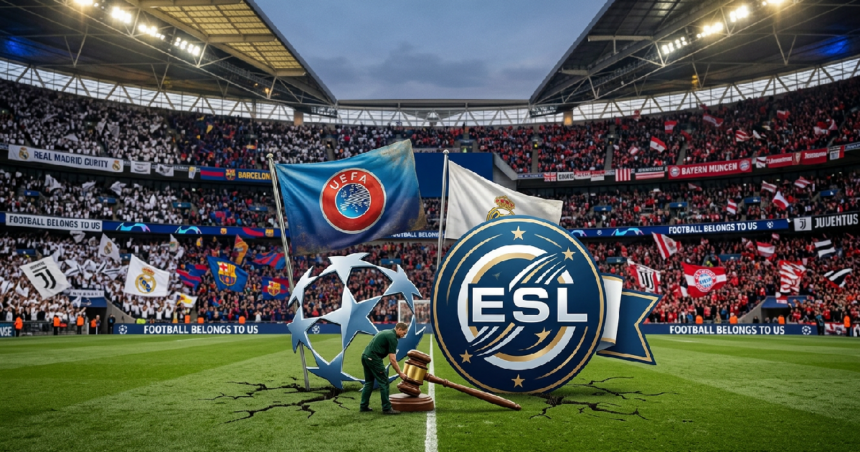
The legal foundations of European football were fundamentally reshaped today following a landmark verdict regarding the European Super League. For decades, UEFA has operated as a de facto monopoly, governing and commercializing the sport with an iron grip. That era, at least legally speaking, has reached a point of no return.
The ruling confirms that UEFA and FIFA acted unlawfully by blocking the creation of the breakaway league and threatening to sanction participating clubs and players. It is a decision that shifts the balance of power from the Nyon-based governing body directly into the hands of the continent’s wealthiest clubs. But while the courtroom battle has been won by the organizers of the Super League, the war for the soul of the game continues on the pitch and in the court of public opinion.
Monopoly broken as UEFA regulations ruled unlawful
At the heart of the verdict is the principle of competition law. The court found that UEFA’s rules on prior approval for new competitions were lacking in transparency, proportionality, and objectivity. By essentially saying “you cannot start a rival competition because we say so,” UEFA violated the Treaty on the Functioning of the European Union.
This does not mean a European Super League will start tomorrow. It does, however, mean that UEFA no longer has the legal right to be the sole arbiter of who gets to play whom. The verdict creates a framework where any organization can theoretically propose a continental tournament without the immediate fear of being banned from domestic leagues or international duty. For teams like Real Madrid and Juventus, who have spearheaded this challenge, it is a validation of years of legal maneuvering.
Club power and the shift in commercial control
The immediate fallout concerns how clubs leverage this new reality. Under the current model, UEFA takes a significant cut of television and commercial rights from the Champions League and Europa League. The Super League proponents argue that the clubs — the ones providing the talent and taking the financial risks — should control that revenue directly.
We are likely to see clubs shift strategy as they navigate these new waters. Large European teams now have a “nuclear option” during every negotiation with UEFA over prize money or tournament formats. If they don’t like the terms, they can point to the verdict and remind the governing body that they are legally free to walk away and start their own project.
The reaction from fans and the Premier League
While the legal victory belongs to the Super League, the logistical and social hurdles remain immense. In England, the reaction from supporter groups has been almost universally hostile. The ghosts of the 2021 protests, which saw fans take to the streets to block the initial breakaway attempt, still haunt the boardrooms of the “Big Six.”
The UK government has also moved to preempt the verdict by introducing the Football Governance Bill, which includes clauses specifically designed to prevent English clubs from joining breakaway competitions. This creates a strange paradox: a club might be legally allowed to join a Super League under European law but find themselves stripped of their domestic license by a national regulator. This tension will likely be the next great battleground for the sport’s executives.
Broadcasting rights and the future of the Champions League
Broadcasters are watching this development with equal parts interest and anxiety. The Champions League remains one of the most valuable sports properties in the world, but its value is tied to the presence of the biggest names. If a Super League ever gains enough momentum to drain away the likes of Kylian Mbappé or Erling Haaland from UEFA competitions, the current TV deals would be worth a fraction of their current price.
UEFA has already attempted to satisfy the big clubs by expanding the Champions League format, but many critics argue the new “Swiss Model” is a bloated compromise that satisfies no one. The Super League organizers have countered with promises of “free-to-view” streaming platforms, a move designed to win over younger audiences who are increasingly frustrated by expensive cable subscriptions.
European Super League Verdict FAQ
Does this mean the Champions League is finished?
Not immediately. UEFA still runs the most prestigious club competition in the world with decades of history. However, they now have to compete to keep it that way. They can no longer rely on threats to keep clubs in line; they must offer the best financial and sporting package to prevent them from leaving.
Can players still be banned from the World Cup?
According to the verdict, no. The court ruled against the “discretionary” power of FIFA and UEFA to sanction players for participating in non-authorized tournaments. This removes one of the biggest deterrents that previously kept players from supporting breakaway moves.
Will English clubs join a new Super League?
It’s complicated. While the legal path is clearer, the political and social cost in England is massive. With the threat of government intervention and the memory of fan revolts, Premier League clubs are currently being very cautious about showing any public support for a revamped Super League proposal.