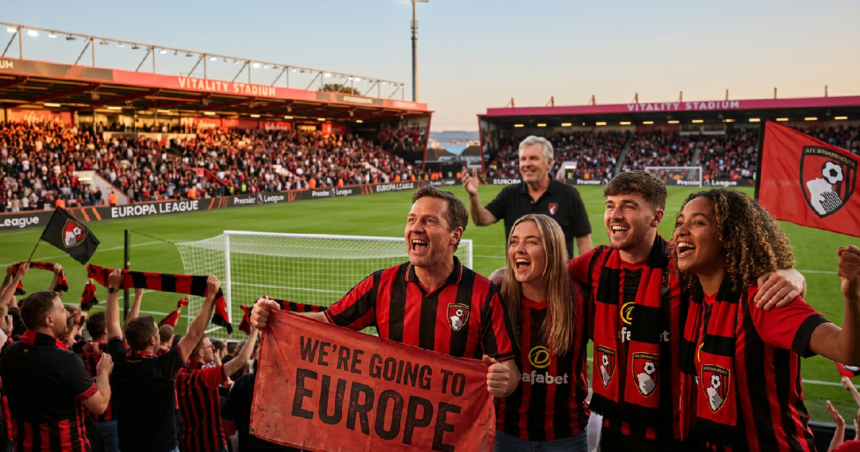
The prospect of European football arriving at the Vitality Stadium has moved from a fever dream to a tangible objective. For a club that spent the better part of its history languishing in the lower tiers of the English pyramid, the current trajectory under the stewardship of Bill Foley and the tactical direction of his coaching staff feels terminal in the best possible way. This isn’t just about a potential fixture list; it’s about a fundamental shift in the club’s DNA.
For Bournemouth fans, the term “euphoria” is often associated with the 2015 promotion or the Great Escape of 2009. But those were moments of survival and arrival. The current push for a continental spot represents something else entirely: evolution. It is the transition from a club happy to be part of the Premier League to one that actively disrupts the established order.
The Foley Era and the Cultural Shift
Since the takeover by the American billionaire, the narrative around the Cherries has shifted. It isn’t just about spending; it’s about the infrastructure and the belief that a coastal town in Dorset can compete with the historic giants of Milan, Seville, or Frankfurt. Bill Foley hasn’t hidden his ambitions, and that transparency has trickled down to the terraces.
The feeling among the squad and the supporters is that the ceiling has been removed. Where previous seasons were defined by a desperate hunt for 40 points, the current dialogue focuses on how the squad can sustain its high-intensity press against top-tier opposition. It’s a psychological evolution as much as a tactical one. As clubs shift strategy as the summer transfer window looms, Bournemouth find themselves in the enviable position of being a destination rather than a stepping stone.
Tactical Identity as a Foundation for Europe
Success on the pitch hasn’t been an accident. The club’s recent data-driven approach to recruitment and a commitment to a specific, aggressive brand of football have paid dividends. The coaching staff has instilled a “no fear” mantra that has seen the Cherries take points off the “Big Six” with increasing regularity.
The evolution is visible in the squad’s depth. They’re no longer reliant on one or two individual talents to drag them through games. Instead, they operate as a cohesive unit that thrives on transition. This style is particularly well-suited to the demands of European competition, where tactical flexibility and physical conditioning are tested to their limits. For the fans, seeing their team go toe-to-toe with the elite has become the new normal, but the prospect of doing it under the lights on a Thursday or Tuesday night is what fuels the current excitement.
What Continental Qualification Means for the Town
Logistically, European football brings challenges. The Vitality Stadium, with its modest capacity, would become one of the most intimate and intimidating venues in continental competition. While some may see the stadium size as a limitation, the fans see it as an advantage — a cauldron of noise that foreign giants would find unsettling.
There is also the economic impact. A European campaign elevates the profile of the town, attracting investment and a different caliber of global attention. But more than the money, it’s about the “euphoria” of the achievement. It would be a validation of a decade-long journey from the brink of liquidation to the grandest stages in sport. The club isn’t just surviving the Premier League anymore; they are looking to expand its boundaries.
A Long-Term Vision Realized
And yet, as the season reaches its business end, the focus remains internal. The players and staff are wary of the “E-word” becoming a distraction. But for the supporters, it’s impossible not to dream. The evolution of Bournemouth is a testament to what can be achieved with clear ownership, a distinct tactical philosophy, and a fanbase that refuses to let the club’s size dictate its ambition.
Whether it happens this season or the next, the trajectory is clear. The Cherries are no longer a novelty act in the top flight. They are a club in the midst of a metamorphosis, and the “euphoria” of European nights would simply be the final proof of their evolutionary jump.
Bournemouth European Ambitions FAQ
Would Bournemouth need a new stadium for European matches?
While the current stadium is small, it meets the basic UEFA requirements for the early stages of competition. However, long-term European aspirations are a major reason why the club is exploring stadium expansion or a new build to increase capacity and revenue.
How has the new ownership changed the club’s goals?
Bill Foley has moved the goalposts from “staying up” to “moving up.” The investment has focused not just on players but on the training ground and recruitment data, aiming to make Bournemouth a top-half mainstay eligible for UEFA competitions.
Which European competition is the most likely target?
Given the current competitive nature of the Premier League, the UEFA Conference League or the Europa League are the most realistic entry points for a club of Bournemouth’s current stature as they continue their upward trend.