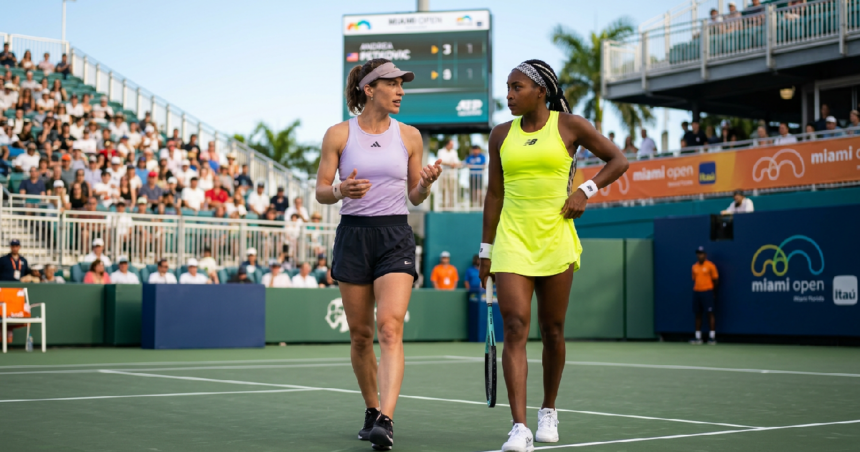
As the dust settles on the sunshine double and the tour pivots toward the European clay, a consensus is forming among tennis analysts about how we measure the progress of young stars. Chief among the topics of conversation is Coco Gauff, whose performance at the Miami Open has sparked a broader debate about the expectations placed on the shoulders of the reigning US Open champion.
Former world number nine Andrea Petkovic has stepped into the fray, making a compelling case for fans and pundits to recalibrate their perspective on Gauff. The German, who has become one of the most insightful voices in the sport since her retirement, suggests that the hyper-fixation on Gauff’s technical flaws—specifically her forehand—is obscuring the reality of her consistent achievement in a volatile era of women’s tennis.
Beyond the technical microscope
It is no secret that Gauff’s game is under more scrutiny than perhaps any other player on the WTA Tour. Every hitch in her forehand wing is analyzed, and every double fault is categorized as a systemic failure. However, Petkovic points out that this narrative ignores the fundamental objective of professional sport: finding a way to win regardless of the aesthetic.
During the Miami Open, Gauff showed flashes of the defensive brilliance that has become her trademark, even when her primary weapons weren’t firing at a hundred percent. For Petkovic, the obsession with “perfecting” Gauff’s game is a distraction from the fact that at just 22 years old, the American is already a fixture in the latter stages of major tournaments. The argument isn’t that the forehand doesn’t need work, but that the work shouldn’t define her entire identity as a competitor.
Gauff’s ability to stay within the top rungs of the rankings while being a “work in progress” is, in Petkovic’s view, a testament to her mental fortitude rather than a reason for criticism. She manages the pressure of being the face of American tennis while simultaneously undergoing a public reconstruction of her technique—a feat few of her predecessors had to manage under such a bright spotlight.
The burden of the generational label
Part of the friction in the public perception of Gauff stems from the “Next Big Thing” label applied to her since she was 15. When a player wins a Grand Slam as a teenager, the expectation is often a linear progression to total dominance. When that dominance resembles a steady, sometimes rocky, climb rather than a sudden takeover, the “disappointment” narrative begins to creep in.
Petkovic’s intervention is a reminder that the path of a champion is rarely a straight line. By focusing on what Gauff “can’t” do yet, fans are missing the elite-level problem-solving she exhibits on court. In Miami, even in matches where she struggled for rhythm, her movement and court coverage remained world-class. It’s this floor—the level she plays at on her worst days—that Petkovic believes should be the real story.
And let’s be clear: Gauff’s “struggles” still result in deep runs at 1000-level events. While the peak of Iga Swiatek remains the gold standard, Gauff has solidified herself as one of the few players capable of consistently challenging that hierarchy. But to appreciate that, you have to stop looking for what’s missing and start looking at what she’s actually producing.
Looking toward the clay season
As the tour moves to the red dirt, the conversation will undoubtedly shift. Clay historically allows more time for Gauff to set up her shots, potentially masking some of the technical issues that hard courts expose. It is a surface where her athleticism is a force multiplier, and where she has previously reached a Roland Garros final.
Petkovic’s plea for a perspective shift comes at a crucial time. If Gauff can navigate the clay season with the support, rather than the skepticism, of the tennis community, the mental burden might lighten. The reality is that Coco Gauff is already a great player who is trying to become an all-time great. Expecting her to be the finished product today is not just unfair; it’s a misunderstanding of how tennis development works.
The Miami Open didn’t end with a trophy for Gauff this year, but according to Petkovic, it should have ended with a renewed respect for a player who refuses to buckle under the weight of a billion opinions. Whether the fans will actually take that advice remains to be seen.
Common questions about Coco Gauff
Why is there so much focus on Coco Gauff’s forehand?
Technically, Gauff’s forehand has a more extreme grip and a longer backswing than her backhand, which can lead to timing issues against fast, low-bouncing balls. Because it is her most vulnerable shot, opponents target it, and commentators focus on it as the “missing piece” that would make her truly dominant.
What exactly did Andrea Petkovic say about her?
Petkovic emphasized that fans should look at Gauff’s “effective” tennis rather than “perfect” tennis. She argued that Gauff’s ability to win matches while still developing her game is a sign of elite maturity and that the constant criticism of her technique ignores her massive competitive strengths.
How has Gauff performed since her US Open win?
Gauff has remained remarkably consistent, staying inside the top 3 of the world rankings and reaching several semi-finals and finals. While she hasn’t added a second Grand Slam yet, her “bad weeks” are still better than the “good weeks” of 95% of the tour, which is the point Petkovic is trying to drive home.