The dawn of the 2026 Formula 1 season represents one of the most drastic shifts in the sport’s technical history. As the federation and teams prepare for a total overhaul of both power units and chassis designs, concerns have mounted within the paddock regarding the efficacy of the new regulations. Yet, Mick Schumacher remains steadfast in his belief that the engineering prowess of the grid will overcome any initial hurdles.
The former Haas driver and current Mercedes reserve has voiced his confidence in the sport’s ability to refine and correct its path. While critics have highlighted potential issues with the balance between electric and internal combustion power, Schumacher suggests that the collective intelligence of F1 teams is often underestimated. He maintains that the sport has a unique “corrective power” that kicks in whenever a new set of rules faces early friction. And while the regulations look daunting on paper, the history of the sport suggests that engineers are adept at finding performance where others see limitations.
Addressing the 2026 Power Unit and Chassis Shift
The upcoming changes are not merely incremental. For 2026, Formula 1 is moving toward a near 50-50 split between electrical energy and the internal combustion engine (ICE). To compensate for the added weight of larger batteries and to ensure racing remains competitive, the cars themselves are expected to become shorter, narrower, and lighter. This shift has led to some simulations suggesting a drop in top speeds or awkward energy management strategies on longer straights.
Despite these technical anxieties, Schumacher points out that the development cycle is far from over. He believes that F1 has a history of identifying flaws during the testing phase and implementing swift solutions. This perspective aligns with how teams managed the transition to ground-effect aerodynamics in 2022, where early problems like “porpoising” were eventually mitigated through technical directives and design evolution. Much like how Oscar Piastri reportedly navigated difficult track conditions at Suzuka, the 2026 transition will require drivers and teams to adapt to unpredictable challenges in real-time.
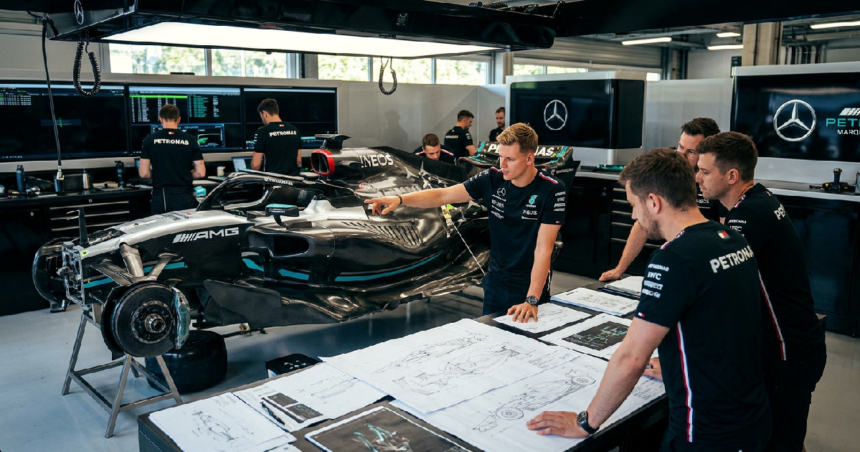
The role of reserve drivers and simulator experts has become increasingly vital during this transition. Much of the quiet work behind the scenes is focused on the data sets for 2026. Schumacher, who spends significant time in the Mercedes simulator, understands the gap between initial theory and final on-track performance better than most. He notes that what looks like a problem in an early CAD drawing often has a solution by the time the carbon fiber is cured.
Schumacher on the Resilience of F1 Engineering
The skepticism surrounding the 2026 rules often centers on the “active aerodynamics” required to make the cars efficient enough for the new engines. If the wings do not adjust correctly, there are fears that the cars could become unstable or difficult to handle in high-speed sections. Schumacher, however, argues that the sport’s technical minds thrive under these constraints. He views the 2026 regulations as a puzzle rather than a barrier.
In his view, once the teams get their hands on the final specifications, the rate of development will be so rapid that many of the current concerns will likely vanish by the first pre-season test. The history of the sport supports this; whenever a rule change is intended to slow the cars down or make them greener, engineers find ways to claw back the performance through innovative packaging and clever aerodynamic solutions. Just as recent sport news updates have highlighted shifts in other major competitive disciplines, F1 is also navigating a period of introspection and evolution.
Balancing Sustainability and Spectacle
A major pillar of the 2026 rules is the move toward fully sustainable fuels. This is part of the sport’s broader strategy to remain relevant in a world increasingly focused on carbon neutrality. However, maintaining the spectacle of F1—the speed and the sound—is a delicate balancing act. Some drivers have expressed worry that the cars might feel too electronic or lose the raw mechanical edge that defines grand prix racing.
The goal is to ensure that the sport remains the pinnacle of motorsport while adhering to new environmental standards. Schumacher believes that as long as the competition remains close, the fans will embrace the change, regardless of how the power is generated. The focus remains on the racing itself, which remains the primary draw for the global audience.
What Lies Ahead for the 2026 Grid
As the 2026 season approaches, the focus is shifting toward how the hierarchy might be reshuffled. Major manufacturers like Audi are entering the fray, and the relationship between engine suppliers and chassis builders will be more critical than ever. Schumacher’s optimism reflects a broader sentiment among some insiders: that the chaos of a rule change is an opportunity rather than a threat.
While the technical regulations are still being fine-tuned, the resolve of the teams appears strong. They are already diverting resources toward 2026 projects, ensuring that they are not left behind when the first lights go out under the new era. Schumacher’s insights provide a window into the confidence that exists within the top-tier teams, even as the public debate over the future of the sport continues to swirl. Much like Gavin Cromwell is reportedly preparing targets for the Grand National with careful attention to detail, F1 teams are currently in the deep preparation phase for their own high-stakes gamble in 2026. Whether the corrective power Schumacher speaks of will lead to a perfectly balanced formula remains to be seen, but the track record of Formula 1 suggests that engineering ingenuity usually wins the day.