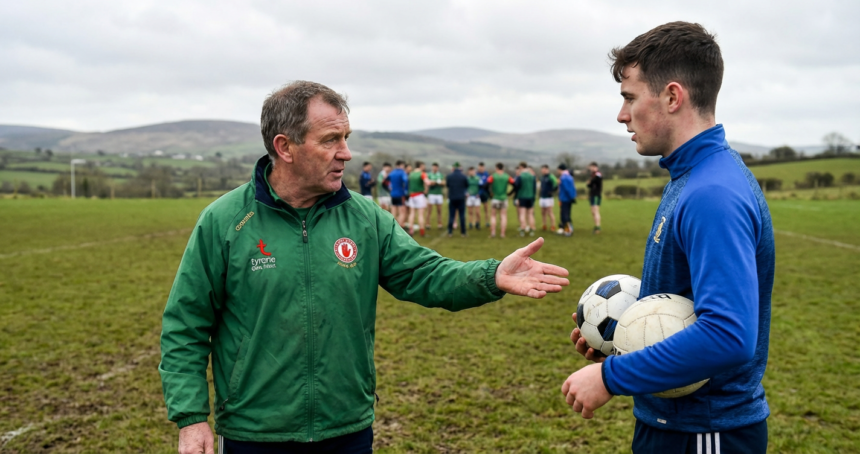
Former Tyrone star Colm McCullagh has underlined the considerable challenges a player faces when making the leap from professional soccer to the rigorous environment of county Gaelic football. His comments come as a notable Tyrone player, recently returned from a stint in the soccer world, embarks on integrating into the senior county panel.
McCullagh, a respected voice in Gaelic games, emphasised that while talent is undeniable, the fundamental differences in the sports necessitate a significant period of adaptation. It’s not simply about fitness; it’s a complete recalibration of instinct, spatial awareness, and the very mechanics of ball control and movement.
The Cross-Code Conundrum
The transition from soccer to Gaelic football is far from straightforward. While both sports demand high levels of athleticism, the specific physical and tactical requirements diverge dramatically. A player accustomed to the precise footwork and limited handling rules of soccer suddenly finds themselves in a game where aerial battles, hand-passing, and unique tackling techniques are paramount. This isn’t just a minor tweak; it’s a fundamental shift in how the game is played and perceived.
For instance, the constant upper-body engagement in Gaelic football – from catching high balls to fending off opponents – is often alien to a soccer player. The larger pitch dimensions, the varied scoring methods (goals and points), and the emphasis on continuous play all contribute to a demanding learning curve. Many observers will be keen to watch how a talent navigates such a significant career change, a decision often fraught with complexity, reminiscent of situations where players face pivotal choices about their club futures.
McCullagh’s Perspective on Integration
McCullagh’s insights stem from years at the highest level of Gaelic football. He understands the tactical intricacies and the sheer physical output required to compete at inter-county standard. His message is clear: patience is key. It’s a message that resonates deeply within the GAA community, where raw talent must be honed and sculpted to fit the unique demands of the game.
The former forward highlighted that even elite athletes require time to adjust their muscle memory and decision-making processes to a new code. The speed of thought, the angles of runs, and the instinctive reactions to a live ball are all vastly different. It’s a delicate balance for coaching staff to manage, integrating new talent while ensuring the team’s cohesion isn’t disrupted. Any major player movement or decision can have significant ripple effects on team dynamics, much like when teams seek replacements for key departing players in other top leagues.
Here’s a breakdown of some key differences between the two codes that underscore McCullagh’s point:
| Attribute | Soccer (Association Football) | Gaelic Football |
|---|---|---|
| Primary Ball Skill | Kicking (feet), heading (head) | Kicking (feet), handling (hands), catching |
| Playing Surface Size | Standard rectangular pitch (approx. 100-110m x 64-75m) | Larger rectangular pitch (approx. 130-145m x 80-90m) |
| Team Size | 11 players | 15 players |
| Physicality | Continuous running, tactical fouling, shoulder challenges, minimal hand use | High-intensity running, aerial contests, direct physical challenges, tackling with hands, vigorous fending |
| Scoring Methods | Goals only (into net) | Goals (3 points, into net), Points (1 point, over bar) |
| Core Movement with Ball | Dribbling, passing, shooting (all with feet) | Carrying, soloing (bouncing/toeing ball), hand-passing, kicking, catching |
The Road Ahead for the Tyrone Player
The journey for the player in question will undoubtedly be scrutinised, but McCullagh’s comments serve as a timely reminder of the nuances involved. It’s a process that demands dedication, resilience, and a willingness to relearn many fundamental aspects of team sport. The Tyrone management team, like any professional sporting organisation, will be focused on providing the necessary support and development pathways. Effective leadership and strategic direction from the sporting director and coaching staff will be vital in facilitating a smooth integration and ensuring the player reaches their full potential in the Gaelic code.
Fans, too, will need to temper expectations. The immediate impact might not be what some anticipate. Instead, a gradual progression, marked by incremental improvements in skill execution and tactical awareness, is the more realistic outlook. The ultimate success of this transition will hinge on the player’s commitment to adapting and the collective patience of those around them.
Frequently Asked Questions
Q: Why is transitioning from soccer to Gaelic football considered difficult?
A: The sports, while both involving a ball and a pitch, have vastly different rule sets and physical demands. Gaelic football involves extensive hand-eye coordination for catching and hand-passing, significantly more physical contact in open play, and a different type of sustained athleticism compared to soccer. Players must unlearn certain habits and develop entirely new skill sets.
Q: How long does it typically take for a player to adjust to a new sport at a professional level?
A: There’s no set timeframe, as it heavily depends on the individual’s natural aptitude, dedication, and the specific demands of the new sport. However, for a transition between two distinct codes like soccer and Gaelic football at an inter-county level, it often takes a full season, or even longer, for a player to truly feel comfortable and perform consistently at their peak.
Q: What kind of support would a player need during such a transition?
A: Comprehensive support is crucial. This would include specialised coaching to refine Gaelic football specific skills, tailored physical conditioning programmes to build the required endurance and strength, and tactical education to understand the team’s system and game plan. Mental conditioning is also vital to help the player navigate the frustrations and challenges of adapting to a new environment and set of expectations.