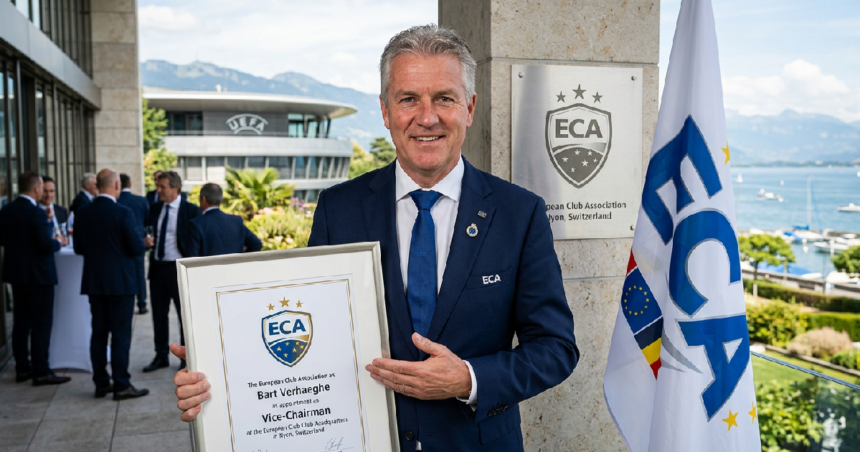
The landscape of European football governance shifted today as Bart Verhaeghe, the chairman of Club Brugge, was officially appointed as the Vice-Chairman of the European Club Association (ECA). The move, confirmed following a series of board meetings in Nyon, places the Belgian executive at the heart of the decision-making process for the continent’s most powerful clubs.
Verhaeghe’s elevation comes at a pivotal moment for the ECA. As the organization represents the interests of over 600 professional football clubs across UEFA’s member associations, his new role will involve navigating the increasingly complex relationship between domestic leagues and expanded European competitions. He joins a leadership tier tasked with managing the commercial and regulatory fallout of the new Champions League format and the ever-present discussions regarding wealth redistribution.
A Strategic Win for Mid-Tier European Leagues
For years, the ECA leadership has been dominated by the heavyweights of the Premier League, La Liga, and the Bundesliga. Verhaeghe’s appointment is seen by many in the industry as a nod toward the “middle class” of European football—clubs like Brugge, Ajax, and Porto—who consistently compete at the highest level despite smaller domestic television markets.
Verhaeghe has been the driving force behind Club Brugge’s modern era, overseeing a period of sustained domestic dominance and strategic financial growth. His ability to modernize the Belgian champions, particularly through infrastructure development and a sophisticated scouting network, has made him a respected figure in boardrooms across Europe. By bringing this perspective to the ECA’s executive committee, he is expected to advocate for a more balanced continental ecosystem.
But the job won’t be easy. The ECA is currently balancing the demands of “super clubs” that want more guaranteed revenue with the needs of smaller clubs fighting for survival. Verhaeghe has previously spoken about the necessity of protecting the “meritocratic nature” of the sport, a stance that may be tested as the debate over the 2024-2027 commercial cycle continues.
The Growing Influence of Club Brugge’s Vision
This appointment is not just a personal accolade for Verhaeghe; it signals a rising profile for Belgian football. Under his chairmanship, Club Brugge has become a regular fixture in the Champions League group stages and beyond, proving that a well-run club from a smaller league can still punch above its weight.
The ECA’s decision to promote him reflects a desire for stability. After the seismic shocks caused by the Super League breakaway attempt in 2021, the association has been trying to rebuild trust among its members. Verhaeghe was among those who remained vocal about the importance of working within the UEFA framework while still demanding reforms that benefit a wider range of clubs. As clubs shift strategy as the summer transfer window looms, having a voice like Verhaeghe’s at the top of the ECA could influence how Financial Fair Play (FFP) and squad cost ratios are applied across different tiers of the game.
Navigating the Future of European Governance
The Vice-Chairman role puts Verhaeghe in the room for the most sensitive negotiations regarding the future of the game. Key items on the upcoming agenda include the potential expansion of the Club World Cup and the ongoing legal challenges regarding the governance of European football. There is also the matter of the “soldarity” payments that filter down to non-competing clubs, a mechanism Verhaeghe has historically suggested needs more transparency.
With the North American World Cup facing daunting logistical hurdles on the horizon, the ECA will also be focusing on the international match calendar. Verhaeghe will likely be a key mediator between clubs who are concerned about player welfare and governing bodies looking to maximize the global footprint of the sport.
As he steps into this role, the eyes of the Belgian Pro League will be on him. They will hope that his presence in Nyon ensures that the interests of leagues outside the “Big Five” are not just heard, but prioritized during this era of rapid commercial expansion.
Frequently Asked Questions
What exactly is the European Club Association (ECA)?
The ECA is the only independent body directly recognized by UEFA and FIFA to represent the interests of professional football clubs at the European level. It consists of hundreds of member clubs who vote on policies regarding competition formats, commercial rights, and transfer regulations.
How long will Bart Verhaeghe serve in this role?
Appointments to the ECA Board typically follow the organization’s election cycles, which generally run for four years. Verhaeghe will serve as a key deputy to the Chairman, participating in the Executive Board’s regular strategic reviews.
Does this role affect his position at Club Brugge?
No, Verhaeghe remains the Chairman and primary figurehead of Club Brugge. His role at the ECA is an external appointment intended to represent the interests of the European club community while he continues to lead the Belgian side’s domestic and international operations.