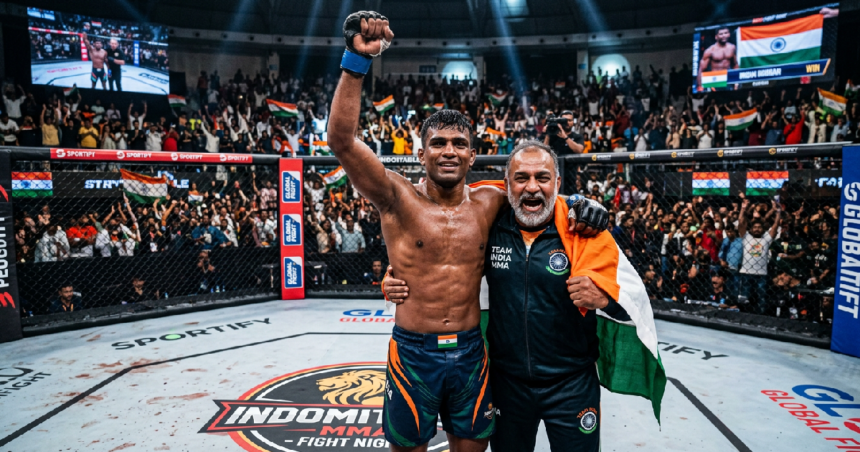
India is no longer a peripheral player in the world of mixed martial arts. At the latest high-octane fight night, a new wave of talent from the subcontinent proved they could handle the pressure and the pace of top-tier competition. While the region has long been overlooked in favor of established powerhouses like Brazil, the United States, and Russia, the performances showcased recently suggest that the infrastructure and talent mapping within India are finally yielding results.
The event, which drew eyes from global scouts and local fans alike, served as a referendum on whether Indian fighters could move beyond regional dominance and compete under the brightest lights. For years, the narrative has been about the potential of the Indian market—a massive demographic with a history of wrestling and combat sports. But tonight, that narrative shifted from potential to production. The technical proficiency on display, particularly in the grappling exchanges, signaled that the current generation is training with an eye on the world stage.
Establishing a New Guard in Training and Technique
The success seen at this fight night is not an accident of nature; it is the byproduct of a shifting training culture. Historically, Indian mixed martial arts struggled with a lack of high-level coaching in the “transition” phases of the sport—specifically the clinch and the wall-walk. However, as more Indian athletes spend time at camps in Thailand, Dubai, and Singapore, those gaps are closing. We are seeing a more sophisticated approach to the cage, where fighters are no more reliant on raw athleticism or a single discipline.
One of the standout elements of the evening was the tactical patience shown by the Indian contingent. In previous years, there was a tendency for regional fighters to rush into brawls, leading to early fatigue or defensive lapses. At this high-octane event, we saw a measured approach. They were setting traps, working behind the jab, and using footwork to dictate the geometry of the cage. It’s the kind of maturity that usually takes decades to develop in a domestic scene, yet India seems to have fast-tracked the process.
The Impact of Global Scouting and Investment
Promotion giants have been circling India for some time, and nights like this explain why. The commercial appeal is obvious, but the technical viability was always the question mark. With several dominant finishes and a few gritty, come-from-behind victories, the Indian fighters have made themselves impossible to ignore. This doesn’t just mean more local shows; it means more contracts with major organizations where the level of competition is exponentially higher.
But it isn’t just about the winners. Even in the losses, the competitiveness of the Indian fighters was a topic of conversation among the pundits. They are no longer “easy outs” on a global card. They are durable, technically savvy, and increasingly comfortable with the psychological demands of being a featured attraction. This shift will likely lead to more investment in domestic academies, creating a virtuous cycle that could see an Indian champion sooner than many expected.
The Long Road to Championship Gold
Despite the celebrations, the road ahead remains steep. Breaking into the top 15 of a major global promotion is a different beast entirely. It requires more than just winning a high-octane fight night; it requires a level of consistency and specialized strength and conditioning that is still being refined in many Indian gyms. The elite 1% of the sport are specialists in every phase, and while Indian fighters are closing the gap, the final hurdle is often the hardest to clear.
And yet, the momentum is undeniable. There is a sense of belief now that wasn’t there five years ago. Young fighters in Mumbai, Chennai, and Delhi are looking at tonight’s results and seeing a viable career path. They aren’t just looking to compete; they are looking to take over. If the current trajectory holds, India’s stake in the MMA world will only grow, transforming from a market to be sold to, into a talent pool to be reckoned with.
Frequently Asked Questions
Is MMA becoming more popular than traditional wrestling in India?
While traditional wrestling (Kushti) remains a cultural staple, MMA is rapidly gaining ground, especially among the urban youth. The success of Indian fighters on international platforms is bridging the gap, showing that wrestling skills can be a lucrative foundation for a professional MMA career.
What training centers are producing these fighters?
There is a mix. Many fighters still start in local wrestling hubs (akhadas), but they are increasingly gravitating toward specialized MMA gyms in major cities or seeking training stints abroad in places like Tiger Muay Thai or AKA Thailand to round out their skill sets.
Are we likely to see a major MMA event in India soon?
The appetite is certainly there. Major promotions have hinted at a return to Indian soil, and with a growing roster of competitive local athletes to fill out the undercard, the logistical and commercial case for a major show is stronger than ever.