The race for silverware and the logistics of global competition have dominated the sporting landscape this Wednesday. As domestic seasons reach their critical junctures and international bodies prepare for the challenges of a multi-national hosting cycle, the focus is squarely on how the world’s biggest events will actually function on the ground.
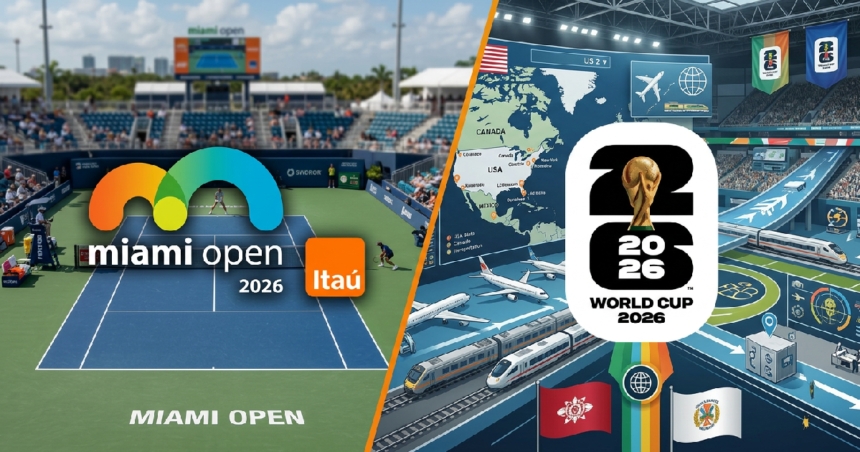
In the tennis world, attention has shifted to the latter stages of the Miami Open, where tactical nuances are beginning to separate the contenders from the also-rans. Meanwhile, football organizers are grappling with the immense physical and organizational demands of the upcoming 19th edition of the FIFA World Cup, a tournament set to test the limits of North American infrastructure.
Miami Open Pressure Builds for Arthur Fils
The semi-final stage of the Miami Open often serves as a litmus test for the next generation of talent. Frenchman Arthur Fils has found himself under the microscope, specifically regarding his tactical approach against high-caliber opponents. Jim Courier, the former world number one and respected analyst, has been vocal about the technical hurdles Fils must clear to reach the next level.
Courier’s assessment suggests that while the raw power and athleticism are present, a specific “tactical flaw” could be his undoing in the upcoming semi-final. In high-stakes matches, the ability to adjust mid-set is what defines champions, and Fils is now at the stage where physical gifts alone are insufficient. For more on the technical breakdown, you can read about how Jim Courier identifies a tactical flaw in Fils ahead of the semi-final.
Logistical Shadows Over the World Cup
While players focus on the pitch, administrators are looking at a map of North America with increasing concern. The 2026 World Cup is unprecedented in its scale, stretching across the United States, Canada, and Mexico. The sheer distances involved present a nightmare for team recovery and fan travel alike.
There is a growing realization that this won’t be a typical tournament where fans can hop on a train between host cities. The reliance on air travel, coupled with varying customs regulations and the sheer volume of supporters, has created what some are calling a daunting logistical hurdle. The debate isn’t just about the football anymore; it’s about whether the infrastructure can sustain the ambition of a 48-team tournament spread across a continent. Detailed reports suggest that logistical hurdles are becoming a primary concern for the organizing committees.
Aintree Preparations Heat Up
In the world of horse racing, the road to Aintree is narrowing. Trainer Gavin Cromwell has confirmed that Final Orders is being aimed squarely at a raid on the Grand National. The horse has shown the kind of jumping proficiency and stamina that suggests he could be a live threat in the world’s most famous steeplechase.
The Grand National remains a unique test of both horse and rider, and Cromwell’s confidence indicates that Final Orders has come out of his recent outings in peak condition. Betting markets are already beginning to react to the confirmation of his entry. Those tracking the build-up can find more on how Cromwell confirms Final Orders targets Aintree.
Shifting Tactics in Football Recruitment
Away from the immediate results, Premier League clubs are already deep into their planning for the summer transfer window. The financial landscape has shifted, and with it, the strategy for long-term squad building. Many clubs are moving away from the “scattergun” approach of previous years, opting instead for data-driven recruitment that prioritizes age profile and resale value.
This shift is partly a response to tighter financial regulations and partly a realization that overspending on established stars doesn’t always guarantee a return on investment. As the window approaches, expect to see more calculated moves rather than high-profile bidding wars. Analysts have noted that clubs are shifting strategy ahead of the summer window to mitigate financial risk.
Sporting Landscape FAQ
Is the World Cup logistics issue manageable?
While the organizing committees express confidence, the reality of moving millions of people across three massive countries remains a significant challenge. Solutions involve dedicated “fan corridors” and increased flight frequencies, but the physical scale remains unchanged.
What is the main concern for Arthur Fils in Miami?
The primary concern, according to analysts like Jim Courier, is a lack of “Plan B” when his aggressive baseline game is neutralized. Top-tier opponents are adept at exploiting predictable patterns, which Fils must now address.
Why is Gavin Cromwell focusing on Aintree for Final Orders?
The horse’s profile—specifically his ability to find a rhythm over large fences and his proven engine—makes the Grand National a logical, albeit difficult, target. Cromwell believes the horse’s current form justifies the ambition.