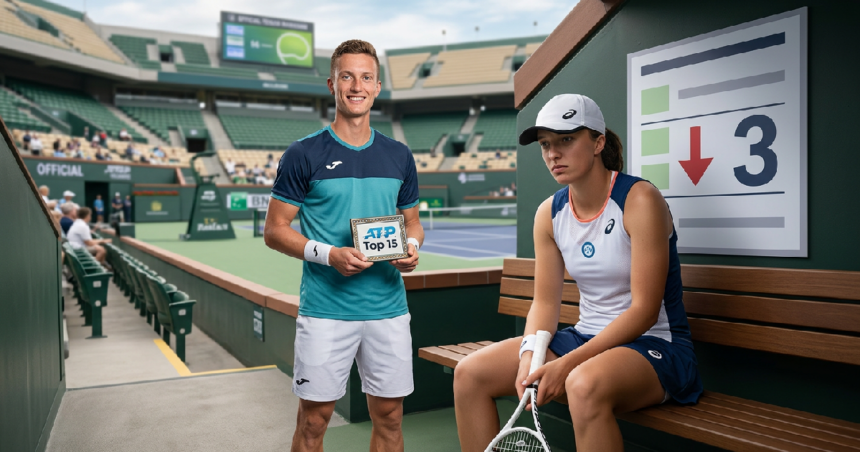
The landscape of the WTA and ATP rankings has undergone a seismic shift this week, headlined by Iga Swiatek’s departure from the world’s top three and a career-best ascent for Jiri Lehecka. For Swiatek, who has spent the better part of the last two years as the undisputed force in women’s tennis, the slide reflects a period of heightened volatility at the top of the women’s game.
Rankings in tennis are often a trailing indicator of momentum, and for Swiatek, the points drop-off comes at a time when her rivals are finding their stride on surfaces where the Pole has previously been dominant. While she remains a perennial favorite entering any tournament, the buffer she once enjoyed over the field has evaporated, allowing a new vanguard to occupy the top three spots.
Swiatek falls from top three as hierarchy shifts
Iga Swiatek’s fall to World No. 4 marks a significant milestone in her career arc. Since her breakout, the Polish star has been synonymous with the top of the ladder, but a combination of early exits in recent high-stakes tournaments and the surging form of her closest competitors has forced this retreat. It’s not so much an indictment of Swiatek’s quality—she remains arguably the most complete player on tour—but rather a testament to the consistency of the players now sitting above her.
The points race has been tightening for months. With the rankings being a 52-week rolling system, failing to defend deep runs from the previous season can be punishing. For Swiatek, this slip below the world No. 3 mark changes the optics of upcoming draws. She will no longer be guaranteed a top-two seed, meaning she could potentially face the world’s best as early as a semi-final, rather than a final, depending on tournament structures.
But Swiatek has never been one to obsess over the numbers. Her focus has consistently remained on the tactical side of her game. And yet, there is no denying that the psychological aura of being “the” world number one or a top-three fixture provides a certain leverage over opponents. How she responds during the upcoming swing will determine if this is a temporary dip or a sign of a more balanced era in the WTA.
Lehecka crashes the ATP top 15
On the men’s side, the story is one of rapid ascension. Jiri Lehecka has officially broken into the Top 15, a feat that confirms his status as one of the most dangerous young players on the ATP Tour. The Czech’s rise has been building for some time, characterized by a heavy baseline game and a composure that belies his age.
Entering the Top 15 is a major hurdle for any rising pro. It moves Lehecka into the category of “dark horse” for majors to a legitimate protected seed that most top-five players would prefer to avoid in the early rounds. His recent performances against established veterans have shown that his game travels well across different surfaces, though his power is particularly devastating on quicker hard courts.
Lehecka’s entry into this elite bracket also signals a resurgence for Czech men’s tennis. Not since the days of Tomas Berdych has the nation had such a consistent threat in the upper echelons of the rankings. For Lehecka, the challenge now is maintaining the physical intensity required to stay in the Top 15, where the margin for error is razor-thin.
Implications for the upcoming tournament cycle
These ranking changes arrive at a critical juncture in the season. With major events on the horizon, the seeding ripples will be felt immediately. Swiatek’s drop means she is now the hunted rather than the hunter in terms of bracket positioning. She will be looking to claw back those points immediately, but the competition at the top—featuring the likes of Aryna Sabalenka and Elena Rybakina—is perhaps the fiercest it has been in half a decade.
For Lehecka, the Top 15 status provides a level of scheduling freedom. He can now be more selective with his entries, ensuring he is fresh for the Masters 1000 events and the Slams. The tennis world is watching to see if he can take the next step into the Top 10, a move that requires not just brilliance, but a relentless week-in, week-out grind.
Frequently Asked Questions
Why did Iga Swiatek fall in the rankings?
Tennis rankings are based on a 52-week rolling system. Swiatek fell below No. 3 because she was unable to defend the significant points she earned during the same period last year, while her immediate rivals performed more consistently in recent months.
What does a Top 15 ranking mean for Jiri Lehecka?
It guarantees him higher seeding in major tournaments, meaning he will avoid playing the world’s top four players until at least the fourth round or quarter-finals. It also significantly increases his prize money potential and sponsorship value.
Can Swiatek return to world number one soon?
Yes. The points gap between the top four players is often quite narrow. A single title win at a 1000-level event or a deep run at a Grand Slam can see a player jump several spots in the rankings within a single week.