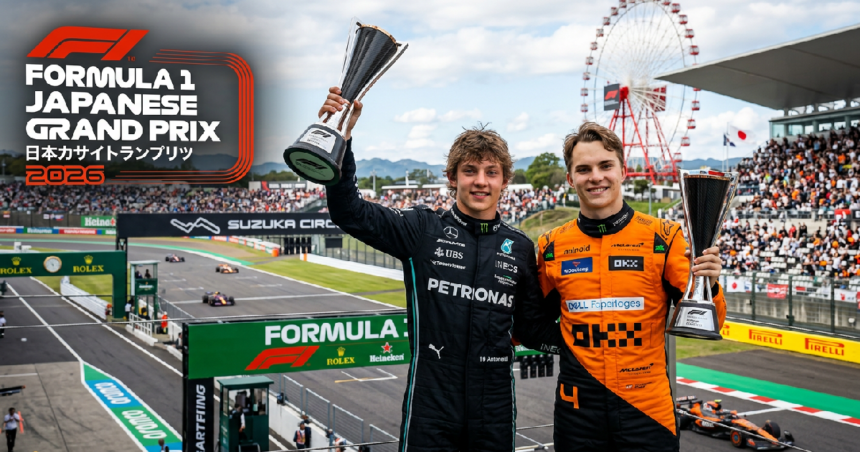
SUZUKA — The heir apparent to the Mercedes throne has officially arrived on the world stage. Kimi Antonelli secured a commanding victory at the Japanese Grand Prix on Sunday, steering his Silver Arrows machine to a win that felt less like a maiden triumph and more like the start of an era. Behind him, Oscar Piastri continued his own ascent, bringing his McLaren home in second place to secure a podium that underscores a generational shift in Formula 1.
Antonelli, who has faced intense scrutiny since being named as the successor to Lewis Hamilton, delivered a performance of poise and technical precision. On a circuit legendary for punishing even the slightest lapse in concentration, the teenager drove a race that mirrored the legends who conquered Suzuka before him. From the moment the lights went out, the result rarely felt in doubt, despite the logistical and tactical challenges posed by a high-degradation surface.
Total control at the Temple of Speed
While many expected the veteran guard to reclaim their territory in Japan, Antonelli’s pace during the middle stint was the deciding factor. He managed his tires with a maturity that defied his lack of experience, stretching his opening run just long enough to maintain track position through the first round of pit stops. It wasn’t just about speed; it was about the intelligence of his defense when under pressure from the charging McLaren of Piastri.
And while Antonelli took the headlines, Oscar Piastri’s drive shouldn’t be overlooked. The McLaren driver has become the most consistent challenger to the front-runners this season. He shadowed the Mercedes for much of the final ten laps, keeping the gap under two seconds, but Suzuka’s notorious “dirty air” in the final sector made a lunge into the chicane a high-risk gamble he ultimately chose not to take. A second-place finish maintains his momentum and cements McLaren’s status as a top-tier outfit again.
The tectonic plates of F1 are shifting
The significance of this result ripples far beyond the podium celebrations in Japan. For Mercedes, it validates a massive gamble. Moving on from a seven-time world champion is the hardest task a team principal can face, but Antonelli’s clinical nature under the Japanese sun suggests the recruitment strategy was sound. The team looks revitalized, perhaps freed from the weight of past expectations and focused on this new, raw potential.
The race also signals a difficult period for some of the established names. While the leaders traded fastest laps, others struggled with the high-speed transitions through the “S” Curves. Strategy played a vital role, with several teams opting for an aggressive two-stop plan that eventually fell victim to the smoother tire management of the lead pair. It’s clear that the technical regulations are finally producing the kind of tight, skill-based racing that fans have been demanding.
Looking at the broader season, Clubs Shift Strategy as Summer Transfer Window Looms in the sporting world, and similarly, F1 teams are now looking at their long-term lineups with fresh eyes. If a driver as young as Antonelli can dominate at Suzuka, the “safest” choice is no longer the only way to win.
What the results mean for the Championship
The haul of points for Antonelli catapults him into the conversation for the top spots in the driver standings. More importantly, it breaks the psychological barrier of that first win. For Piastri, the second-place finish is another brick in the wall of his championship aspirations. He is no longer the “promising rookie”; he is a legitimate contender who is extracting every ounce of performance from the McLaren chassis.
The paddock now turns its eyes toward the upcoming European swing. With the development race heating up, Mercedes and McLaren have set a high bar. Red Bull and Ferrari will be under immense pressure to bring upgrades that can neutralize the straight-line speed Mercedes showed today and the cornering efficiency of the McLaren.
Japan GP Frequently Asked Questions
How did Antonelli manage to beat Piastri in the final laps?
It came down to tire management in the second sector. Antonelli was able to hook up the Degner curves perfectly, which gave him enough of a gap through 130R to prevent Piastri from using DRS on the start-finish straight. It was a tactical masterclass in defensive positioning.
Is Mercedes now the fastest car on the grid?
It’s too early to say they are definitively the fastest across all tracks, but at high-downforce circuits like Suzuka, the W17 looks incredibly balanced. Their upgrade package brought to this race seems to have solved the rear-end instability that plagued them earlier in the season.
What happened to the pole-sitter during the race?
The race was won and lost in the pit lane. A slightly slow change on the front-right tire during the first stop cost vital seconds, allowing Antonelli to execute the overcut. Once you lose track position at a circuit like this, it is notoriously difficult to regain it without a massive tire advantage.