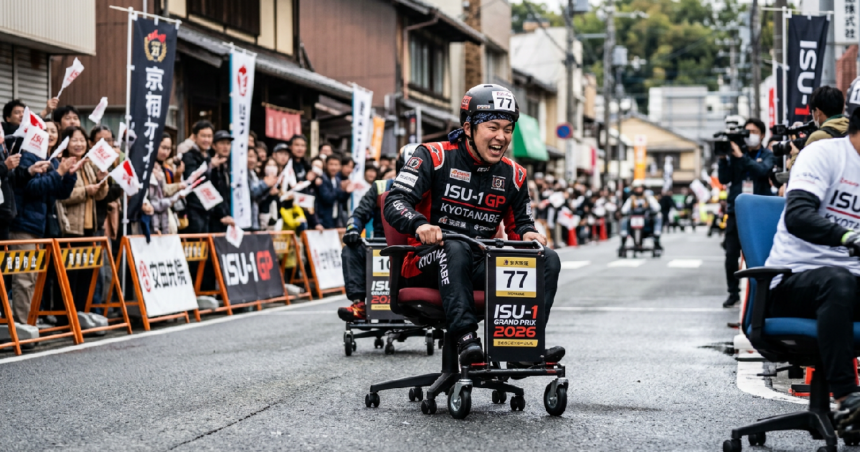
Kyotanabe’s street corners have seen their fair share of activity, but nothing quite matches the sight of dozens of corporate employees in business suits hurtling backward at high speed. The sport is Grand Prix Isu-1, an endurance race that has transformed the humble office chair from a piece of stationery into a high-performance racing machine. What began as a local promotional gimmick in 2010 has evolved into a grueling competitive circuit across Japan.
At first glance, it looks like a corporate team-building exercise gone wrong. But talk to any of the seasoned racers on the grid and they’ll tell you it’s closer to a marathon or a cycling criterium. Teams of three are tasked with completing as many laps of a 200-meter circuit as possible within a two-hour window. The catch? You can only move by propelling yourself backward with your legs.
The Evolution of the Isu-1 Grand Prix
The concept was born in a shopping district in Kyoto, originally intended to breathe life back into local commerce. However, the Japanese appetite for unique endurance challenges quickly turned it into a serious pursuit. Today, the Isu-1 Grand Prix (a play on the Japanese word for chair, ‘isu’) features several rounds across the country, attracting serious athletes and engineering enthusiasts alike.
The rules are deceptively simple but strictly enforced. Chairs must be commercially available, though they can be modified for durability. These modifications are essential because the stress placed on a standard swivel chair during two hours of intense friction is immense. Common failures include casters snapping off at high speed or seats literally disintegrating under the rhythmic torque of a racer’s legs. Many teams now bring “pit crews” equipped with spare parts and lubricants to keep their seats rolling.
Physiological Demands and Strategy
And then there is the physical cost. Unlike traditional running or cycling, the reverse-propulsion movement targets the quadriceps and calves in a way that most gym routines cannot replicate. Proponents of the sport often describe a unique brand of “thigh burn” that sets in around the 30-minute mark. Because the racers move backward, they must constantly check their shoulders to avoid collisions with other teams or the barriers, adding a layer of neck strain to the proceedings.
Strategic positioning is vital. In a two-hour race, managing the rotation of the three team members is the difference between a podium finish and a mid-pack collapse. Some teams favor short, high-intensity shifts of five minutes to maintain maximum velocity, while others prefer longer stints to minimize the time lost during “chair swaps”—the Isu-1 equivalent of a driver change in Le Mans.
Why Corporations are Buying In
While the visual of men in ties and helmets is inherently humorous, the competitive level is rising. Sponsors have begun to notice, and some Japanese regional offices now treat Isu-1 participation as a point of pride. It reflects a specific niche of Japanese culture: taking a seemingly absurd premise and executing it with military precision and absolute sincerity.
This isn’t just about the novelty. Professional racers often analyze the rolling resistance of different caster materials and the aerodynamics of various chair backs. The winning teams often complete over 100 laps within the two-hour limit—a staggering distance when you consider the method of travel. As the sport continues to grow, there are talks of expanding the Grand Prix beyond Japan, seeking more “professional” office furniture athletes across Asia.
Future Outlook for Chair Racing
The 2026 season is expected to see the largest turnout yet, with races scheduled in various prefectures. Organizers are currently looking at ways to standardize safety gear, as the increasing speeds have led to more spectacular—and painful—wrecks. As far as urban sports go, Isu-1 occupies a space that is uniquely accessible yet incredibly difficult to master. It’s a reminder that with enough competitive spirit, even the most mundane object can become a vessel for high-stakes sport.
Frequently Asked Questions
What kind of chairs are allowed in Isu-1?
Racers must use standard office chairs with wheels. While minor reinforcements are allowed, the chair must maintain its original silhouette—you can’t just slap wheels on a sofa and call it a day. Most competitive teams look for chairs with high-quality casters that won’t melt under the heat of friction.
Is this actually considered a sport?
In Japan, it’s treated with a significant degree of seriousness. It has a governing body, a set of regulations, and a points-based championship system. Given the physical endurance required to propel a chair for two hours, most participants would argue it’s more of a sport than many traditional pastimes.
Do you have to wear a suit to compete?
It isn’t a hard requirement, but many teams do it for the “salaryman” aesthetic. However, safety gear is mandatory. Helmets, knee pads, and elbow pads are essential because when a caster fails at top speed, the resulting wipeout on asphalt is unforgiving.