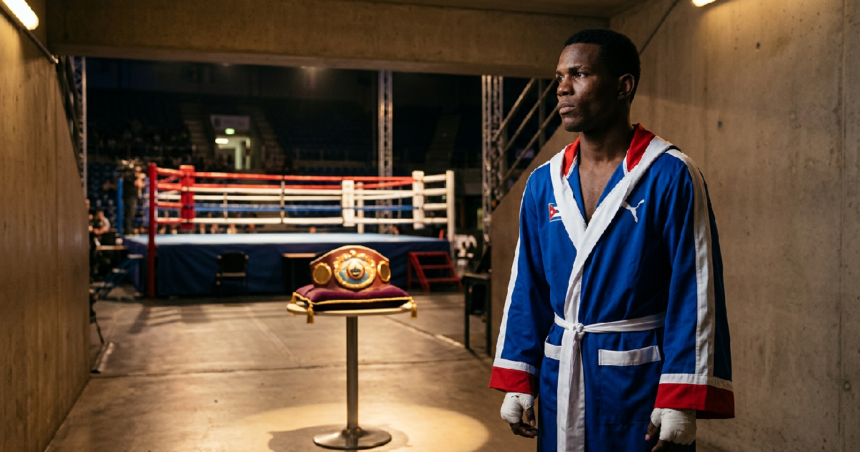
Yoenli Hernandez stands on the cusp of a world title opportunity, a position that seemed functionally impossible just months ago when the Cuban standout was ready to walk away from the sport entirely. After a period of deep uncertainty and professional frustration, the middleweight contender has recalibrated his career, turning a potential retirement into a resurgence that has caught the attention of the division’s power players.
The journey of a Cuban defector in the professional ranks is rarely a straight line. For Hernandez, the transition involved more than just adjusting to a pro style; it was a battle against the promotional doldrums that often leave elite talent idling on the sidelines while their prime years tick away. Sources close to his camp suggest that the lack of consistent activity and the difficulty of securing meaningful matchups nearly forced him to hang up the gloves for good.
From Frustration to the Fast Track
Hernandez’s frustration wasn’t born of a lack of skill. As a two-time amateur world champion, his pedigree was never in question. The issue was the “high risk, low reward” label that often plagues Cuban stylists. In the high-stakes world of middleweight boxing, champions are often reluctant to gamble their belts against a technician who hasn’t yet built a massive commercial following.
But the narrative changed when Hernandez decided to stick with the grind. Rather than allowing the inactivity to sour his discipline, he stayed in the gym, banked rounds with top-tier sparring partners, and waited for the landscape to shift. That patience is now paying dividends. With the middleweight division currently in a state of flux—as older champions look for exit fights and younger lions scramble for position—Hernandez has emerged as a fresh, dangerous alternative for a major television date.
His recent performances have shed the “boring” tag often lazily applied to Cuban boxers. He has shown a greater willingness to sit on his punches, trading the safety of the amateur point-scoring system for the raw physicality required to end fights early. This shift in style hasn’t just won him fights; it has won him the interest of promoters looking for a new face to challenge the established order.
Navigating the Middleweight Hierarchy
The path to a belt isn’t without its hurdles. The 160-pound division is currently a minefield of mandatory challengers and political maneuvering between rival promotional houses. However, Hernandez has the benefit of being a “boogeyman” that people are finally starting to mention by name. Whether it’s a shot at a vacant title or a final eliminator, the Cuban is no longer an outlier; he is a priority.
And it’s not just about the belt. For Hernandez, this run represents a personal vindication. Returning from the brink of quitting requires a specific type of mental fortitude. It’s one thing to train when a multi-million dollar contract is on the table; it’s quite another to do it when you’re unsure if your next phone call will be from your manager or a debt collector. That grit is now being viewed as a competitive advantage.
While some prospects look for the easiest path to a payday, Hernandez’s team has signaled they are willing to take the “hard road.” This might involve traveling to a champion’s backyard or taking a short-notice fight to prove he belongs at the top of the marquee. With the summer schedule beginning to take shape, the buzz in the industry is that Hernandez is just one signature away from the career-defining moment he almost walked away from.
The Impact of the Cuban School of Boxing
Hernandez is part of a broader wave of Cuban talent attempting to dismantle the stereotypes of the past. For years, the knock on Cuban pros was that they were too defensive and lacked the “fan-friendly” aggression needed for Las Vegas main events. Hernandez, along with a few of his contemporaries, is proving that you can combine elite footwork with genuine finishing power.
This evolution is critical. Promoters are more likely to take a risk on a fighter who can provide a highlight-reel knockout, and Hernandez’s recent training camps have focused heavily on inside fighting and power mechanics. He’s no longer just trying to outpoint his opposition; he’s trying to dismantle them.
As we look toward the later half of 2026, the question isn’t if Hernandez will get a big fight, but which champion will be the first to blink. He has transitioned from a cautionary tale of wasted talent into a legitimate threat to anyone holding a world title at 160 pounds.
Frequently Asked Questions
Why did Yoenli Hernandez almost quit boxing?
Hernandez faced significant professional hurdles, primarily centered around inactivity and the difficulty of securing high-level opponents. The mental toll of training without a confirmed fight date led him to seriously consider leaving the sport before his recent career resurgence.
Is Yoenli Hernandez ready for a world title shot?
Most analysts agree that his amateur pedigree—including two world championships—gives him a technical foundation that few professionals can match. His recent transition to a more aggressive professional style suggests he is ready for the elite level of the middleweight division.
What makes Hernandez different from other Cuban boxers?
While he possesses the traditional “Cuban School” movement and defense, Hernandez has shown an increased focus on power and fan-friendly aggression. He is actively working to shed the image of the defensive-first fighter to become more marketable to major networks and promoters.